

Method and apparatus for filtering an air stream using an aqueous-froth together with nucleation
a technology of air stream and nucleation, which is applied in the direction of liquid separation agent, combination device, dispersed particle separation, etc., can solve the problem of supersaturation of air stream, and achieve the effect of effective removal of contaminants and improved filtering performan
Inactive Publication Date: 2005-03-29
IND CLIMATE SOLUTIONS INC
View PDF9 Cites 28 Cited by
- Summary
- Abstract
- Description
- Claims
- Application Information
AI Technical Summary
Benefits of technology
"The present invention is a new air filter that can effectively remove contaminants from an air stream using a combination of nucleation and aqueous-froth techniques. The filter is capable of removing particles as small as 0.005 microns in diameter, including industrial sulfate aerosols, biological agents, and chemical weapon agents. The filter has high efficiency, low maintenance costs, and is ideal for filtering particles in the 0.1 micron range. It is also easy to scale up to large systems. The invention addresses the need for efficient and low-cost air filtration methods that can effectively remove aerosolized chemical and biological weapon agents. Current state-of-the-art air filtration technology is inadequate for these threats, and the invention offers a solution to mitigate the risks associated with them."
Problems solved by technology
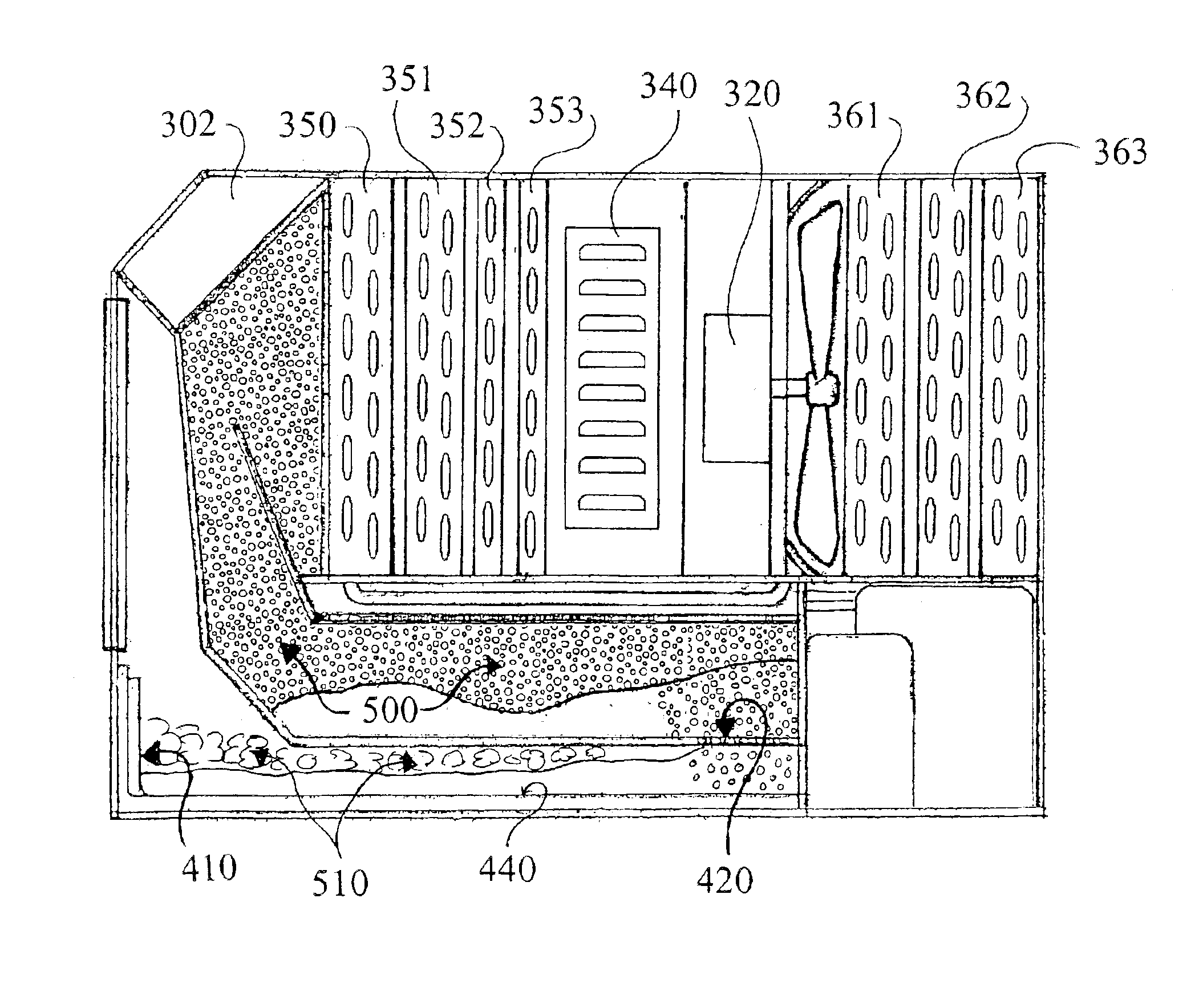
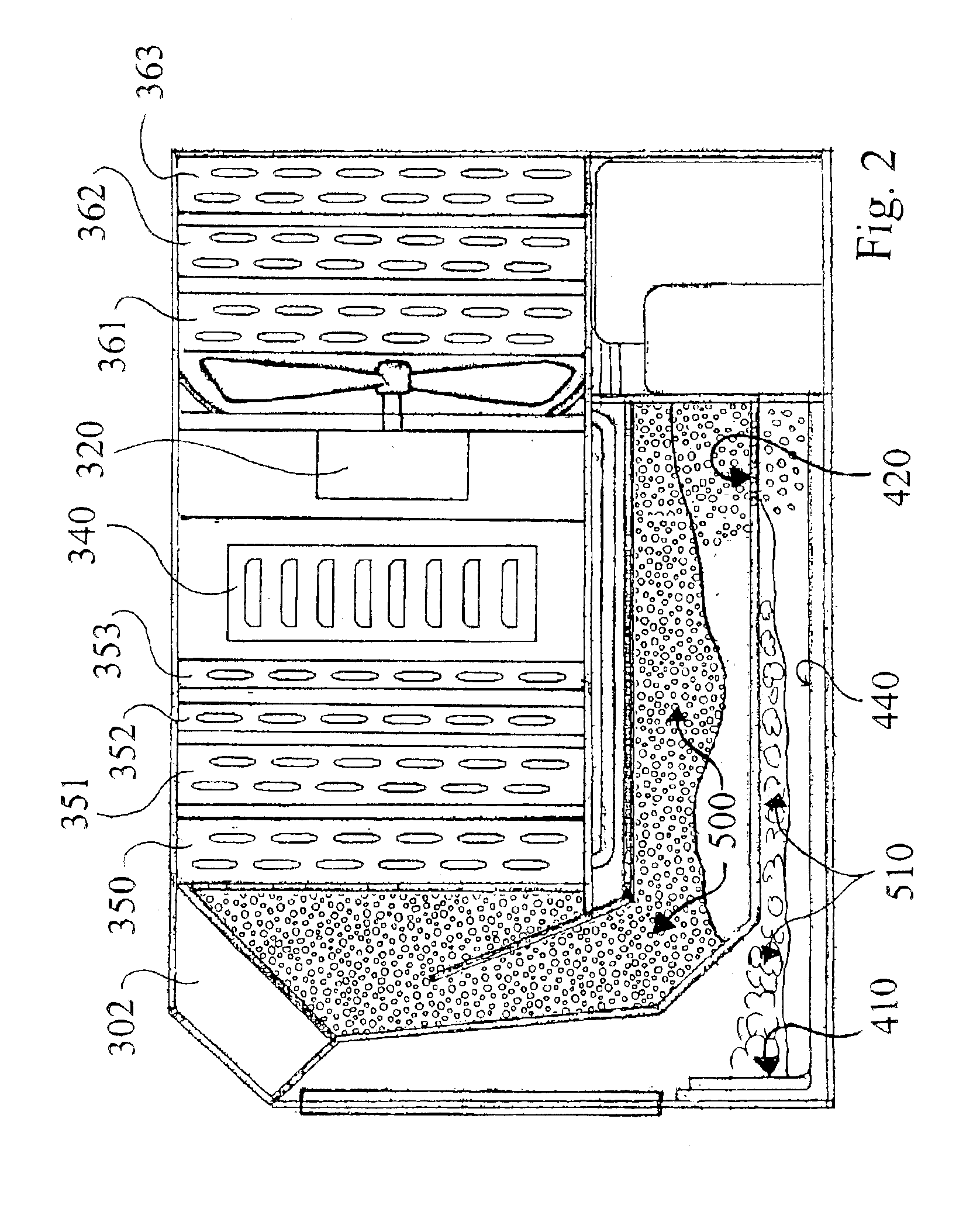
In the “nucleation” technique, the incoming contaminated air stream is saturated with a fine mist produced by fogger nozzles, causing supersaturation of the air stream.
Method used
the structure of the environmentally friendly knitted fabric provided by the present invention; figure 2 Flow chart of the yarn wrapping machine for environmentally friendly knitted fabrics and storage devices; image 3 Is the parameter map of the yarn covering machine
View moreImage
Smart Image Click on the blue labels to locate them in the text.
Smart ImageViewing Examples

Examples
Experimental program
Comparison scheme
Effect test
third embodiment
[0028]FIG. 7 is a schematic illustration of the invention;
fourth embodiment
[0029]FIG. 8 is a schematic representation of the invention;
fifth embodiment
[0030]FIG. 9 is a schematic representation of a fifth embodiment utilizing a mobile tent system to assist in a clean-up operation; and
the structure of the environmentally friendly knitted fabric provided by the present invention; figure 2 Flow chart of the yarn wrapping machine for environmentally friendly knitted fabrics and storage devices; image 3 Is the parameter map of the yarn covering machine
Login to View More PUM
| Property | Measurement | Unit |
|---|---|---|
| mean diameter | aaaaa | aaaaa |
| mean diameter | aaaaa | aaaaa |
| size | aaaaa | aaaaa |
Login to View More
Abstract
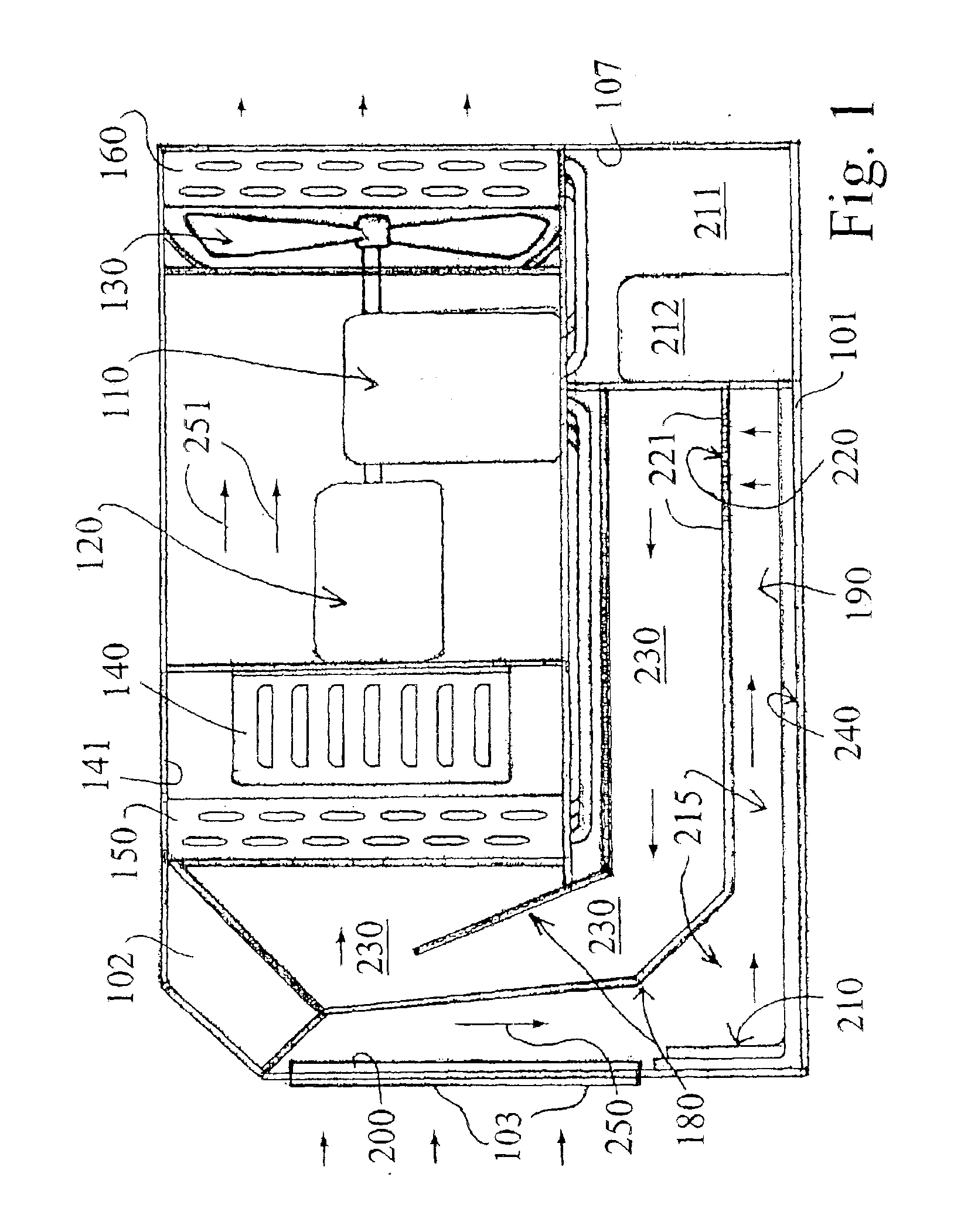
A method for urging contact between contaminants in an air stream and the wet surfaces of an aqueous-froth, and additional means of limiting the froth to a predetermined volume are provided. A wide spectrum of solution micro-droplet sizes (0.001 to 1000 micron) is introduced into a contaminated air stream. Micro-droplets suspended in the air stream remove contaminants by contact, collide and coalesce in the dynamics of the air stream and are removed by inertia. Smaller micro-droplets remain suspended in the air stream. The smallest micro-droplets evaporate, increasing the solution vapor pressure of the air stream. The humidified or saturated, contaminated air stream continuously expands the surface area of the solution reservoir exponentially into an aqueous froth of tiny bubbles. Airflow velocity drops in the micro-atmosphere inside each bubble of the froth. Contaminants and solution micro-droplets suspended in the air, inside the bubbles, settle out by the acceleration of gravity into the wet surfaces inside of each bubble. The froth is dewatered by condensation of the bubble walls, solution vapor, and micro-droplets, with trapped contaminants, onto the cold air, adjacent cold surfaces, and cold refrigerant coils. The liquid solution and contaminants drain from the refrigerant coils into the solution reservoir. Solution micro-droplets remaining in the air stream are drawn through a centrifugal blower / droplet separator and are thrown onto the blower housing to drain back into the solution reservoir. The air stream is passed through condensing refrigerant coils to reheat the air stream and reduce relative humidity. Variations including scaling, alternative methods of fogging, and additional applications are described.
Description
CROSS REFERENCES TO RELATED APPLICATIONS[0002]This application is a continuation-in-part of U.S. patent application Ser. No. 09 / 889,235 filed Jul. 10, 2001, now U.S. Pat. No. 6,616,733, which is a 371 of PCT / US00 / 27771, filed Oct. 4, 2000, and entitled, “Method and Means for Filtering an Air Stream with an Aqueous Froth.” This application also claims the benefit of and priority from U.S. provisional application Ser. No. 60 / 384,562 filed May 30, 2002.BACKGROUND—BRIEF SUMMARY OF THE INVENTION[0003]Generally, the invention of this application relates to filtering an air stream. Specifically, the invention relates to improvements to the technique of removing gaseous, liquid, and solid contaminants from an air stream with an aqueous-froth as described in parent application Ser. No. 09 / 889,225, incorporated herein by reference.[0004]The key aspect of the present invention is the novel combination of using “nucleation” in concert with an aqueous froth (shown best in FIGS. 3A-3G). In the “n...
Claims
the structure of the environmentally friendly knitted fabric provided by the present invention; figure 2 Flow chart of the yarn wrapping machine for environmentally friendly knitted fabrics and storage devices; image 3 Is the parameter map of the yarn covering machine
Login to View More Application Information
Patent Timeline
 Login to View More
 Patent Type & AuthorityPatents(United States)
IPC IPC(8): B01D47/02B01D47/04B01D50/00
CPCB01D47/04B01D47/027B01D50/006B01D50/60
InventorPELLEGRIN, ROY J.
OwnerIND CLIMATE SOLUTIONS INC