Evaluation method for polycrystalline silicon

a polycrystalline silicon and evaluation method technology, applied in the direction of individual semiconductor device testing, semiconductor/solid-state device testing/measurement, instruments, etc., can solve the problems of difficult to flexibly apply the evaluation results to actual practice, time-consuming evaluation procedures, and contamination of silicon surface, etc., to achieve accurate counting

US6916657B2Inactive Publication Date: 2005-07-12MITSUBISHI MATERIALS CORP
13 Cites 17 Cited by

Patent Information

Authority / Receiving Office
US · United States
Current Assignee / Owner
Publication Date
2005-07-12
Estimated Expiration
Not applicable · inactive patent

Smart Images

  • Figure 1
    Figure 1
  • Figure 2
    Figure 2
  • Figure 3
    Figure 3
Patent Text Reader

Abstract

An evaluation method for polycrystalline silicon including the steps of immersing the polycrystalline silicon in an agent which is capable of dissolving the polycrystalline silicon, and counting the number of foreign particles in the agent. The polycrystalline silicon thus evaluated may be used as a material for pulling single crystal silicon. The evaluation method may further include a step of analyzing the composition of the foreign particles. In yet another aspect, the evaluation method may further include a step of subjecting the agent to a circulation filtering process prior to the immersion of the polycrystalline silicon in the agent.
Need to check novelty before this filing date? Find Prior Art

Description

BACKGROUND OF THE INVENTION

[0001] 1. Field of the Invention

[0002] The present invention relates to an evaluation method for polycrystalline silicon. More specifically, the present invention relates to an evaluation method for polycrystalline silicon which may be used as a material for pulling single crystal silicon.

[0003] 2. Description of Related Art

[0004] As a method for producing single crystal silicon, the Czochralski method (hereinafter referred to as the CZ method) is well-known. The CZ method has the advantages that single crystals of a large diameter and high purity can easily be obtained with no transition state or a small number of little lattice defects.

[0005] In the CZ method, after washing a polycrystalline silicon piece of extremely high purity, the polycrystalline silicon piece is put into a quartz crucible and melted in a heating furnace. At that time a necessary amount of a conductive impurity (e.g., an additive or a dopant) is added to control, for example, the type of ...

Examples

Embodiment Construction

[0025]The invention summarized above and defined by the enumerated claims may be better understood by referring to the following detailed description, which should be read with reference to the accompanying drawings. This detailed description of a particular preferred embodiment, set out below to enable one to build and use one particular implementation of the invention, is not intended to limit the enumerated claims, but to serve as a particular example thereof.

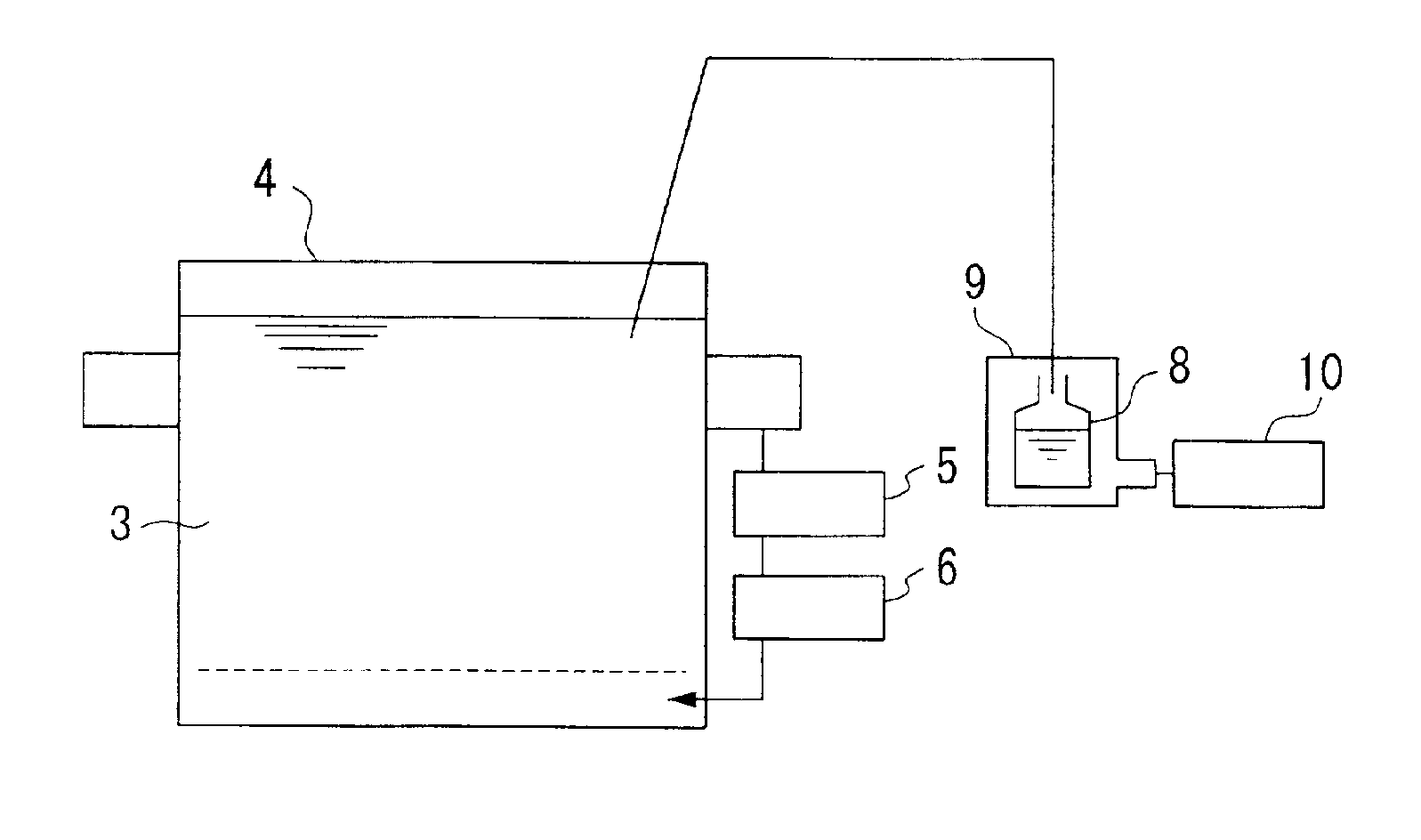
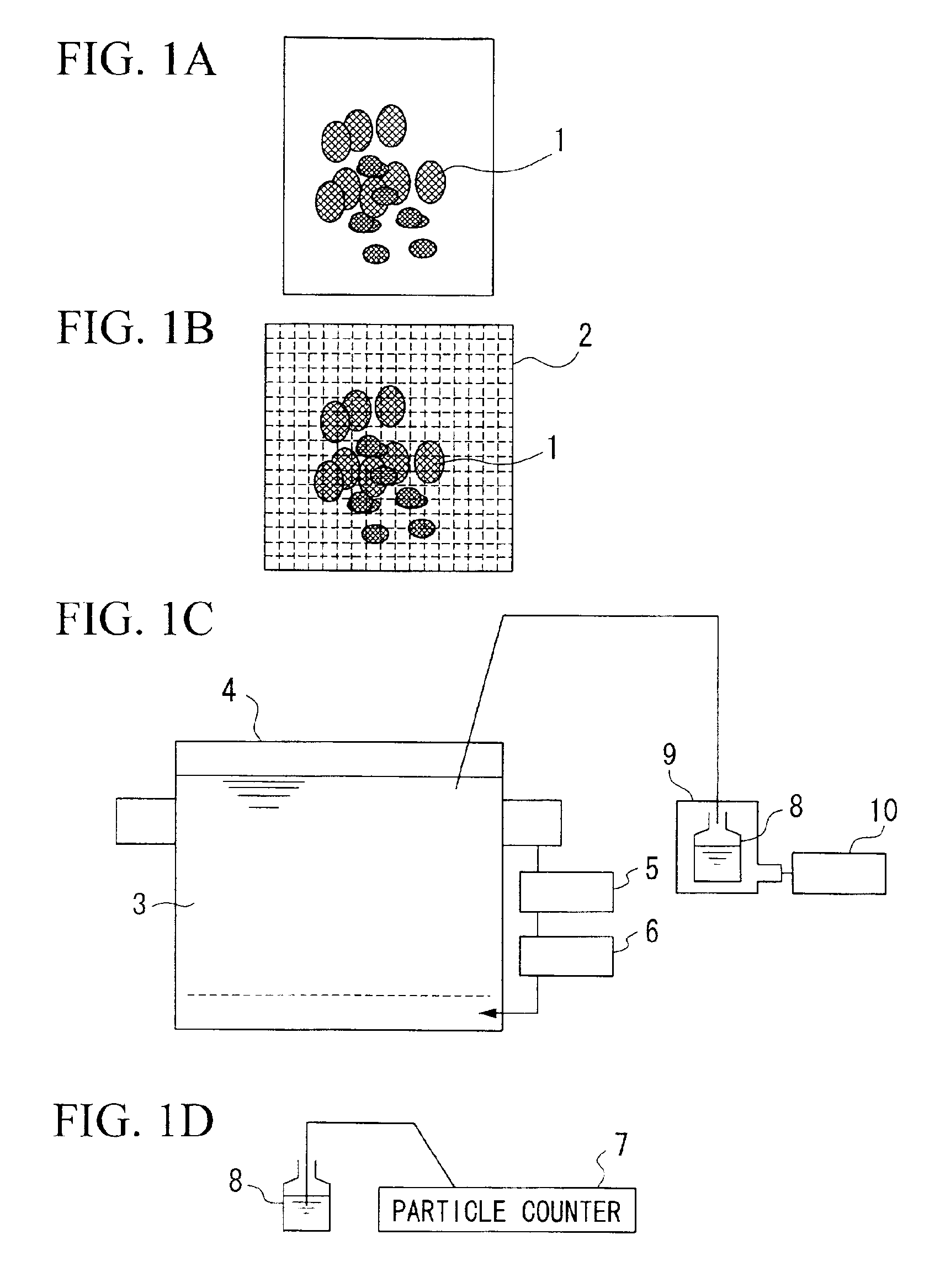
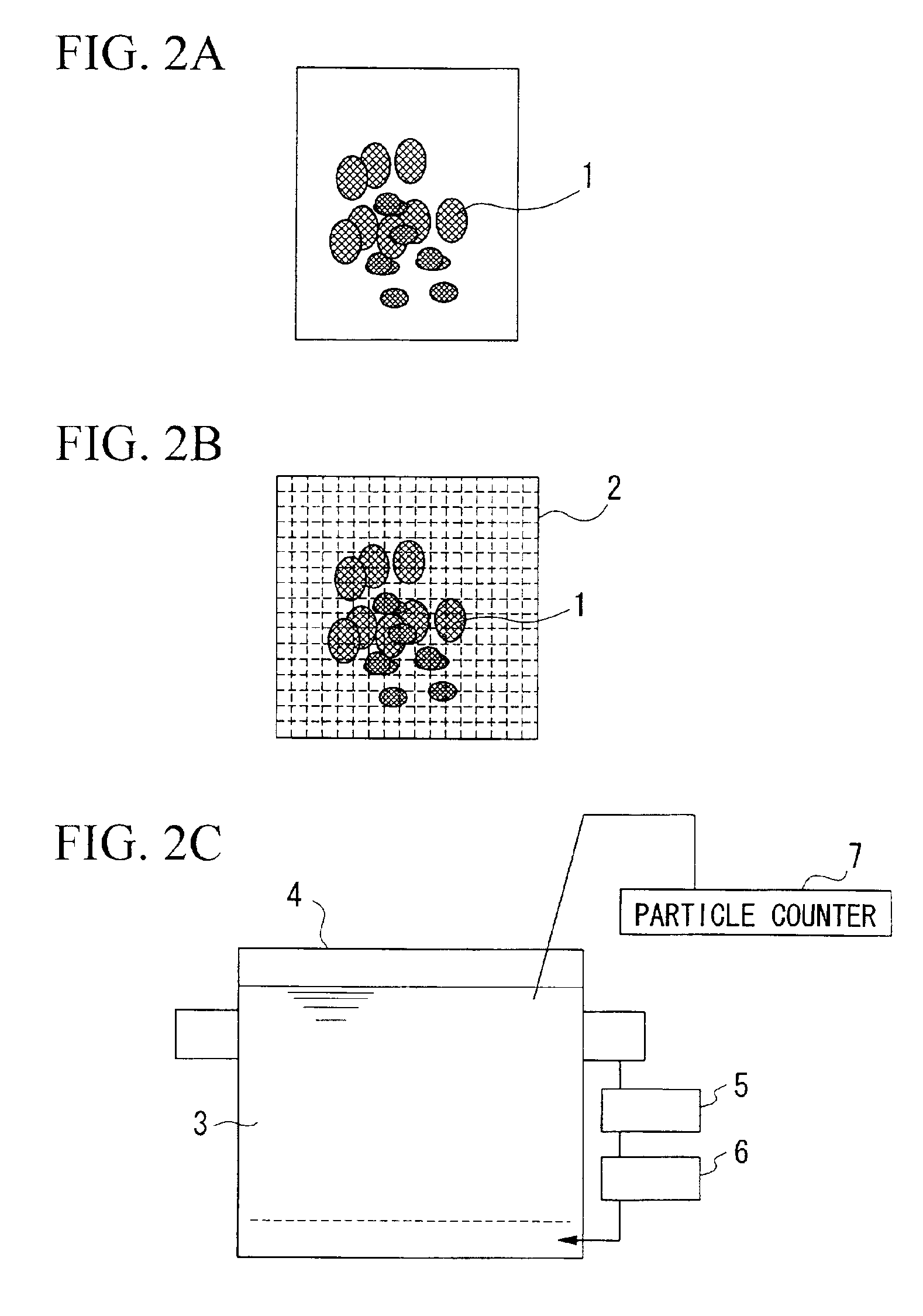
[0026]An evaluation method for polycrystalline silicon according to an embodiment of the present invention will be described with reference to FIGS. 1A through 1D.

[0027]First, as shown in FIG. 1A, a certain amount (for instance, 5 kg) of polycrystalline silicon pieces 1 to be evaluated are prepared. The shape of the polycrystalline silicon pieces 1 is not particularly limited and they may be aggregated or pellet shaped.

[0028]Then, as shown in FIG. 1B, the polycrystalline silicon pieces 1 are put into a container 2 made of, f...