
Ultra-short ion and neutron pulse production
a technology of ultra-short pulses and neutrons, applied in chemical to radiation conversion, electrical equipment, electric discharge tubes, etc., can solve the problems of large percentage of neutrons being discarded and material activation occurring
- Summary
- Abstract
- Description
- Claims
- Application Information
AI Technical Summary
Benefits of technology
Problems solved by technology
Method used
Image

Examples
Embodiment Construction
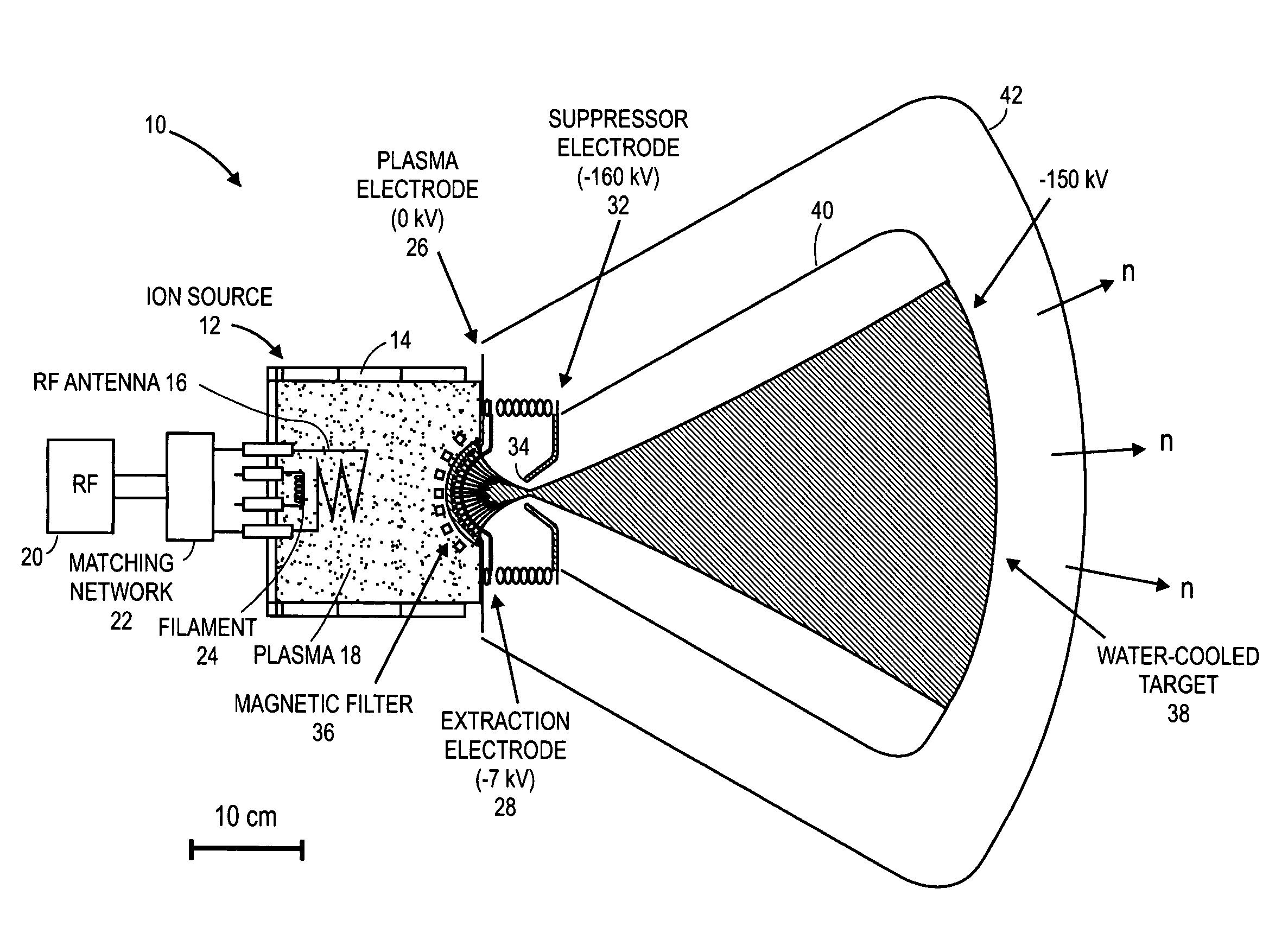
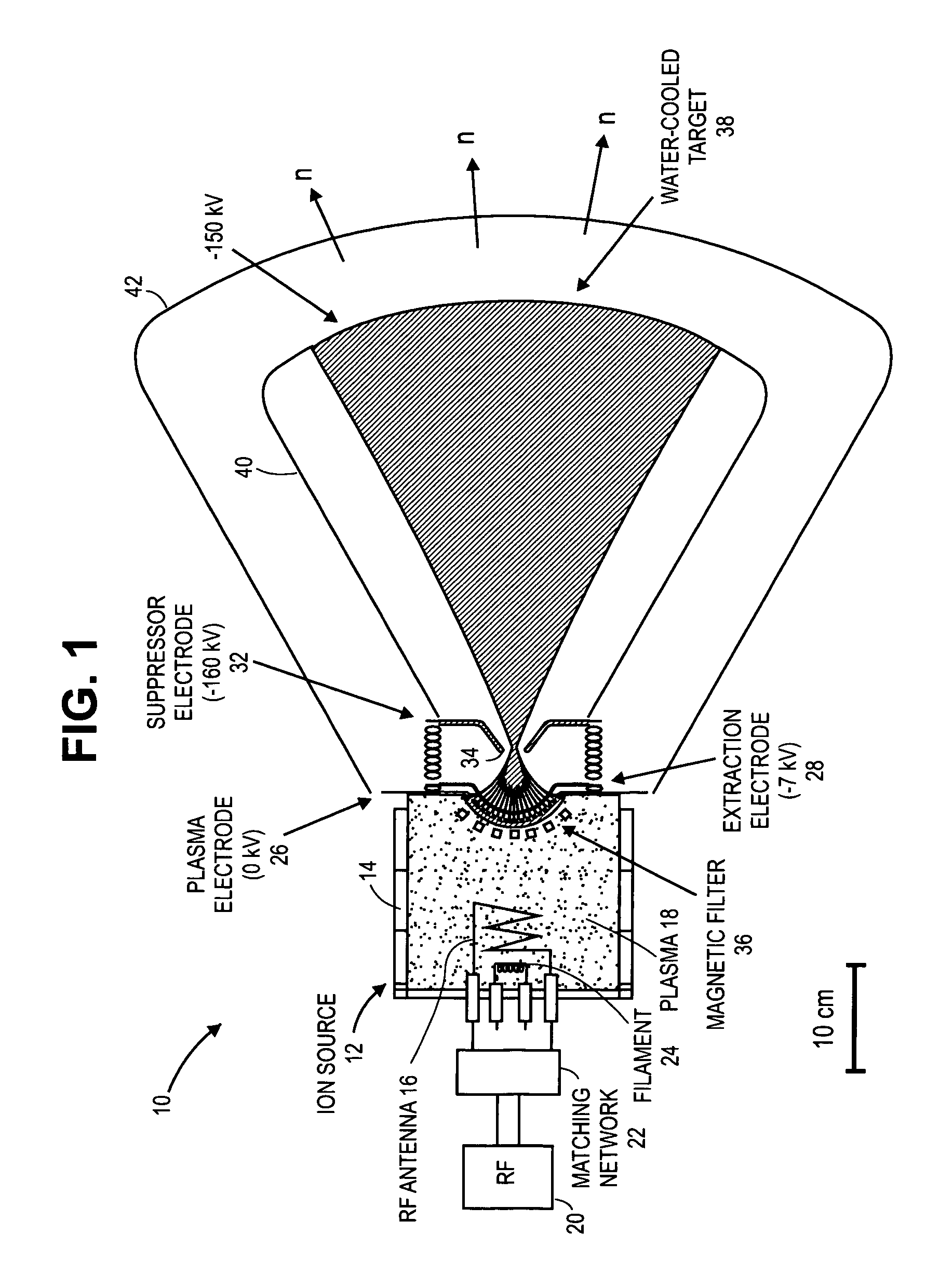
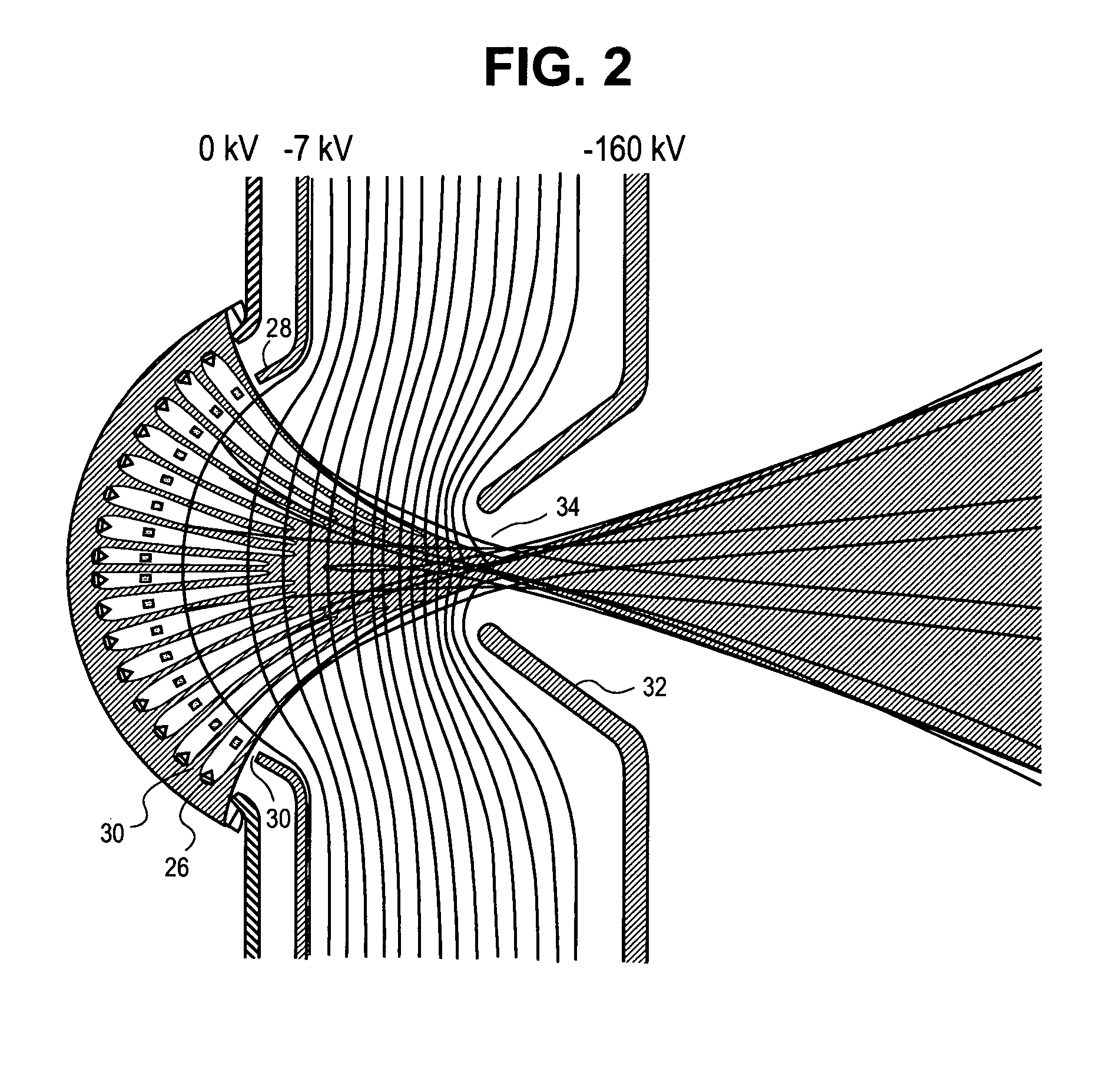
[0015]As shown in FIG. 1, compact high flux neutron generator 10 has a plasma ion source or generator 12, which typically is formed of a cylindrical shaped chamber. The principles of plasma ion sources are well known in the art. Preferably, ion source 12 is a magnetic cusp plasma ion source. Permanent magnets 14 are arranged in a spaced apart relationship, running longitudinally along plasma ion generator 12, to form a magnetic cusp plasma ion source. The principles of magnetic cusp plasma ion sources are well known in the art. Conventional multicusp ion sources are illustrated by U.S. Pat. Nos. 4,793,961; 4,447,732; 5,198,677; 6,094,012, which are herein incorporated by reference.
[0016]Ion source 12 includes an RF antenna (induction coil) 16 for producing an ion plasma 18 from a gas which is introduced into ion source 12. RF antenna 16 is connected to RF power supply 20 through matching network 22. Ion source 12 may also include a filament 24 for startu...
PUM
 Login to View More
 Abstract
Description
Claims
Application Information
 Login to View More