
Semiconductor integrated circuit device
a technology of integrated circuits and semiconductors, applied in semiconductor devices, digital storage, instruments, etc., can solve the problems of source-drain resistance (parasitic resistance) components, differences in the low-level side margin of input signals, and significant decreases in low-level side margins of input signals. , to achieve the effect of suppressing relative deviation of operation characteristics, less occupation area, and well-stabilized operability
- Summary
- Abstract
- Description
- Claims
- Application Information
AI Technical Summary
Benefits of technology
Problems solved by technology
Method used
Image

Examples
Embodiment Construction
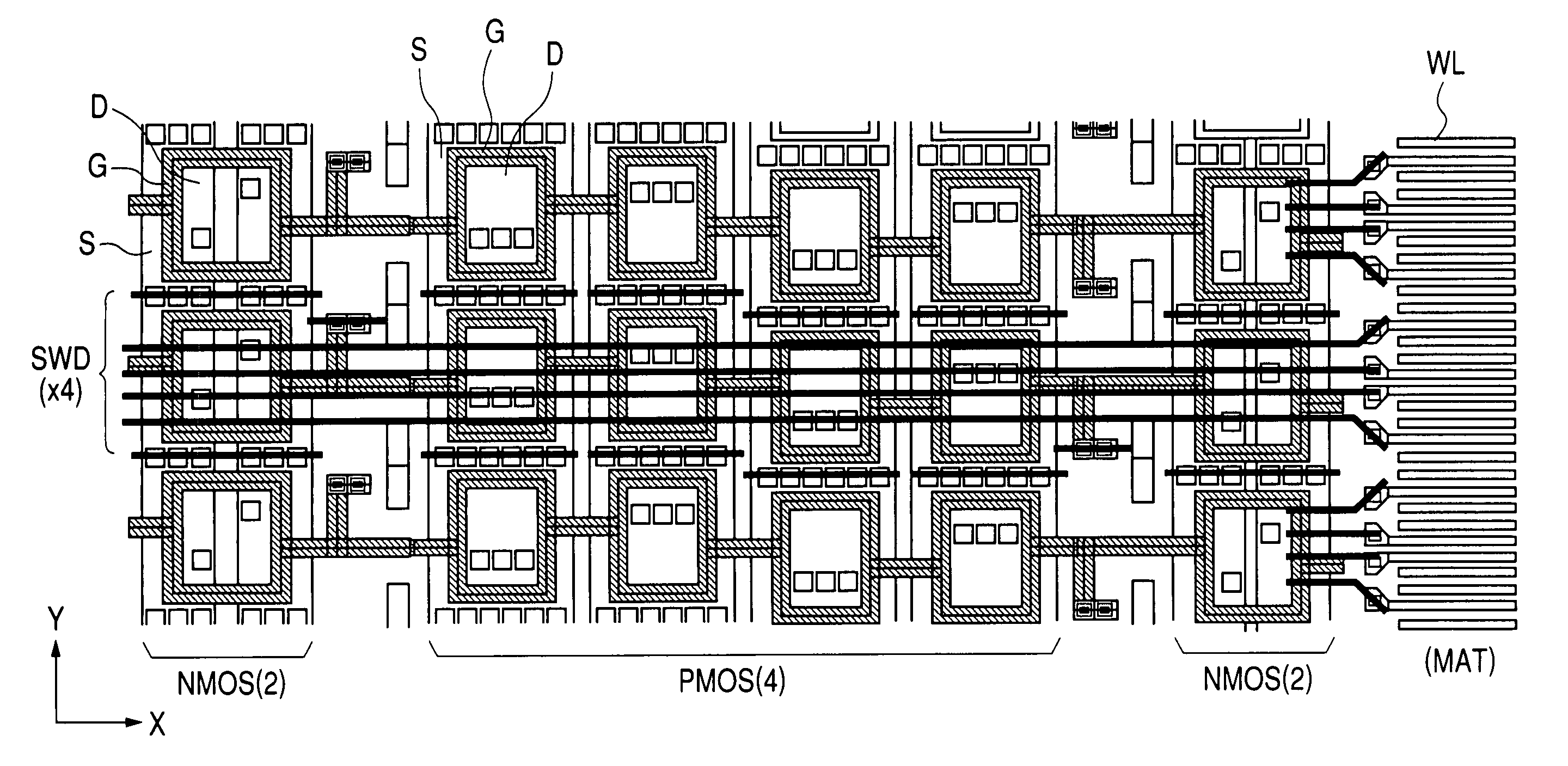
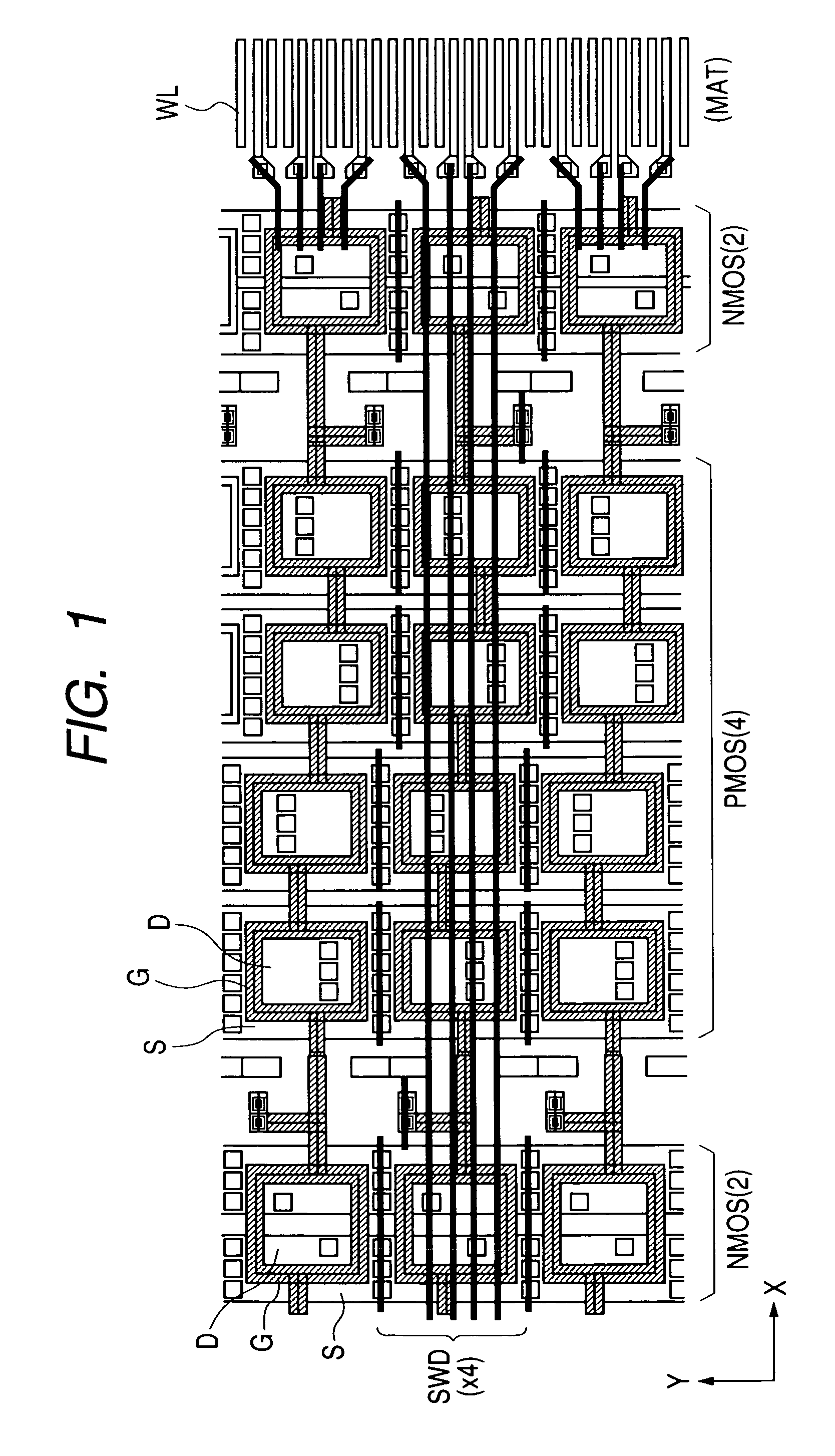
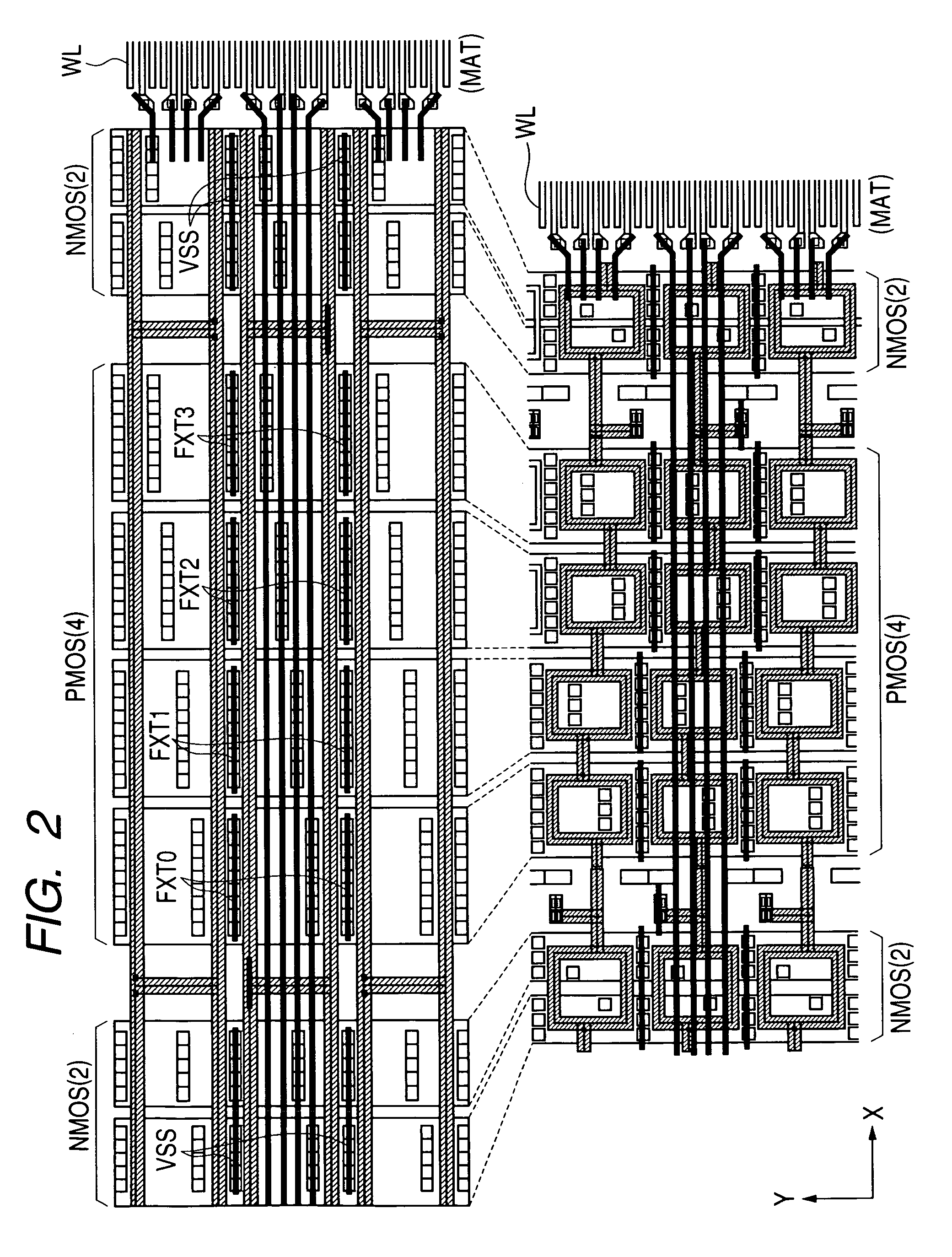
[0025]Referring to FIG. 1, there is shown a layout diagram of one embodiment of a sub-word driver unit in accordance with this invention. In this embodiment, MOSFETs making up four sub-word drivers corresponding to four sub-word lines WL are formed so that these are arrayed in a word-line direction (X direction in FIG. 1). The subword drivers SWD are such that each is operable to drive subword lines WL which are provided in two memory mats (sub-arrays) that are formed to put it therebetween, as will be described later. There are exemplarily shown in FIG. 1 those subwordlines WL that are provided in one of the two memory mats, which is located on one end side in the X direction.
[0026]In a chip surface area in which the above-noted four subword drivers SWD (x4) are formed, a total of eight subwordlines WL are allocated. Since a respective one of the subword drivers is the one that drives the subwordlines WL of two memory mats that interpose it therebetween as stated previously, when l...
PUM
 Login to View More
 Abstract
Description
Claims
Application Information
 Login to View More