
Coated articles having enhanced reversible thermal properties and exhibiting improved flexibility, softness, air permeability, or water vapor transport properties
a technology of reversible thermal properties and coated articles, which is applied in the field of coated articles, can solve the problems of substantially diminishing the ability of continuously coated fabrics to transport air or water vapor, unsatisfactory reductions in flexibility, softness, air permeability, water vapor transport properties, etc., and achieves enhanced reversible thermal properties, and improved flexibility and air permeability
- Summary
- Abstract
- Description
- Claims
- Application Information
AI Technical Summary
Benefits of technology
Problems solved by technology
Method used
Image


Examples
example 1
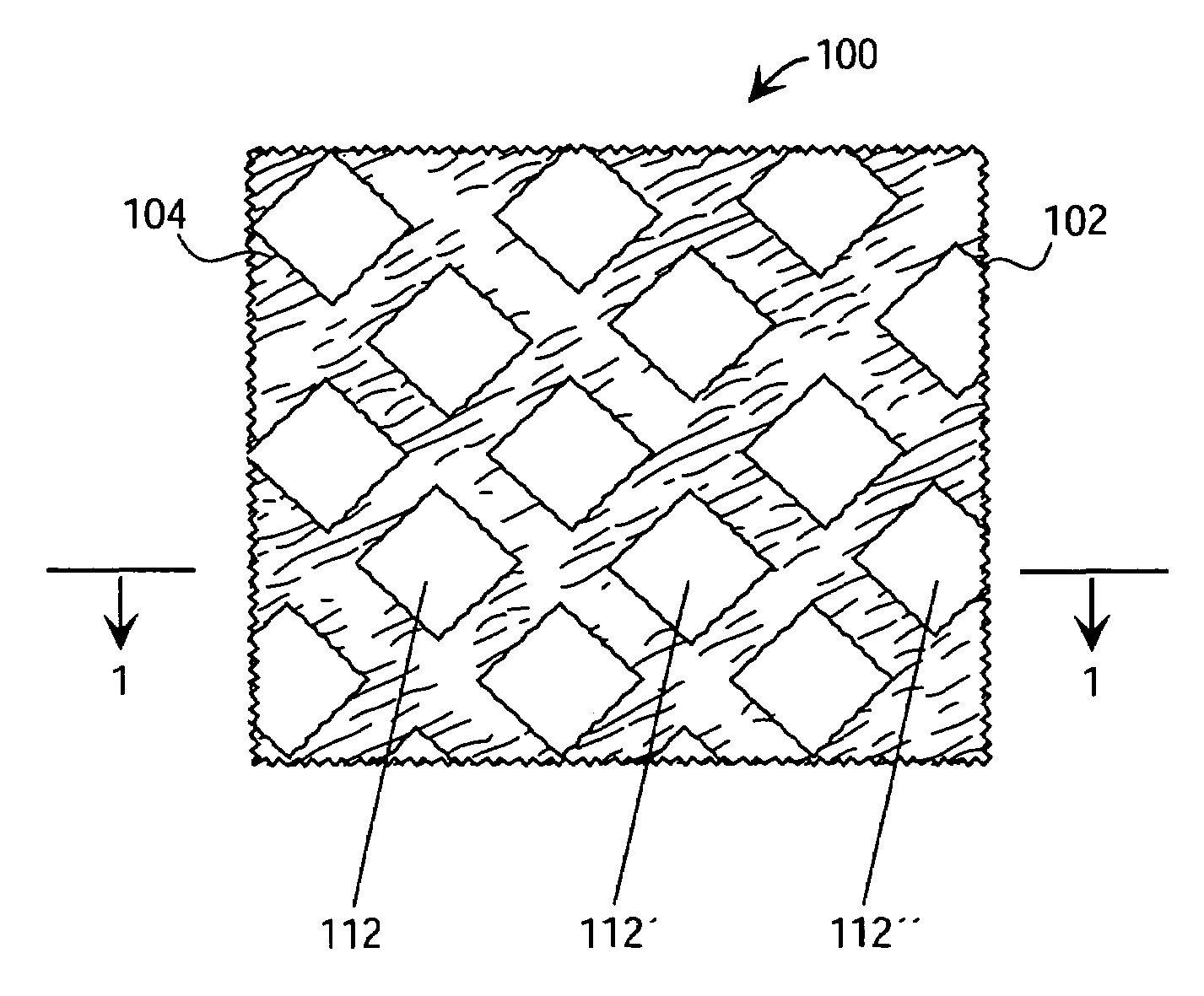
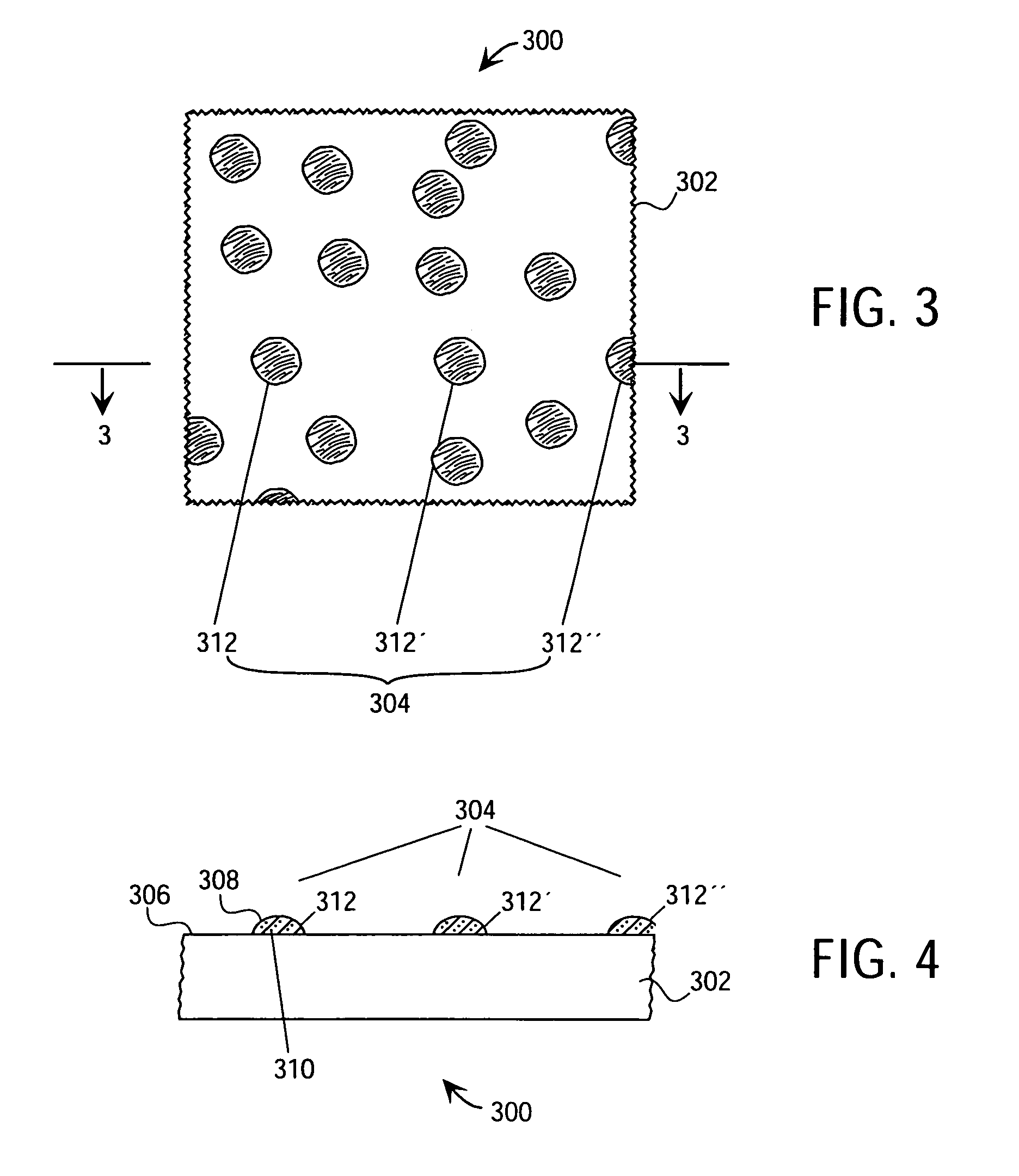
[0063]A water-based acrylic resin coating blend (65 percent of dry weight of microcapsules containing a phase change material based on total dry weight of solids, supplied as BR-5152 by Basic Adhesives Inc., Carlstadt, N.J.) was adjusted for viscosity and applied to a substrate using a rotary screen. The rotary screen (manufactured by vanVeen-Bell, Easton, Pa.) was a 30 mesh metal screen with screen pattern #0T03 produced on it. This pattern provided 75 percent surface coverage with a circular dot pattern. The substrate used was a 140 g / m2 100% polyester micro fleece lining (Vendor Style: A001606, supplied by Ching-Mei Textile Corp., Taiwan). The coating blend was applied to the substrate at 200 g / m2 and then dried in a forced air oven for 10 minutes at 130° C. to yield a flexible, air permeable coating with a circular dot pattern. The final weight of the coating was 100 g / m2, which yielded 65 g / m2 of the microcapsules containing the phase change material.
example 2
[0064]A water-based acrylic resin coating blend (65 percent of dry weight of microcapsules containing a phase change material based on total dry weight of solids, supplied as BR-5152 by Basic Adhesives Inc., Carlstadt, N.J.) was adjusted for viscosity and applied to a substrate using a rotary screen. The rotary screen (manufactured by vanVeen-Bell, Easton, Pa.) was a 30 mesh metal screen with screen pattern #0T03 produced on it. This pattern provided 75 percent surface coverage with a circular dot pattern. The substrate used was a 150 g / m2 100% polyester apertured non-woven fabric (supplied by Tiong Liong Corp., Taiwan). The coating blend was applied to the substrate at 230 g / m2 and then dried in a forced air oven for 10 minutes at 130° C. to yield a flexible, air permeable coating with a circular dot pattern. The final weight of the coating was 115 g / m2, which yielded 75 g / m2 of the microcapsules containing the phase change material.
PUM
| Property | Measurement | Unit |
|---|---|---|
| transition temperature | aaaaa | aaaaa |
| transition temperature | aaaaa | aaaaa |
| sizes | aaaaa | aaaaa |
Abstract
Description
Claims
Application Information
 Login to View More