This helps you quickly interpret patents by identifying the three key elements:
Problems solved by technology
Method used
Benefits of technology
Benefits of technology
[0011]It has now been discovered that oxindoles having novel structures effectively inhibit the replication of HIV, including drug resistant strains of the virus. Selected oxindoles of the invention are potent reverse transcriptase inhibitors. Accordin
Problems solved by technology
HIV / AIDS treatments exist, however, the drugs currently used in treatment modalities exhibit numerous side effects, require prolonged treatment that often induces drug resistance, and do not result in complete eradication of the virus from the body.
In addition, viral reverse transcriptase, the enzyme used in making a new virion particle, is not very specific, and causes transcription mistakes that result in continually changed glycoproteins on the surface of the viral protective coat.
This lack of specificity decreases the immune system's effectiveness because antibodies specifically produced against one glycoprotein may be useless against another, hence reducing the number of antibodies available to fight the virus.
Eventually, the HIV largely holds free reign over the body's immune system, allowing opportunistic infections to set in and, without the administration of antiviral agents, immunomodulators, or both, death may result.
Method used
the structure of the environmentally friendly knitted fabric provided by the present invention; figure 2 Flow chart of the yarn wrapping machine for environmentally friendly knitted fabrics and storage devices; image 3 Is the parameter map of the yarn covering machine
View more
Image
Smart Image Click on the blue labels to locate them in the text.
Viewing Examples
Smart Image
Click on the blue label to locate the original text in one second.
Reading with bidirectional positioning of images and text.
Smart Image
Examples
Experimental program
Comparison scheme
Effect test
example 1
1.1 Preparation of (5-bromo-1,2-dihydro-2-oxo-3H-indol-3-ylidene), ethyl ester
[0181]
[0182]A solution containing 5-bromoisatin (226 mg, 1 mmol) and (carbethoxymethyl)-triphenylphosphorane (383 mg, 1.1 mmol) in toluene (20 mL) was stirred at 80° C. under argon for 16 hours. The reaction mixture was concentrated to dryness in vacuo and the residue was chromatographed using hexane and ethyl acetate (v / v 4:1) as eluent. The title compound was isolated (220 mg, 75%) as orange crystals. MS: m / z 296 [M+1]+. 1H 1 NMR (DMSO-d6): δ 8.51 (d, 1H), 7.53 (m, 1H), 6.84 (d, J=8 Hz, 1H), 6.57 (s, 1H), 4.24 (m, 2H), 1.29 (t, 3H).
1.2 Preparation of 5-Bromo-1,2-dihydro-2-oxo-3H-indol-3-ylidene)acetonitrile
[0183]The title compound was prepared using a method analogous to that set forth above. MS m / z 249.0 [M+1]+.
example 2
Preparation of 5-chloro-1,3-dihydro-3-(2-pyridinylmethylene)-2H-indol-2-one
[0184]A 5 mL of ethanol solution containing 5-chlorooxindole (167 mg, 1 mmol), 2-pyridine-carboxaldehyde (129 mg, 1.2 mmol) and 3 drops of piperidine was stirred at 80° C. for 6 hours. After cooling the solution to 5° C., yellow precipitate was obtained (200 mg, 78%). MS: m / z 257 [M+1]+.
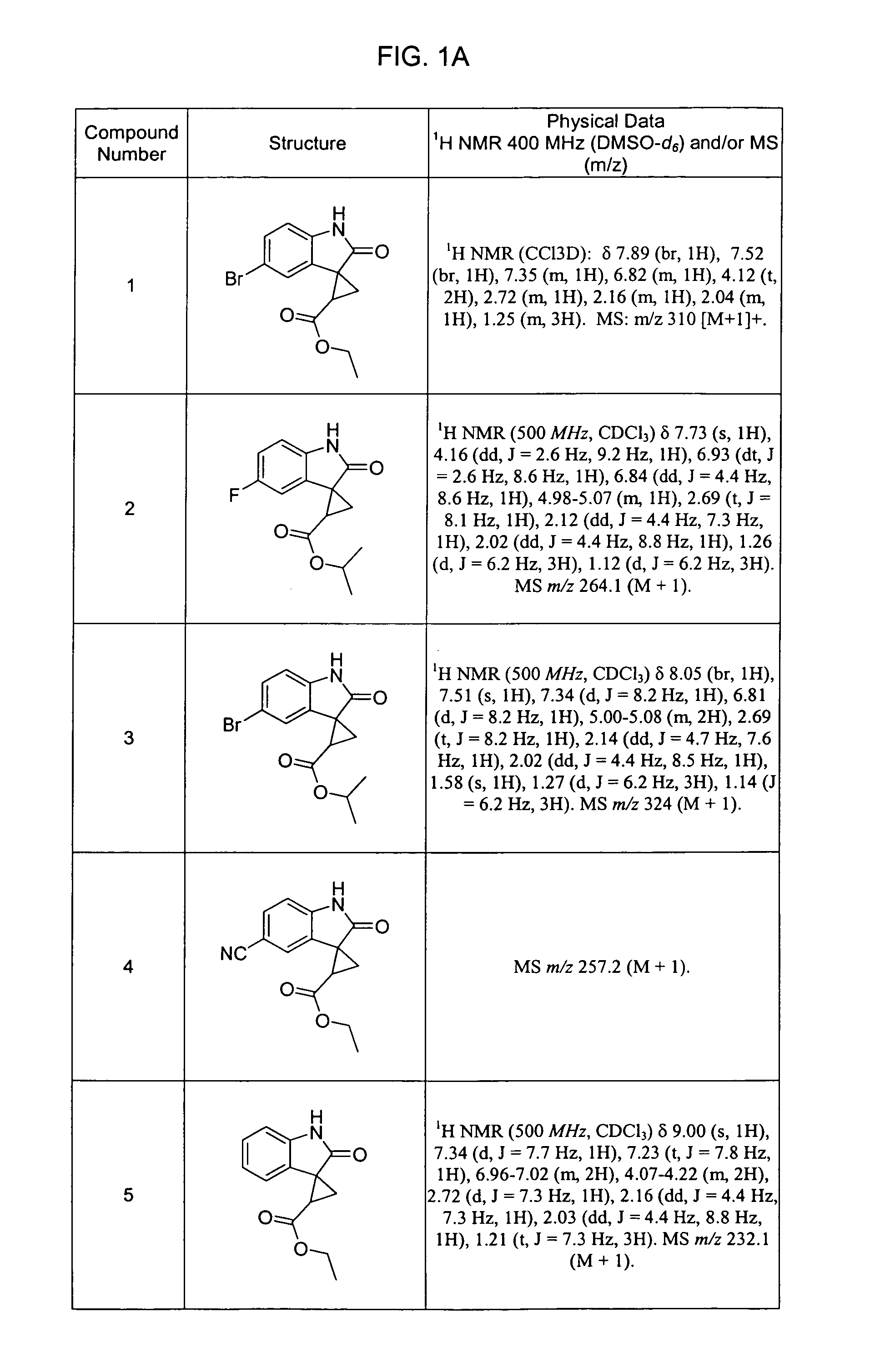
[0186]An excess of an ethereal diazomethane solution was added portion-wise from a syringe to a suspension of 5-bromo-1,2-dihydro-2-oxo-3H-indol-3-ylidene, ethyl ester (30 mg, 0.1 mmol), prepared as set forth in Example 1, in dry ether (30 mL). The suspension was stirred at 0° C. for 2 hours. Excess diazomethane was quenched with two drops of acetic acid. The reaction mixture was concentrated to dryness in vacuo and the residue was dissolved in toluene (20 mL). The resulting solution was heated to reflux for 6 hours. Following removal of the solvents, the solid residue was chromatographed using hexane and ethyl acetate (v / v 1:1) as eluent. The title compound was isolated in 50% yield (15 mg). MS: m / z 310 [M+1]+.
the structure of the environmentally friendly knitted fabric provided by the present invention; figure 2 Flow chart of the yarn wrapping machine for environmentally friendly knitted fabrics and storage devices; image 3 Is the parameter map of the yarn covering machine
Login to View More
PUM
Property
Measurement
Unit
Electrical conductance
aaaaa
aaaaa
Composition
aaaaa
aaaaa
Electrical resistance
aaaaa
aaaaa
Login to View More
Abstract
The present invention relates to inhibition of viruses, e.g., HIV using oxindoles and compounds related to oxindoles. The invention further relates to methods for identifying and using agents, including small molecule chemical compositions that inhibit HIV in a cell; as well as to methods of prophylaxis, and therapy related to HIV infection and related disease states such as AIDS.
Description
CROSS-REFERENCE TO RELATED APPLICATIONS[0001]This is a non-provisional filing of U.S. Provisional Patent Application No. 60 / 420,482 filed on Oct. 21, 2002, the disclosure of which is incorporated herein by reference in its entirety for all purposes.FIELD OF THE INVENTION[0002]The present invention relates to inhibition of a virus, e.g., HIV, using oxindole-based compounds. The compounds of the invention are of use to combat infection by mutant, drug-sensitive, drug-resistant, and multi-drug resistant strains of HIV. The invention further relates to methods for identifying and using to inhibit HIV and to treat HIV-related diseases.BACKGROUND OF THE INVENTION[0003]The Human ImmunodeficiencyVirus (HIV) infects millions of people globally. Cases are reported from nearly every country amounting to 40 million adults and children living with HIV / AIDS worldwide. In 2001, 5 million people were newly infected with HIV, and there were 3 million adult and child deaths due to HIV / AIDS. A full t...
Claims
the structure of the environmentally friendly knitted fabric provided by the present invention; figure 2 Flow chart of the yarn wrapping machine for environmentally friendly knitted fabrics and storage devices; image 3 Is the parameter map of the yarn covering machine
Login to View More
Application Information
Patent Timeline
Application Date:The date an application was filed.
Publication Date:The date a patent or application was officially published.
First Publication Date:The earliest publication date of a patent with the same application number.
Issue Date:Publication date of the patent grant document.
PCT Entry Date:The Entry date of PCT National Phase.
Estimated Expiry Date:The statutory expiry date of a patent right according to the Patent Law, and it is the longest term of protection that the patent right can achieve without the termination of the patent right due to other reasons(Term extension factor has been taken into account ).
Invalid Date:Actual expiry date is based on effective date or publication date of legal transaction data of invalid patent.



 Login to View More