

Method of attaching an end seal to manufactured seeds
a technology of end seals and manufactured seeds, which is applied in the field of manufacturing seeds, can solve the problems of difficult fusing of difficult maintenance of exact location of openings into the cavities of cotyledons, and difficulty in maintaining the exact location of openings into the cavity of cotyledons, etc., and achieves the effect of reliably attaching end seals to seed coats and high degree of reliability
- Summary
- Abstract
- Description
- Claims
- Application Information
AI Technical Summary
Benefits of technology
Problems solved by technology
Method used
Image

Examples
Embodiment Construction
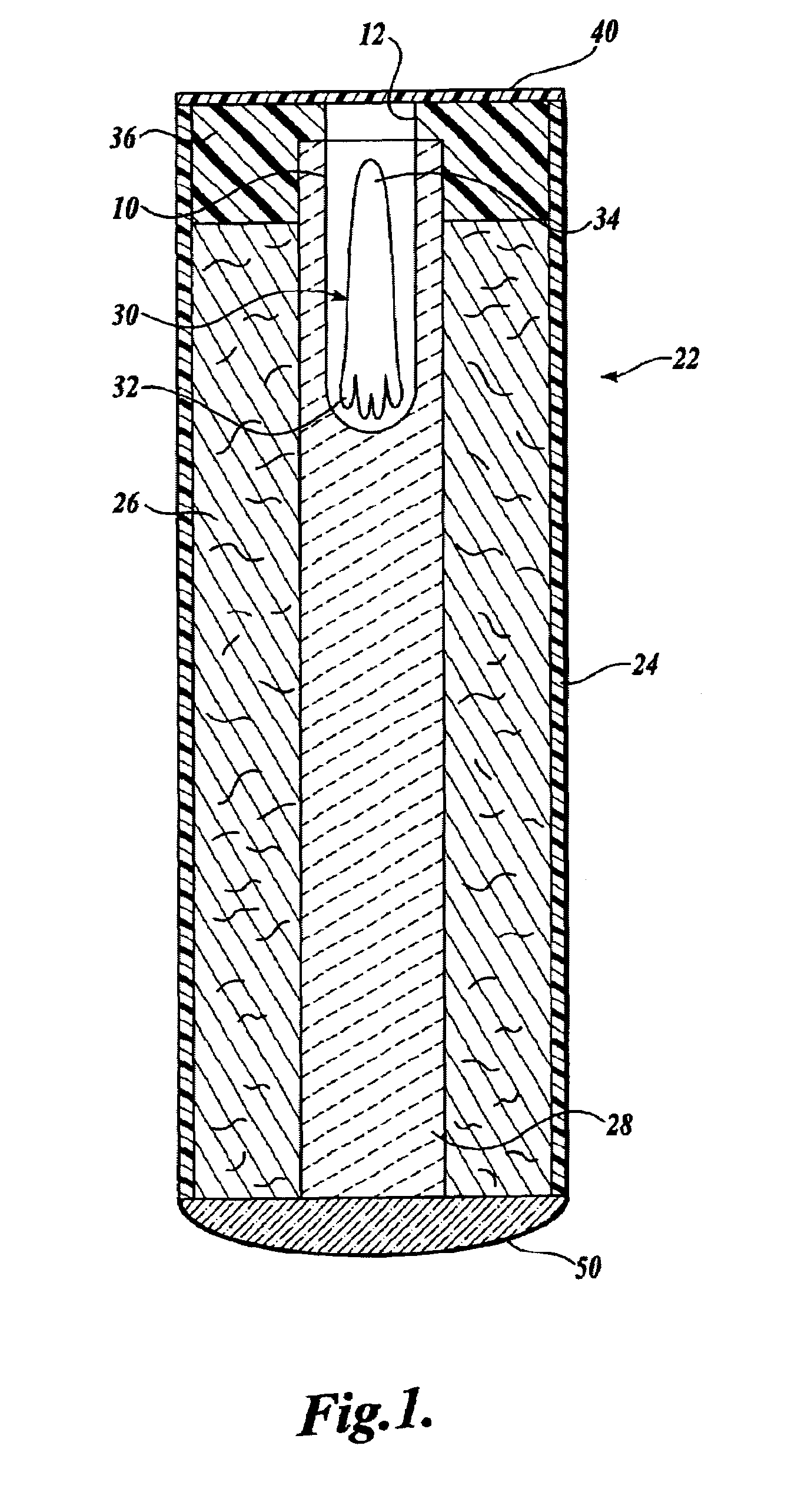
[0023]FIG. 1 illustrates an end seal 40 constructed in accordance with certain embodiments of the present invention for a manufactured seed 22. As is disclosed in U.S. Pat. No. 5,701,699, issued to Carlson et al., the disclosure, which is hereby expressly incorporated by reference, well known manufactured seeds 22 include a seed coat 24, synthetic gametophyte 26, a cotyledon restraint 28, a plant embryo 30, a primary end seal 36, and a secondary end seal 50. The cotyledon restraint 28 is suitably manufactured from a hard porous material and includes a longitudinally extending cavity 10. The cavity 10 extends through the primary end seal 36 and partially through one end of the cotyledon restraint 28. The open end of the cavity 10 is known as a cotyledon restraint opening 12. The cavity 10 is sized to receive the plant embryo 30 therein. The plant embryo 30 includes a cotyledon end 32 and a root end 34.
[0024]The end seal 40 seals the cotyledon restraint opening 12. The end seal 40 is ...
PUM
| Property | Measurement | Unit |
|---|---|---|
| volume | aaaaa | aaaaa |
| volume | aaaaa | aaaaa |
| volume | aaaaa | aaaaa |
Abstract
Description
Claims
Application Information
 Login to View More