
Gas-cooled electrical machine with pressure charging
a technology of electrical machines and gas-cooled electrical machines, which is applied in the direction of liquid fuel engines, magnetic circuit rotating parts, magnetic circuit shapes/forms/construction, etc., can solve the problems of high cost of external auxiliary devices, high cost of power and process control technology, and relatively high complexity, so as to improve heat dissipation and improve the effect of heat dissipation and effective cooling of the generator
- Summary
- Abstract
- Description
- Claims
- Application Information
AI Technical Summary
Benefits of technology
Problems solved by technology
Method used
Image

Examples
third embodiment
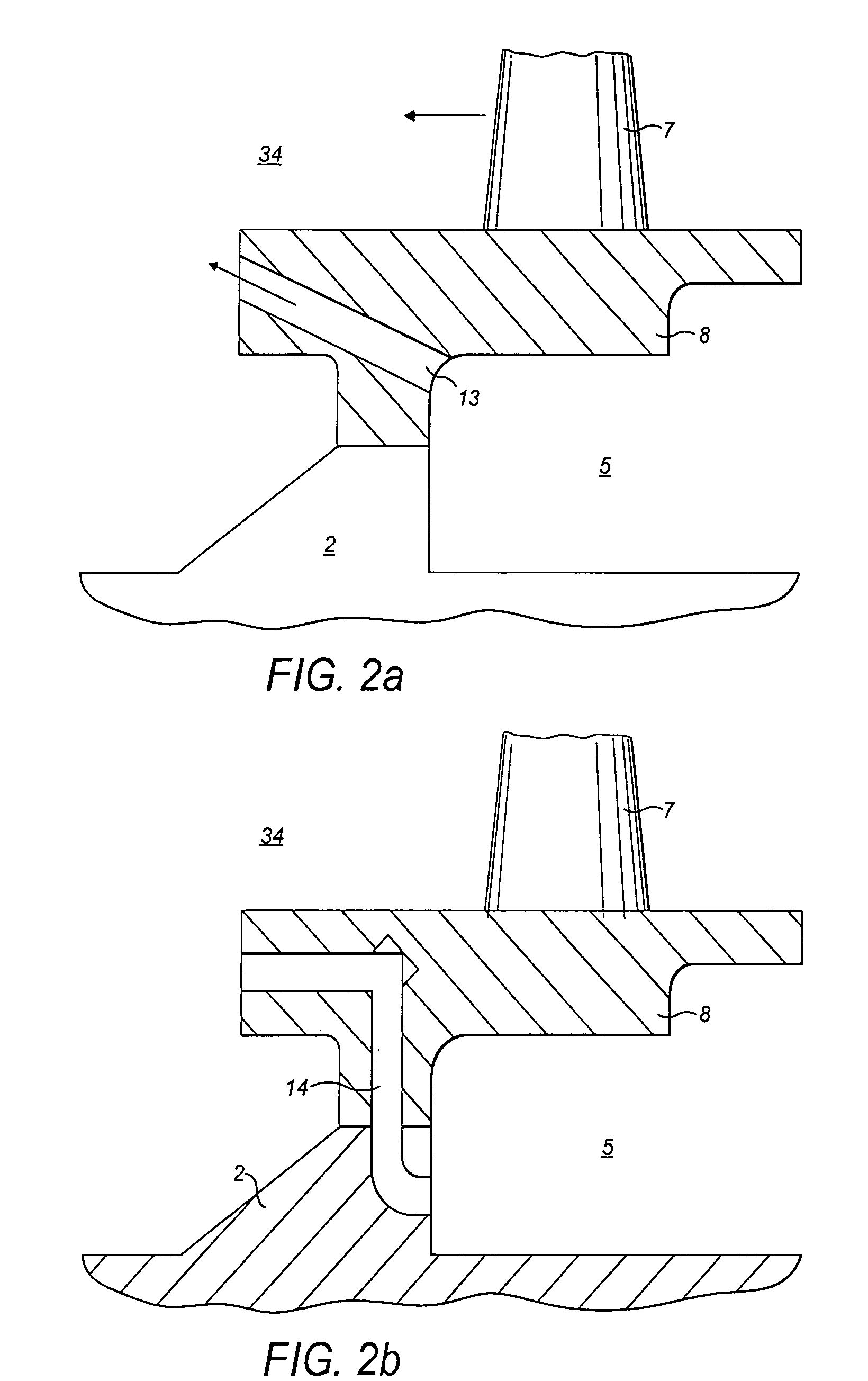
[0039]FIG. 2a shows a second advantageous embodiment of a pressure boosting means according to the invention, in which a diagonal passage bore 13 is made in the fan hub 8. As a result, the cooling air conveyed by the pressure boosting means into the generator interior 34 can flow out more favorably, which does not have negative impact on the flow coming off the fan blades 7. The same applies to the third embodiment depicted in FIG. 2b, in which there is a Z-shaped or double-L-shaped passage channel 14. Here, too, the flow is deflected, so that negative effects on the flow coming off the fan blades 7 are reduced. Here, the inlet side in the hub interior 5 lies on a smaller radius than the outlet side in the generator interior 34.
fourth embodiment
[0040]FIG. 3 shows a fourth embodiment in which the radius differential over the hub height is lengthened by means of a tubular sleeve 17 that is anchored in the fan hub 8 by means of a threaded bore 16 and that is connected to the hub interior 5 via a diagonal bore 15. In the embodiment according to FIG. 3, the tubular sleeve 17 is arranged on the trailing edge of the fan blades 7 and its height approximately matches the height of the fan blades 7. This likewise prevents disturbances on the flow coming off the fan blades 7, although the height of the tubular sleeve 17 can be varied here in such a way that the desired increase in the absolute pressure in the generator interior 34 can be achieved.
[0041]FIG. 4a shows a fifth advantageous embodiment of the present invention and FIG. 4b shows a sectional view in the arrow direction along an intersection line IV-IV in FIG. 4a. Here, on the trailing edge of the fan blade 7, there is a tubular sleeve 21 with a streamlined jacket 18 or an a...
PUM
 Login to View More
 Abstract
Description
Claims
Application Information
 Login to View More