
Integrated circuit layout device, method thereof and program thereof
a technology of integrated circuits and layout devices, applied in the field of integrated circuit layout devices, a method and a program, can solve the problem that the timing error of each path cannot be improved in a short period of time, and achieve the effect of improving the timing error of each path and improving the timing error
- Summary
- Abstract
- Description
- Claims
- Application Information
AI Technical Summary
Benefits of technology
Problems solved by technology
Method used
Image

Examples
first embodiment
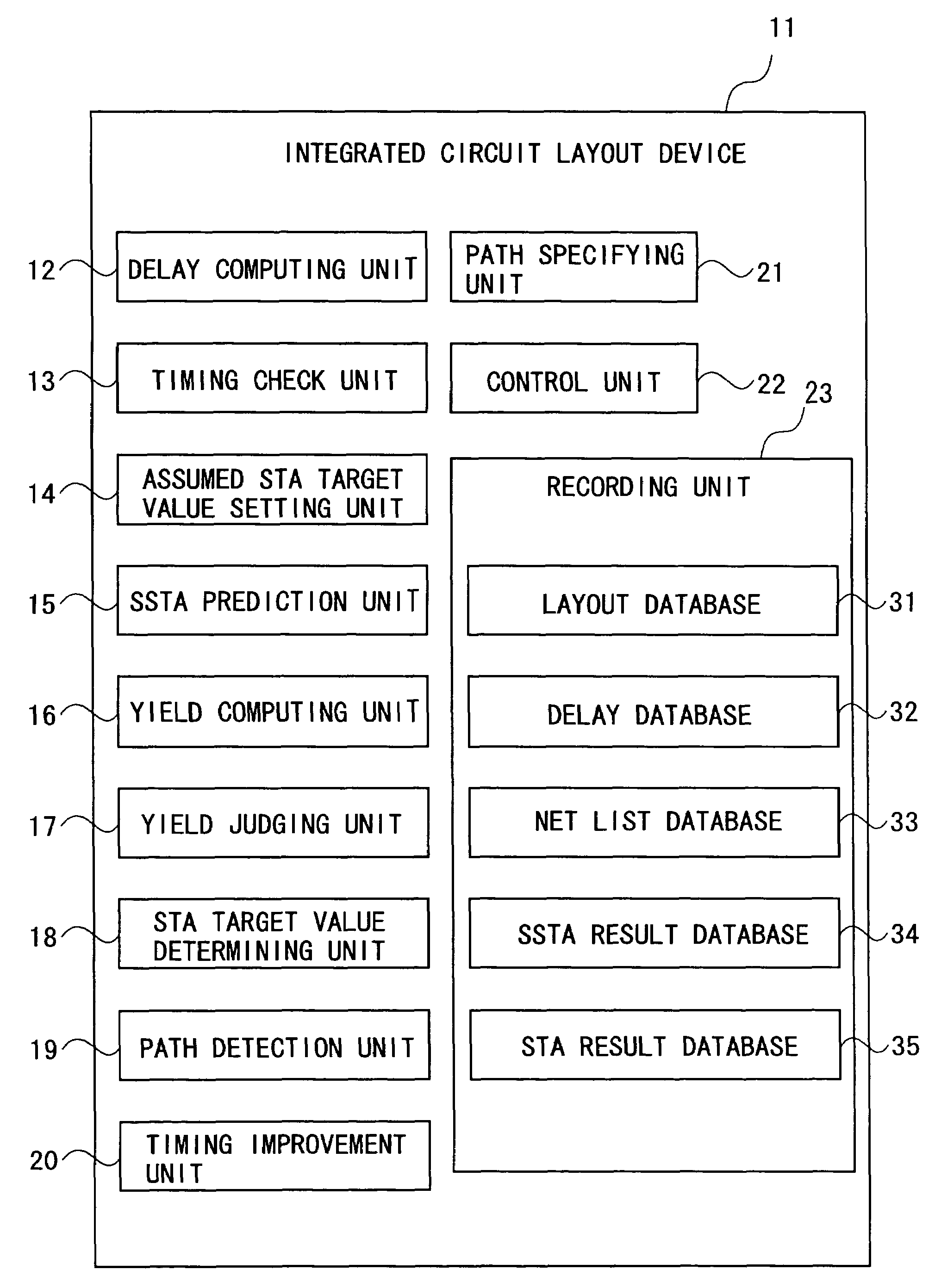
[0050]FIG. 7 is a flowchart of a process of converging the yield of the integrated circuit within a yield target allowable range. To start with, the delay computing unit 12 computes the delay time of each path on the basis of the layout information and the wiring information of the target integrated circuit. The layout information and the wiring information of the target integrated circuit are previously recorded on the layout database 31. Then, the delay computing unit 12 records the delay database 32 with the delay information defined as a result of performing the delay computation (S701).
[0051]Next, based on the net list and the delay information, the timing check unit 13 executes the timing check by the SSTA and the STA with respect to each of the paths of the target integrated circuit (S702). Herein, the timing check may involve doing simulation and may also involve making the actual measurement. Further, the timing check unit 13 records a result of performing the timing check ...
second embodiment
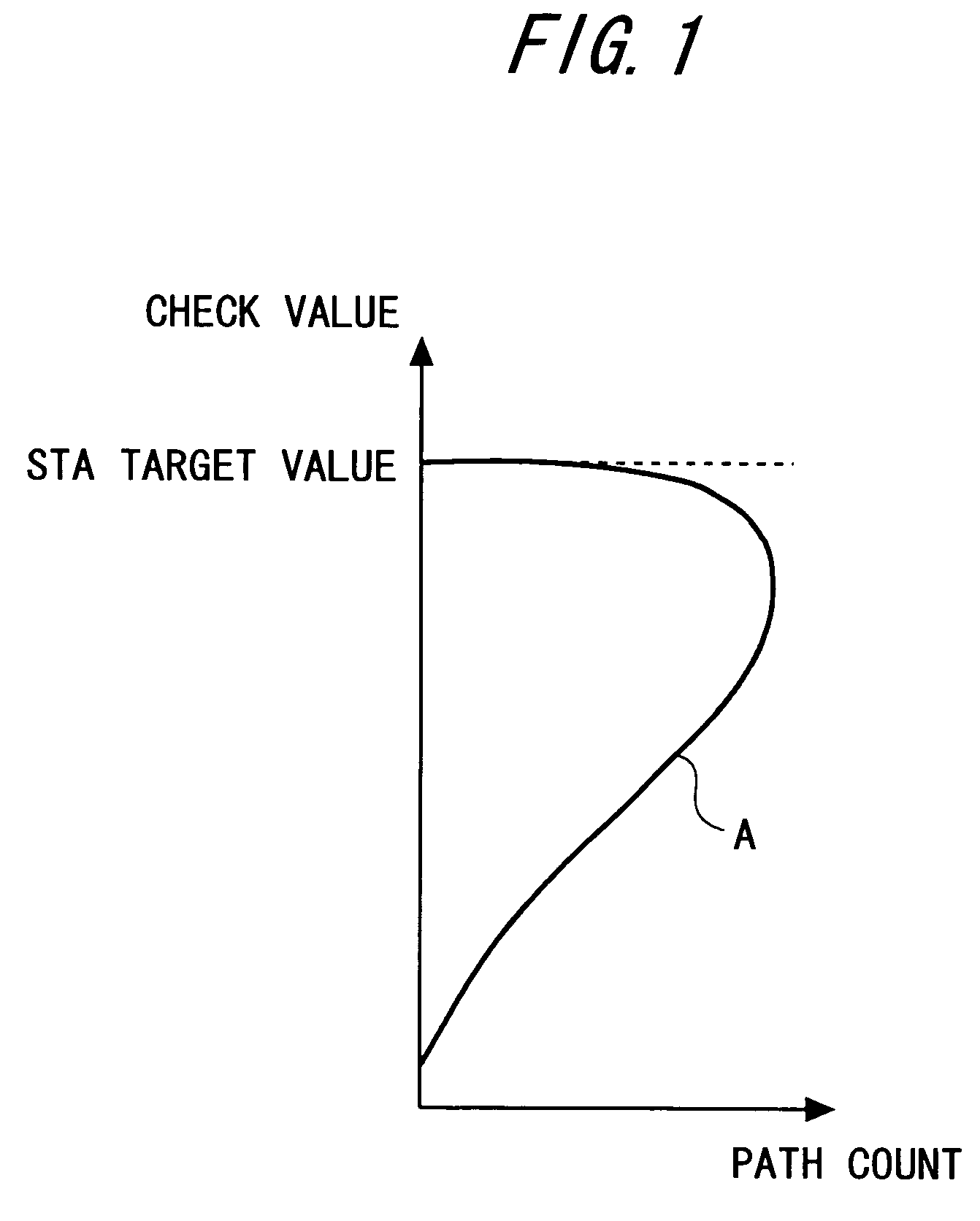
[0075]The first embodiment is that in the check value distribution predicting process, the check value distribution is parallel-shifted in the smaller check value direction by the value obtained by subtracting the assumed STA target value from the check value of each of the paths of the target integrated circuit. A second embodiment is that the parallel-shifting value is adjusted by a coefficient in a way that uses an empirically experimentally acquired coefficient. In this case, the coefficient can be changed on a path-by-path basis from a circuit topology such as path branching and path confluence. Further, in the check value distribution predicting process, the post-prediction check value distribution can be also obtained not by parallel-shifting the check value distribution but by changing a form of the check value distribution. In this case, the post-prediction check value distribution can be also acquired by changing the form of the check value distribution from the circuit to...
PUM
 Login to View More
 Abstract
Description
Claims
Application Information
 Login to View More