
Bi-directional DC-DC converter and method for controlling the same
a dc-dc converter and bi-directional technology, applied in the direction of electric variable regulation, process and machine control, instruments, etc., can solve the problems of becoming an obstacle to preventing the realization of miniaturization and high efficiency, so as to achieve the effect of large electric power
- Summary
- Abstract
- Description
- Claims
- Application Information
AI Technical Summary
Benefits of technology
Problems solved by technology
Method used
Image

Examples
Embodiment Construction
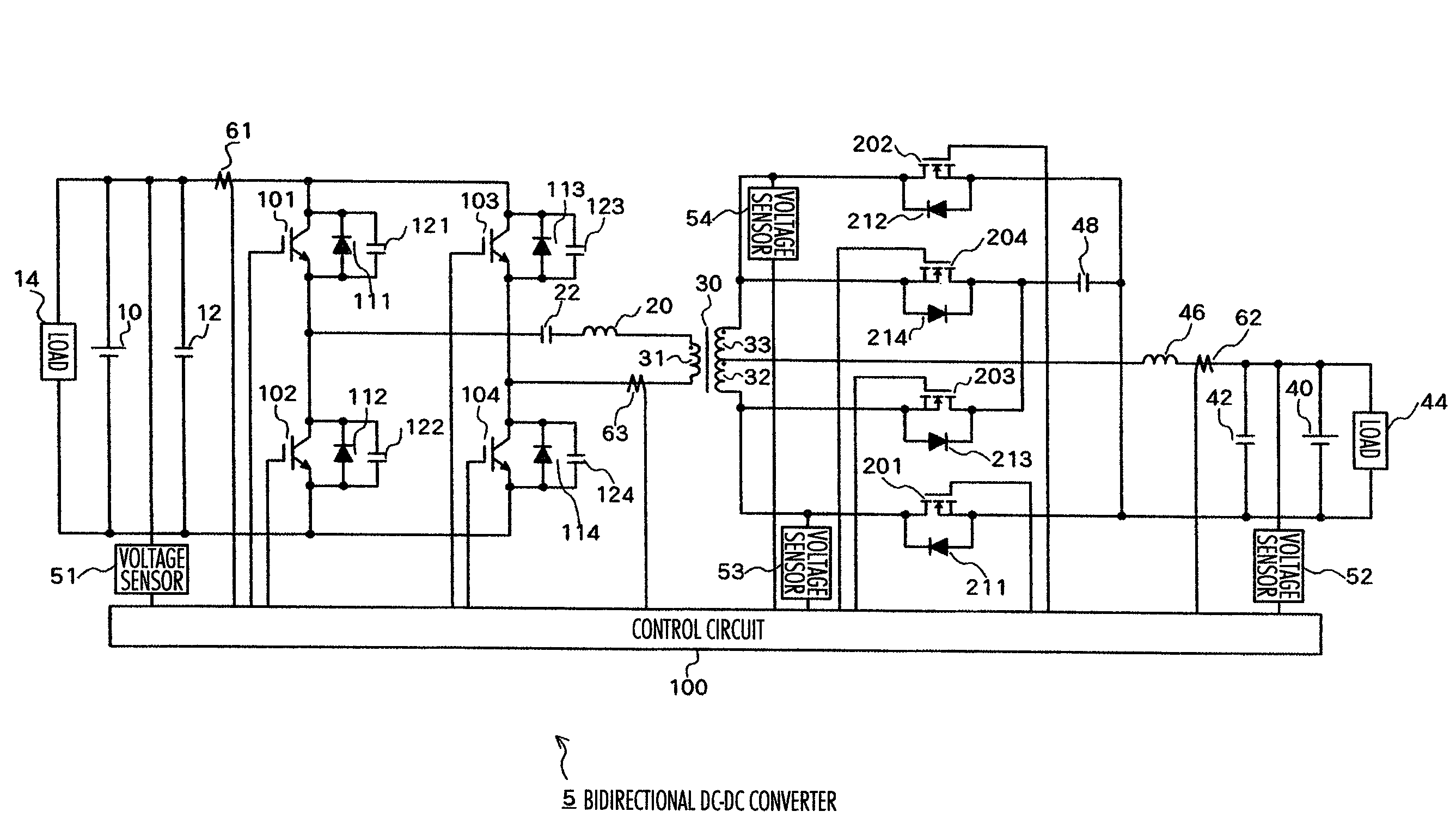
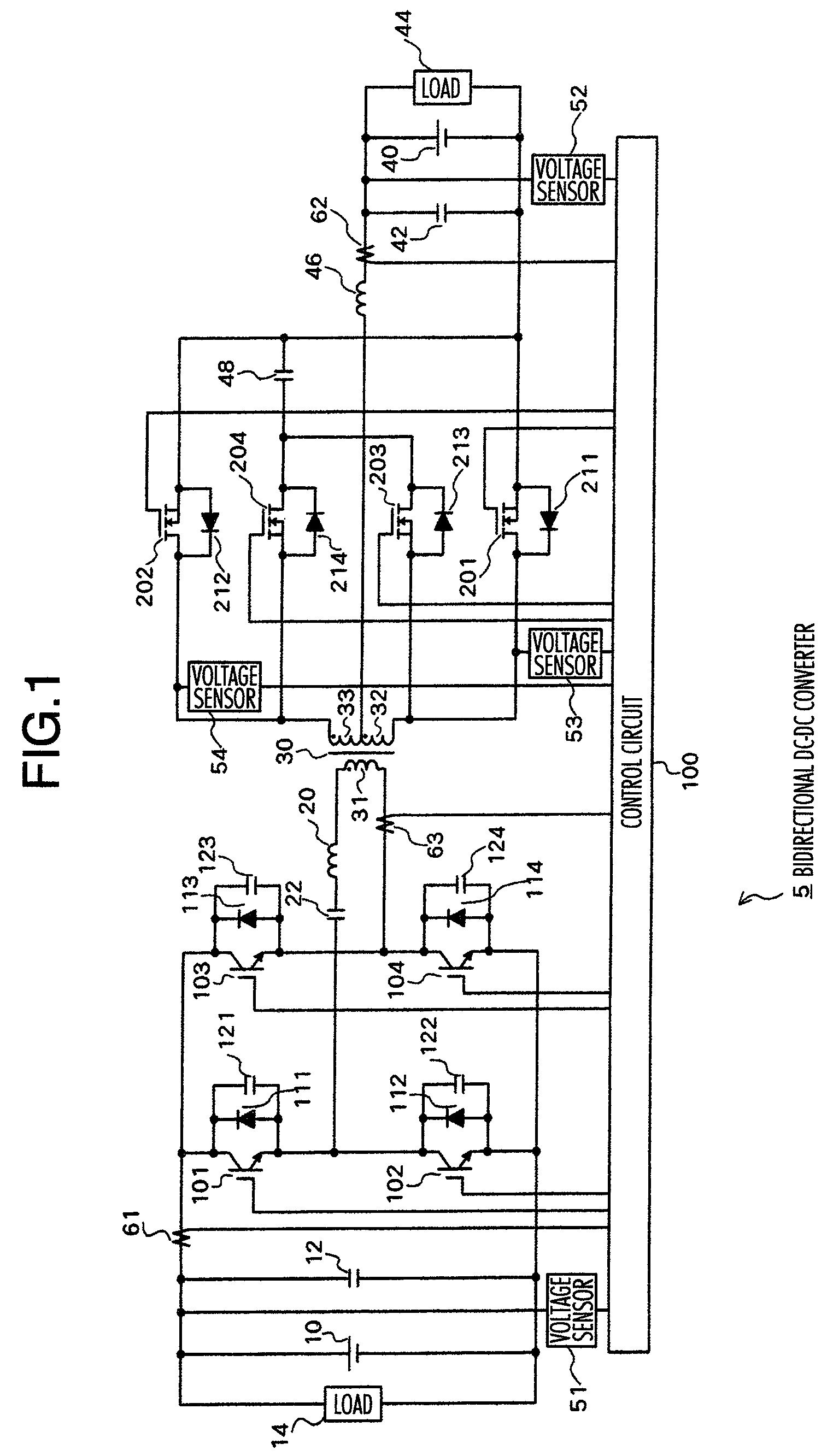
[0038]An embodiment of the invention will be described in detail with reference to the drawings. The same or corresponding portions in the drawings are designated by the same reference numerals. In the embodiment, although it is assumed that an IGBT and a MOSFET are used as switching elements as an example, the invention is not limited to them. A voltage of the switching element in an ON state or a voltage which is almost equal to or lower than a forward drop voltage of a diode is assumed to be a zero voltage.
[0039]FIG. 1 is a circuit constructional diagram of a bi-directional DC-DC converter 5 according to the embodiment of the invention. In FIG. 1, a smoothing capacitor 12, a load 14, a first switching arm in which an emitter of an IGBT 101 and a collector of an IGBT 102 are connected, and a second switching arm in which an emitter of an IGBT 103 and a collector of an IGBT 104 are connected are connected in parallel to a power source 10 on a high voltage side.
[0040]Each of diodes ...
PUM
 Login to View More
 Abstract
Description
Claims
Application Information
 Login to View More