Multilayer film, electrooptic device, electronic apparatus, and process for forming multilayer film
a multi-layer film and electrooptic technology, applied in the field of multi-layer film, electrooptic device, electronic apparatus, and can solve the problems of insufficient improvement of adhesion and contact properties between layers, known process for forming multi-layer film by droplet discharge method, etc., to achieve convenient formation of liquid layer, effective redissolving of the surface of the solid lower layer, and satisfactory adhesion and contact properties
- Summary
- Abstract
- Description
- Claims
- Application Information
AI Technical Summary
Benefits of technology
Problems solved by technology
Method used
Image

Examples
first embodiment
Electrooptic Device
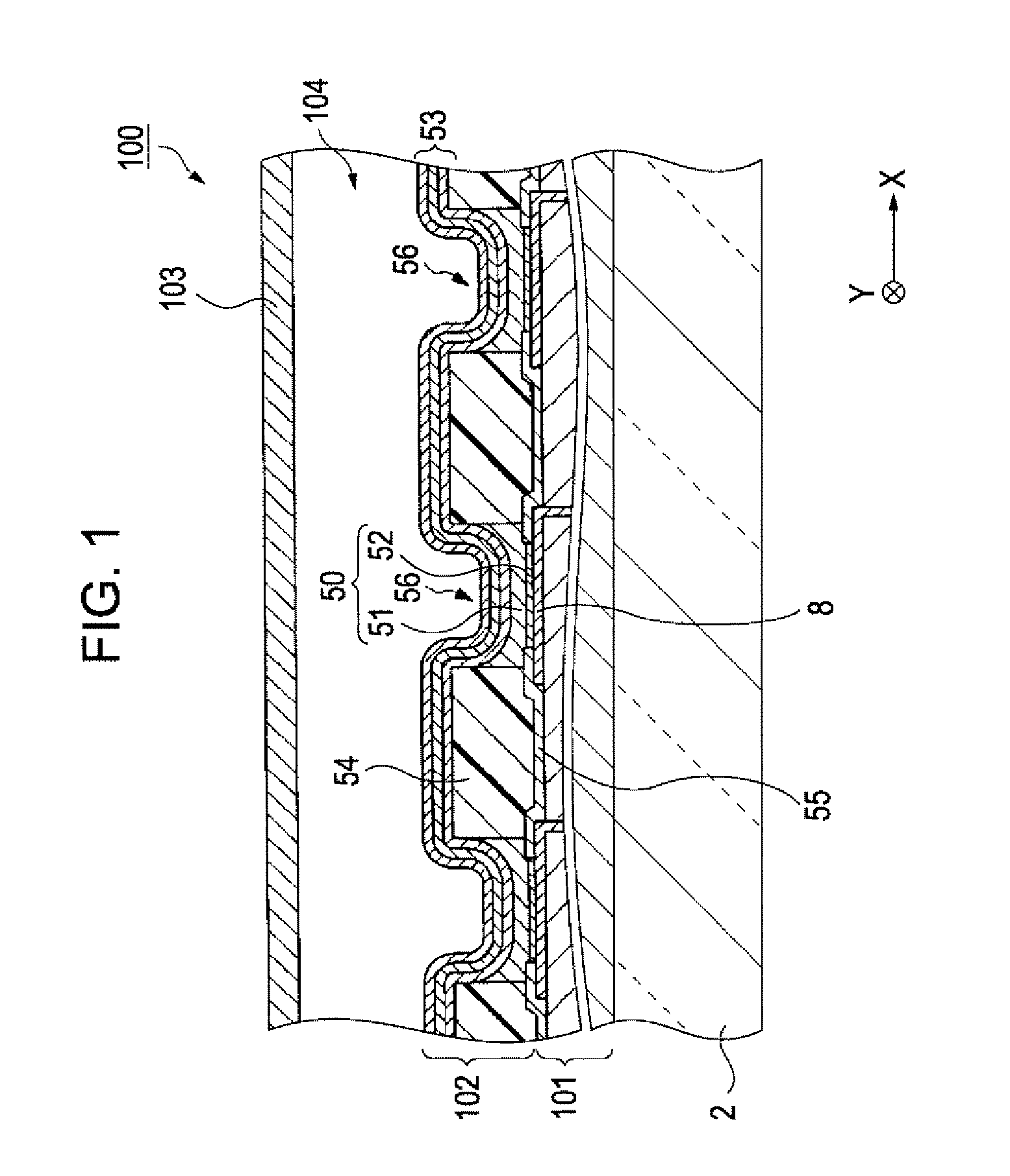
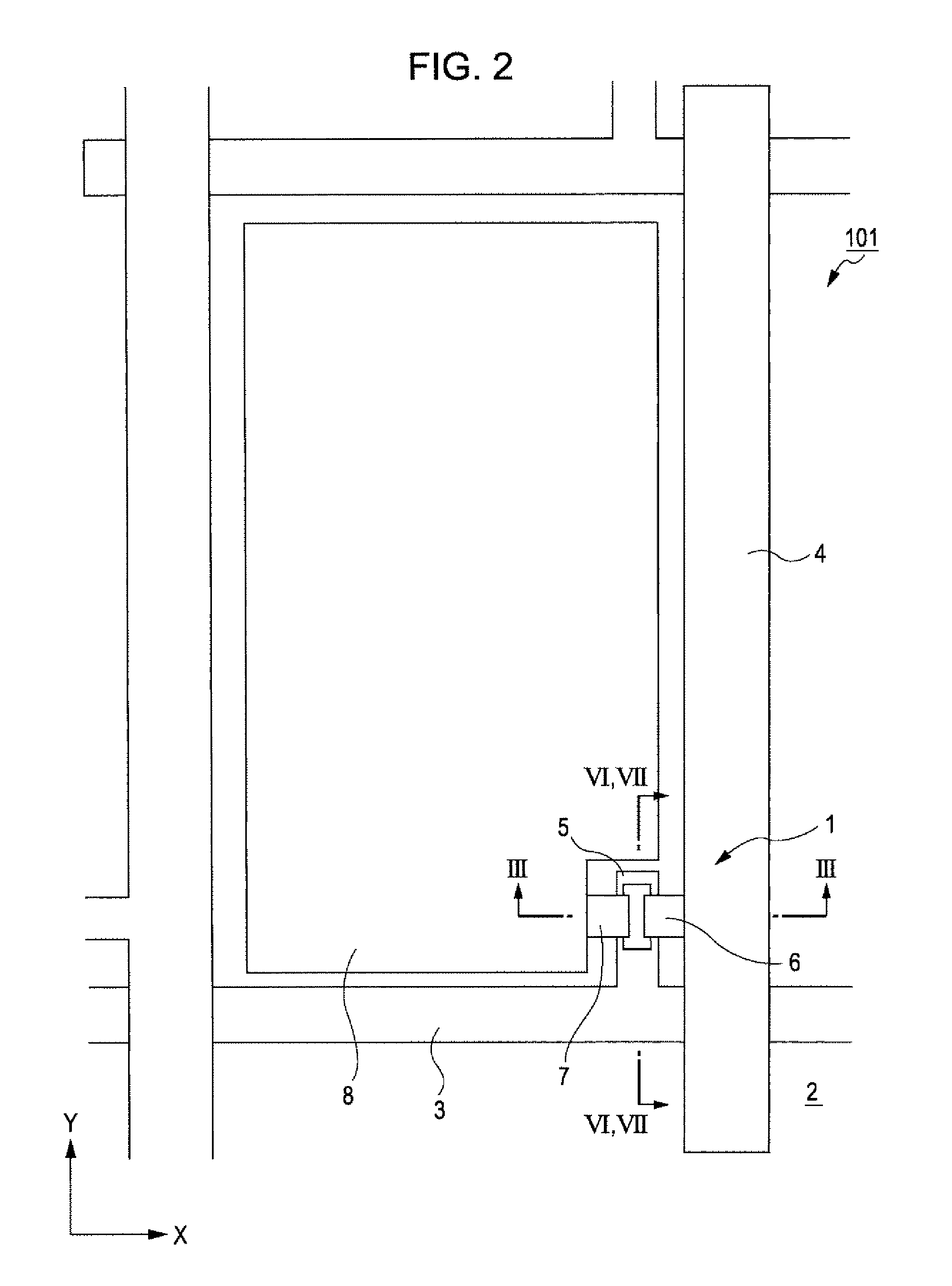
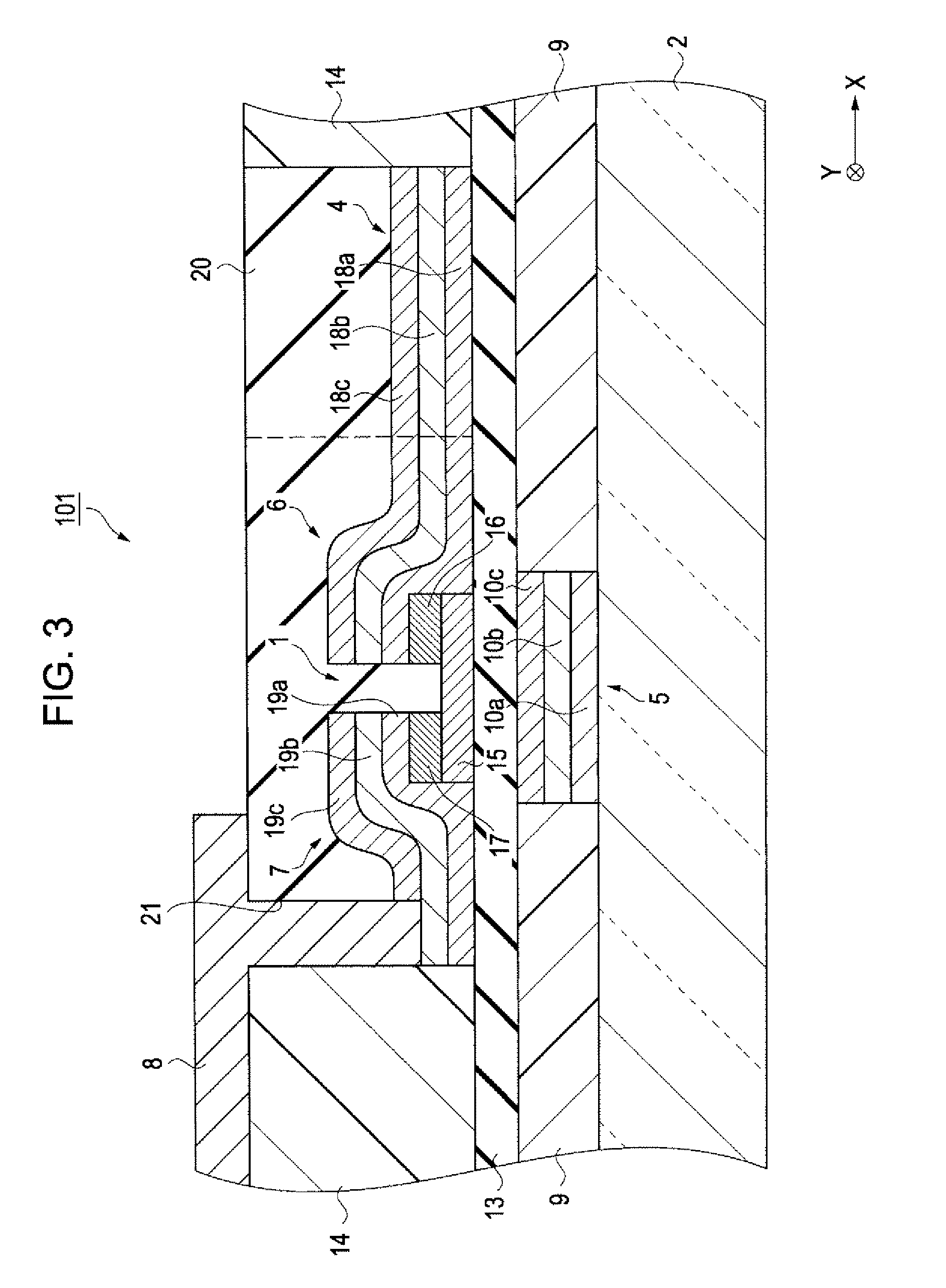
[0039]An electrooptic device in accordance with the invention will be described with reference to FIGS. 1, 2, and 3. FIG. 1 is a fragmentary cross-sectional view of the electrooptic device in accordance with an embodiment of the invention. FIG. 2 is a plan view of the driving circuit portion of the electrooptic device. FIG. 3 is a cross-sectional view of a driving element and its peripheral structure, the view being taken along the line III-III in FIG. 2.
[0040]As shown in FIG. 1, an electrooptic device 100 includes an elemental substrate 2, a driving circuit portion 101 on the elemental substrate 2, a luminescent element portion 102 on the driving circuit portion 101, and a sealing substrate 103 for sealing the driving circuit portion 101 and the luminescent element portion 102, the sealing substrate 103 being remote from the elemental substrate 2. The elemental substrate 2 is preferably a glass substrate. A sealed cavity 104 sealed with the sealing substrate 103 ...
second embodiment
[0083]Referring now to FIG. 11, a second embodiment of the invention will be described. FIG. 11 is a schematic perspective view of a fuel cell in accordance with an embodiment of the invention.
[0084]A fuel cell 120 shown in FIG. 11 generates electric power by reaction of a hydrogen gas and an oxygen gas. The fuel cell 120 has a structure in which a multilayer film 130 is disposed between two substrates 121 and 122 having gas channels 121a and 122a, respectively, the multilayer film 130 including electrode layers 128 and 129, gas diffusion layers 123 and 124, catalytic layers 125 and 126, and an ion-exchange layer 127. The electrode layers 128 and 129 are each composed of a conductive material such as copper. The gas diffusion layers 123 and 124 are each composed of porous carbon and the like. The catalytic layers 125 and 126 are each composed of platinum and the like. The ion-exchange layer 127 is composed of an ion-conducting electrolyte, such as Nafion® (manufactured by Du Pont Ka...
PUM
 Login to View More
 Abstract
Description
Claims
Application Information
 Login to View More
 - R&D
- Intellectual Property
- Life Sciences
- Materials
- Tech Scout
- Unparalleled Data Quality
- Higher Quality Content
- 60% Fewer Hallucinations
Browse by: Latest US Patents, China's latest patents, Technical Efficacy Thesaurus, Application Domain, Technology Topic, Popular Technical Reports.
© 2025 PatSnap. All rights reserved.Legal|Privacy policy|Modern Slavery Act Transparency Statement|Sitemap|About US| Contact US: help@patsnap.com