Check patentability & draft patents in minutes with Patsnap Eureka AI!

Anhydrous chromium(III) halide complex preparation

a technology of anhydrous chromium and complexes, which is applied in the direction of group 6/16 element organic compounds, chemistry apparatus and processes, etc., can solve the problems of high production cost of anhydrous and/or anhydrous chromium complexes of this type and few convenient synthetic techniques availabl

Active Publication Date: 2013-05-28
CHEVRON PHILLIPS CHEMICAL CO LP
View PDF0 Cites 0 Cited by
  • Summary
  • Abstract
  • Description
  • Claims
  • Application Information

AI Technical Summary

Benefits of technology

This patent describes a process for preparing chromium(III) halide complexes using a chromium(III) halide hydrate, a water absorption agent, and a coordinating compound. The process involves contacting the chromium(III) halide hydrate with the coordinating compound and the water absorption agent, and optionally isolating the complex. The technical effect of this process is the ability to efficiently prepare chromium(III) halide complexes without the need for heating or vacuum, and with a low water content.

Problems solved by technology

Substantially anhydrous and / or anhydrous chromium complexes of this type generally are expensive to produce and few convenient synthetic techniques are available.
Such methods typically require heating and / or vacuum, and the presence of acid.
Chromium(III) halide complexes produced via these methods can contain impurities or by-products which can be detrimental to preparing coordination and organometallic chromium compounds and / or catalyst systems containing the prepared coordination and organometallic chromium compounds.

Method used

the structure of the environmentally friendly knitted fabric provided by the present invention; figure 2 Flow chart of the yarn wrapping machine for environmentally friendly knitted fabrics and storage devices; image 3 Is the parameter map of the yarn covering machine
View more

Image

Smart Image Click on the blue labels to locate them in the text.
Viewing Examples
Smart Image
  • Anhydrous chromium(III) halide complex preparation
  • Anhydrous chromium(III) halide complex preparation
  • Anhydrous chromium(III) halide complex preparation

Examples

Experimental program
Comparison scheme
Effect test

example 1

Substantially Anhydrous CrCl3(THF)3 Prepared from CrCl3(THF)2(H2O)

Comparative Method

[0228]Substantially anhydrous CrCl3(THF)3 was prepared from the hydrate from CrCl3(THF)2(H2O), using Me3SiCl as the drying agent, as follows. A 500 mL round bottom flask was charged with a stir bar, 50 g of CrCl3(THF)2(H2O), 200 mL of anhydrous THF, and 50 mL of trimethylchlorosilane (Me3SiCl). This mixture was stirred under an inert atmosphere (in the dry box) for 4 days. The resulting purple solid was collected by filtration using a glass frit, washed with 100 mL of THF followed by 100 mL of pentane, and dried under vacuum. Yield, 47.5 g CrCl3(THF)3. Elemental analysis, IR spectra, and Karl-Fischer titration confirmed that the material was substantially anhydrous CrCl3(THF)3. Elemental analysis; found (calculated): % C, 38.17 (38.47); % H, 6.52 (6.46); % Cl, 28.66 (28.39). Karl-Fisher titration of 0.1 grams of the purple solid in 9.0 grams of THF indicated a water content of 17 ppm water versus a p...

example 2

Substantially Anhydrous CrCl3(THF)3 Prepared from CrCl3(THF)2(H2O)

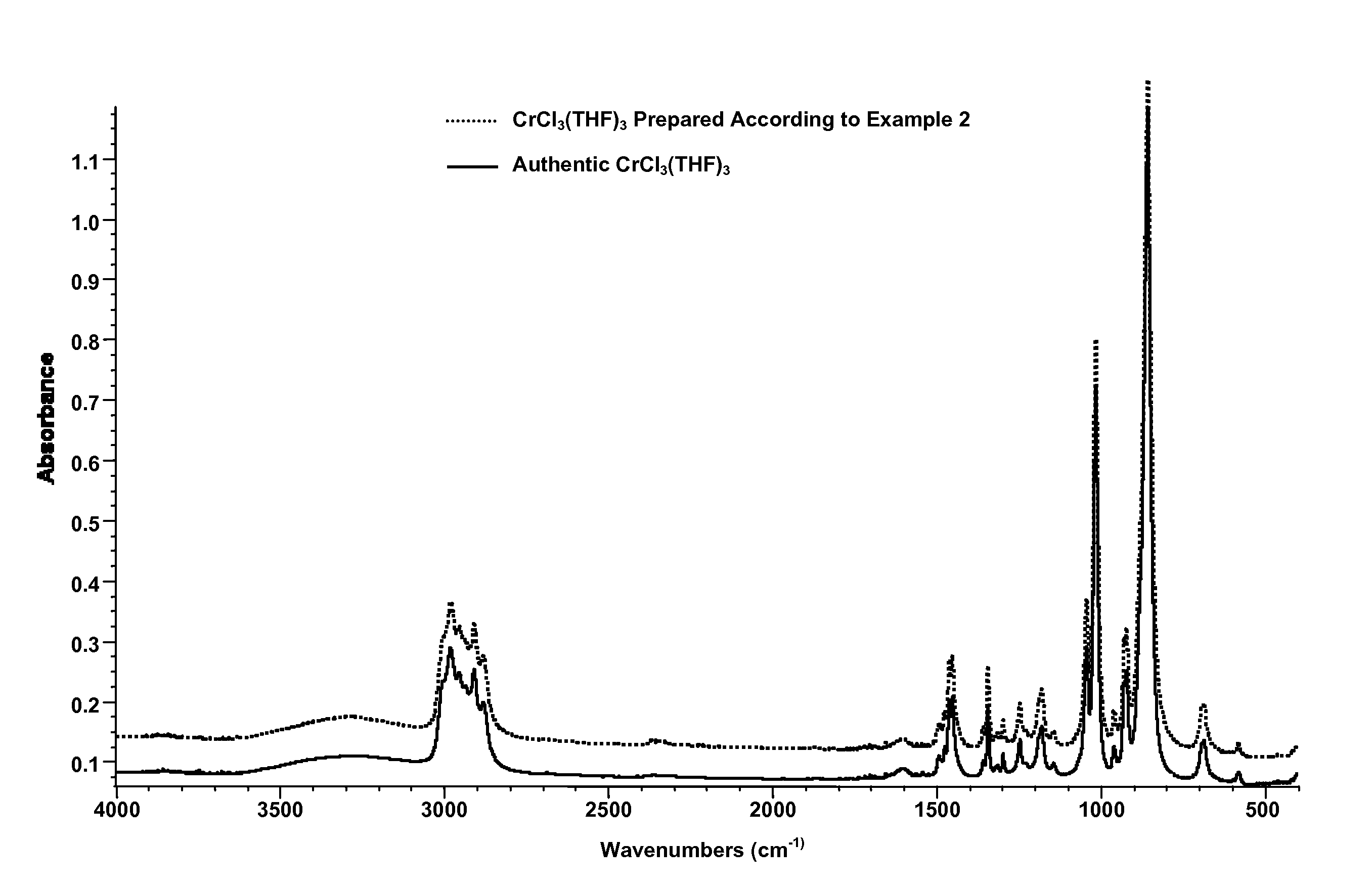
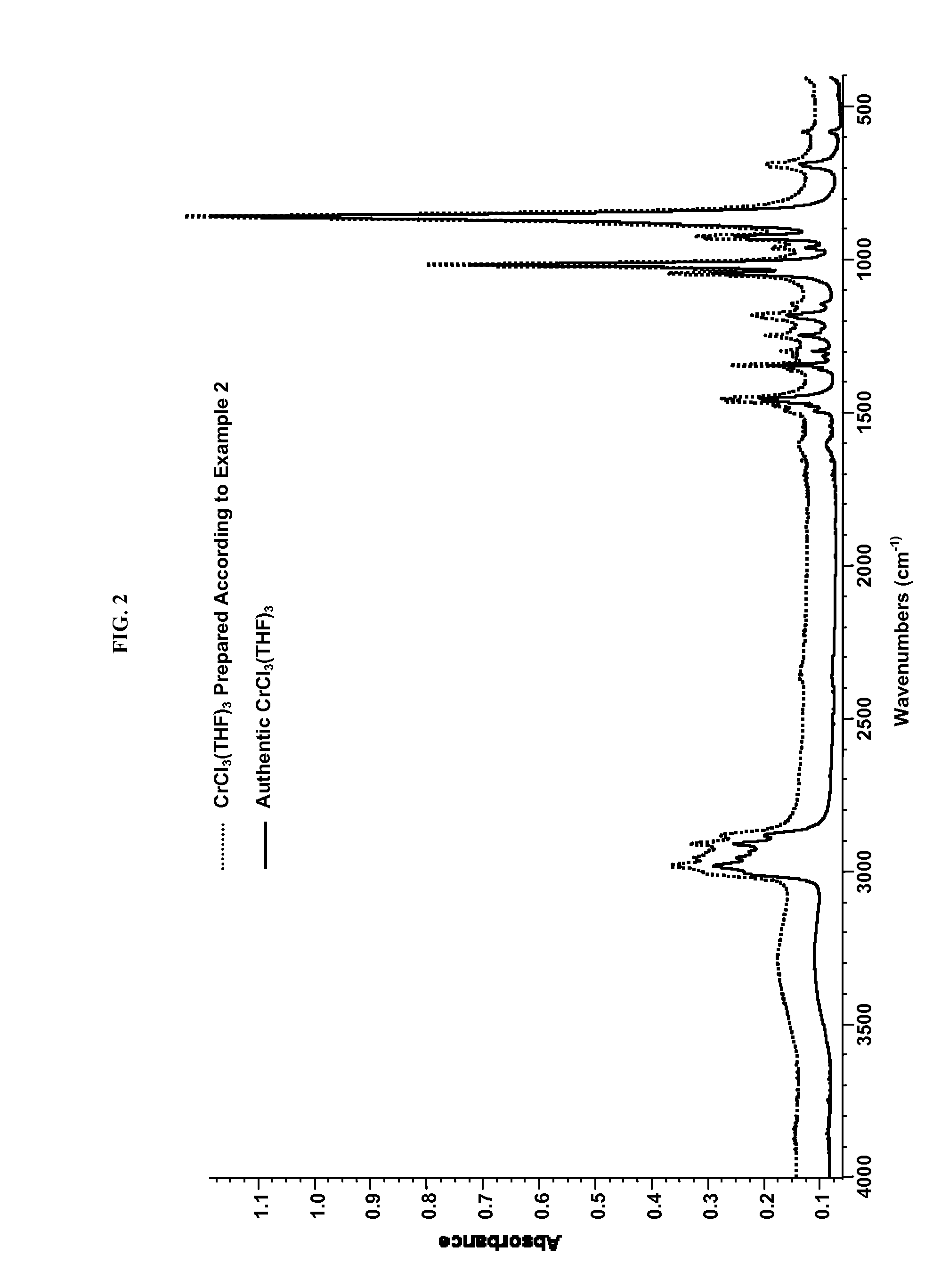
[0229]Substantially anhydrous CrCl3(THF)3 was prepared from the hydrate from CrCl3(THF)2(H2O), using molecular sieves as the drying agent, as follows. A 20 mL glass vial was charged with 0.5 g of CrCl3(THF)2(H2O), 10 g of anhydrous THF, and 0.7 g of activated 5 {acute over (Å)} molecular sieves. This mixture was stirred for 3 days, over which time a purple solution, purple solid, and crushed molecular sieves formed. This mixture was filtered through a 0.25 micron syringe filter disk, and the purple solution was cooled to −10° C., producing 0.25 g of purple crystals of substantially anhydrous CrCl3(THF)3. Formation of substantially a CrCl3(THF)3 was confirmed by IR spectroscopy (KBr window), by comparing this sample with an authentic sample of substantially anhydrous CrCl3(THF)3, FIG. 2.

example 3

Substantially Anhydrous CrCl3(THF)3 Prepared from CrCl3.6H2O

[0230]Substantially anhydrous CrCl3(THF)3 was prepared from CrCl3.6H2O (also written [Cr(H2O)4Cl2]Cl.2; H2O), as follows. A 250 mL round bottom flask was charged with 10.0 g [Cr(H2O)4Cl2]Cl.2H2O, 100 mL of anhydrous THF, and 25.0 g of activated 5 {acute over (Å)} molecular sieves. The mixture was stirred for 3 days, over which time its color turned from green to purple. The mixture then was filtered through a glass frit, the filtrate was concentrated to about one-quarter of its original volume, and the concentrated filtrate was layered with approximately an equal volume of pentanes. The purple solid that resulted from this procedure was collected by filtration and dried under vacuum. Karl-Fischer titration confirmed that the purple solid was the mono-hydrate CrCl3(THF)2(H2O). Thus, Karl-Fischer titration of 0.1 grams of the purple solid in 9.0 grams of THF indicated a water content of 538 ppm water, versus a predicted conte...

the structure of the environmentally friendly knitted fabric provided by the present invention; figure 2 Flow chart of the yarn wrapping machine for environmentally friendly knitted fabrics and storage devices; image 3 Is the parameter map of the yarn covering machine
Login to View More

PUM

No PUM Login to View More

Abstract

This disclosure provides a process for preparing an anhydrous chromium(III) halide complex, comprising contacting a chromium(III) halide hydrate, a water absorption agent, and a coordinating solvent, L, and forming a chromium(III) halide complex having the formula CrX3.mL, wherein X is a halide and m is the number of moles of L per mole of chromium. This process is exemplified in the preparation of the substantially anhydrous or anhydrous CrCl3(THF)3, the process comprising contacting CrCl3.6H2O, tetrahydrofuran, and 3 Å, 4 Å, 5 Å, 10×, or 13× molecular sieves; forming CrCl3(THF)3; and isolating the CrCl3(THF)3 having a water content of less than or equal to 100 ppm.

Description

TECHNICAL FIELD OF THE INVENTION[0001]This disclosure relates to synthetic methods for preparing substantially anhydrous metal halide complexes, such as substantially anhydrous first-row transition metal halide complexes, and in particular, substantially anhydrous chromium halide complexes, including chromium(III) halide complexes.BACKGROUND OF THE INVENTION[0002]Substantially anhydrous and / or anhydrous chromium(III) halide complexes (e.g., CrCl3(THF)3) are useful materials for producing coordination and organometallic chromium compounds. Substantially anhydrous and / or anhydrous chromium complexes of this type generally are expensive to produce and few convenient synthetic techniques are available. For example, current methods can require either the separate formation of the substantially anhydrous and / or anhydrous CrCl3 from CrCl3 hydrate, or employ dehydrating agents that produce acid as a result of their dehydrating action. Such methods typically require heating and / or vacuum, an...

Claims

the structure of the environmentally friendly knitted fabric provided by the present invention; figure 2 Flow chart of the yarn wrapping machine for environmentally friendly knitted fabrics and storage devices; image 3 Is the parameter map of the yarn covering machine
Login to View More

Application Information

Patent Timeline
no application Login to View More
IPC IPC(8): C07F11/00
CPCC07F11/005
Inventor SYDORA, ORSON L
Owner CHEVRON PHILLIPS CHEMICAL CO LP
Features
  • R&D
  • Intellectual Property
  • Life Sciences
  • Materials
  • Tech Scout
Why Patsnap Eureka
  • Unparalleled Data Quality
  • Higher Quality Content
  • 60% Fewer Hallucinations
Social media
Patsnap Eureka Blog
Learn More