
Method for producing filler-containing fluororesin sheet
a technology of fluororesin and filler, which is applied in the field of method for producing filler-containing fluororesin sheets, can solve the problems of lower strength of fluororesin sheets, and achieve the effect of efficient production of elongated filler-containing fluororesin sheets
- Summary
- Abstract
- Description
- Claims
- Application Information
AI Technical Summary
Benefits of technology
Problems solved by technology
Method used
Image

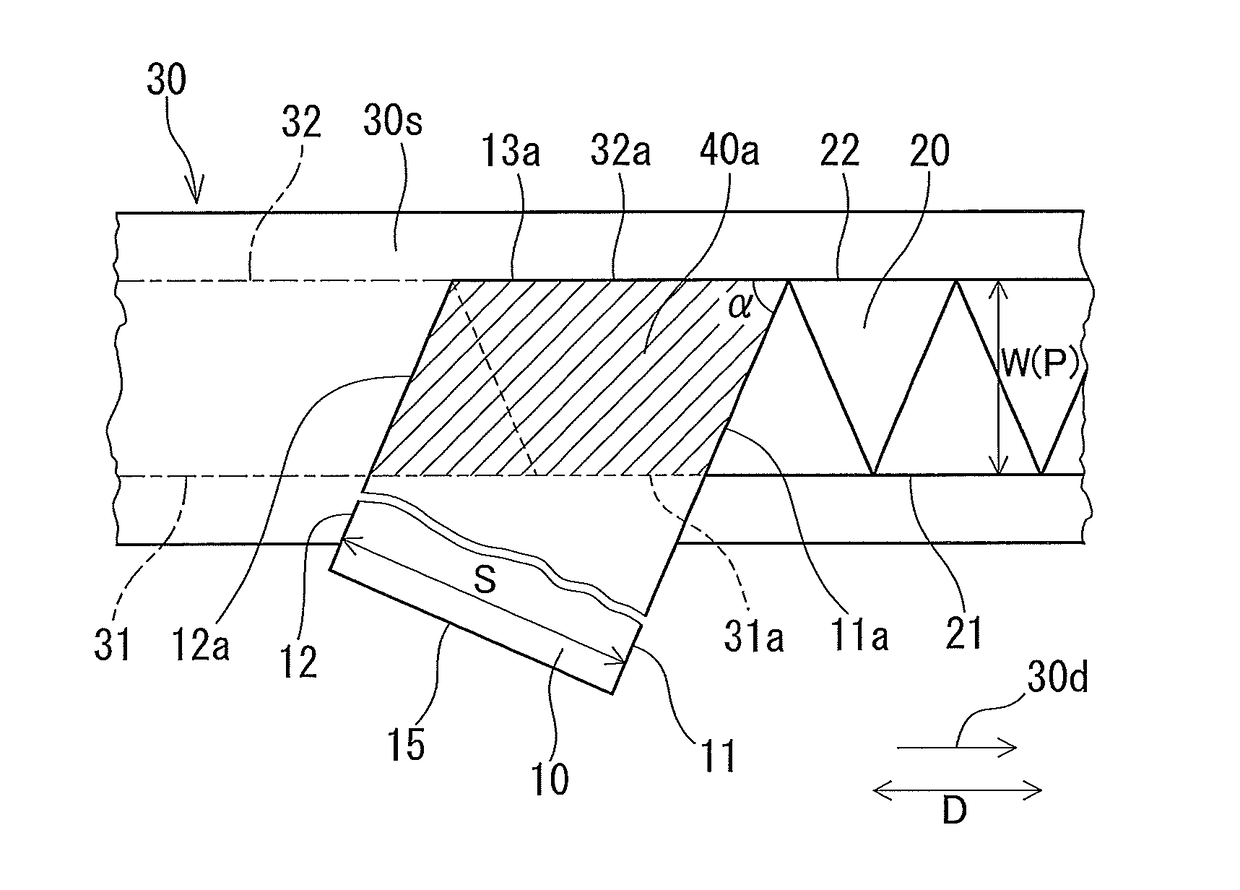
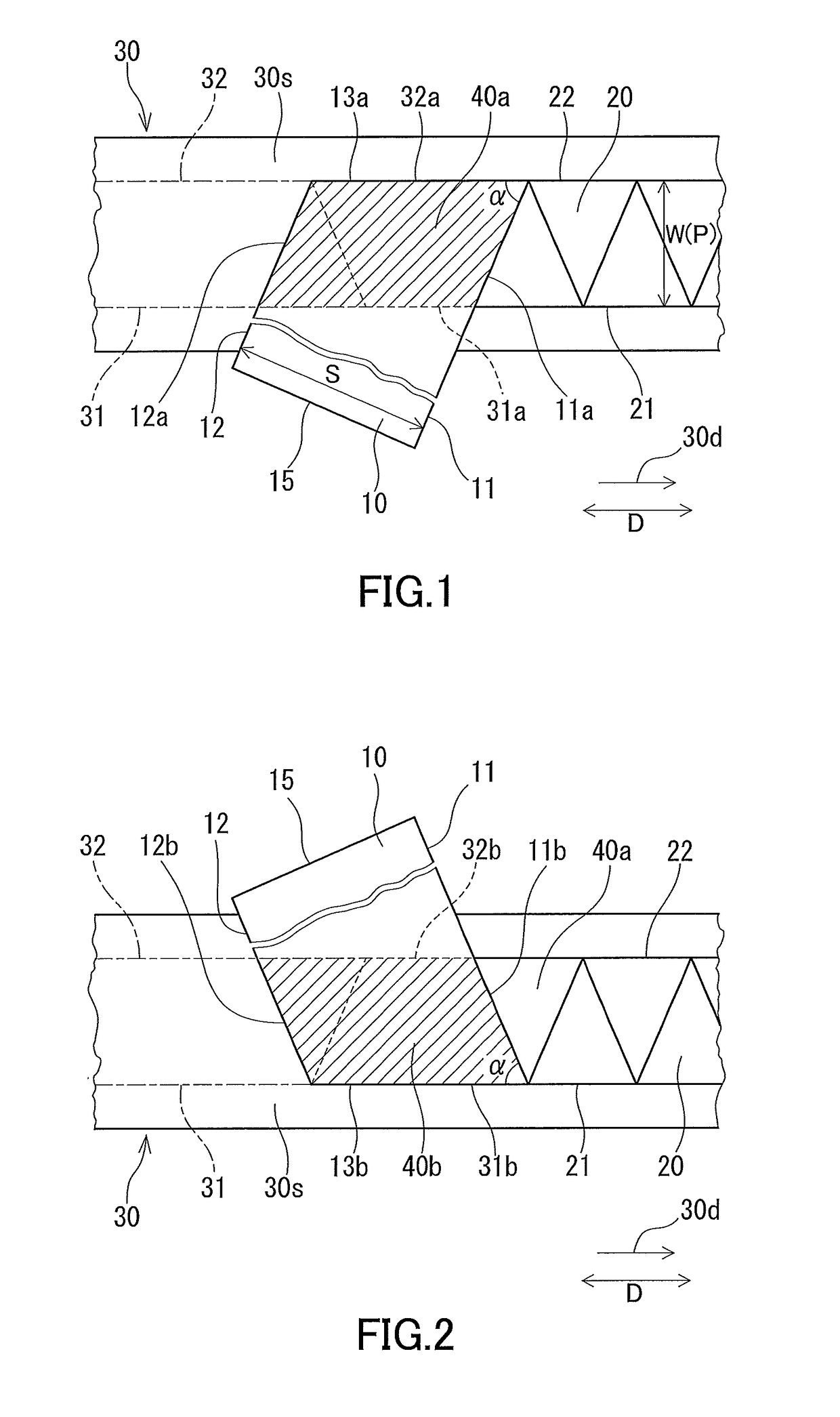
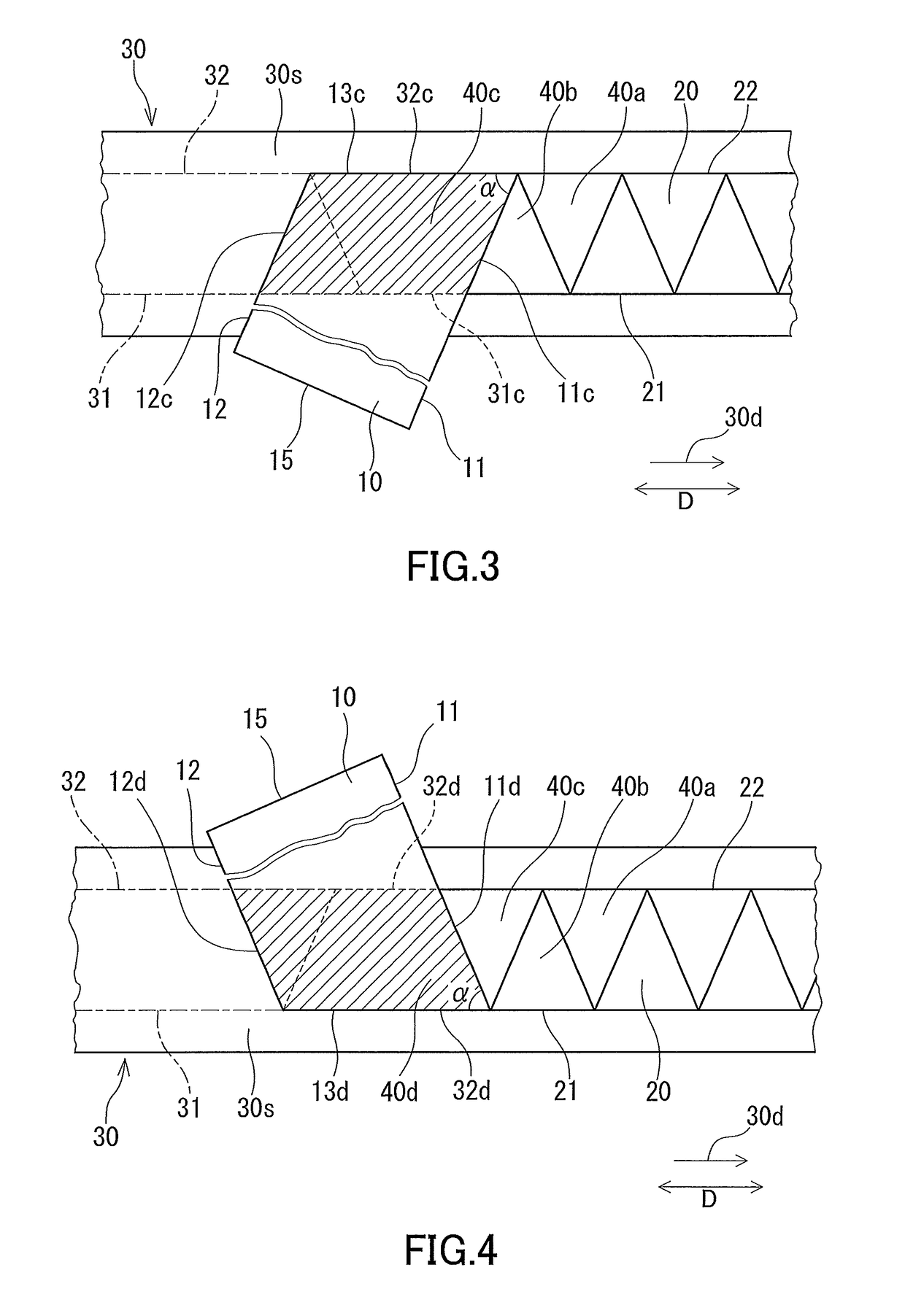
Examples
example 1
(Example 1)
[0099]Carbon black (CB) particles (as a filler, “Toka Black (registered trademark) #4500”, with an average particle diameter of 40 nm, manufactured by Tokai Carbon Co., Ltd.) were dispersed in water, and a PTFE dispersion (“Fluon (registered trademark) AD938E”, with a PTFE content of 60 wt. %, manufactured by Asahi Glass Co., Ltd.) was added to the CB dispersion to obtain a mixture containing PTFE and CB at a weight ratio of 50:50. PTFE and CB in the mixture were coaggregated to form a coaggregate, which was then heated and dried to obtain a PTFE-CB particle mixture. “Isopar (registered trademark) M” (manufactured by Exxon Mobil Corporation) as a forming aid was added to the dried PTFE-CB particle mixture. Thus, a pasty mixture containing 47 wt. % of the forming aid per 100 wt. % of the PTFE-CB particle mixture was obtained.
[0100]Next, the pasty mixture was formed into pellets using a preforming machine. These pellets were fed into an extruder (at an extrusion speed of 60...
example 2
(Example 2)
[0102]A sheet strip with a thickness of 114 mm and a width of 110 mm was produced in the same manner as in Example 1, except that the acute angle α was 75.5° and the width of the strip member was 100 mm. The longitudinal length of the sheet strip was 8 m.
example 3
(Example 3)
[0103]A sheet strip with a thickness of 1.22 mm and a width of 198 mm was produced in the same manner as in Example 1, except that the acute angle α was 82.8° and the width of the strip member was 200 mm. The longitudinal length of the sheet strip thus obtained was 4 m.
[0104]Table 1 shows the measurement results of the tensile strength.
[0105]
TABLE 1AcuteTensile strength (MPa)angleLongitudinalTransverse45°135°α (°)directiondirectiondirectiondirectionExample 1601.050.600.730.66Example 275.50.830.770.680.69Example 382.80.560.690.630.58
[0106]In Examples 1 to 3, sheet strips with low directional dependence of strength were obtained. Particularly in Examples 2 and 3, in which the acute angles a were relatively large, the directional difference in the tensile strength was sufficiently reduced.
[0107]In Examples 1 to 3, the acute angles a were within a range of 0.1° above or below cos−1(S / 2nW). Therefore, the resulting strip members and sheet strips had high thickness uniformity. ...
PUM
| Property | Measurement | Unit |
|---|---|---|
| acute angle | aaaaa | aaaaa |
| acute angle | aaaaa | aaaaa |
| acute angle | aaaaa | aaaaa |
Abstract
Description
Claims
Application Information
 Login to View More