Method and device for realizing service type self adaption
A type of business, adaptive technology, applied in the field of communication transmission, to achieve the effect of improving maintainability and flexibility
- Summary
- Abstract
- Description
- Claims
- Application Information
AI Technical Summary
Problems solved by technology
Method used
Image



Examples
Embodiment 1
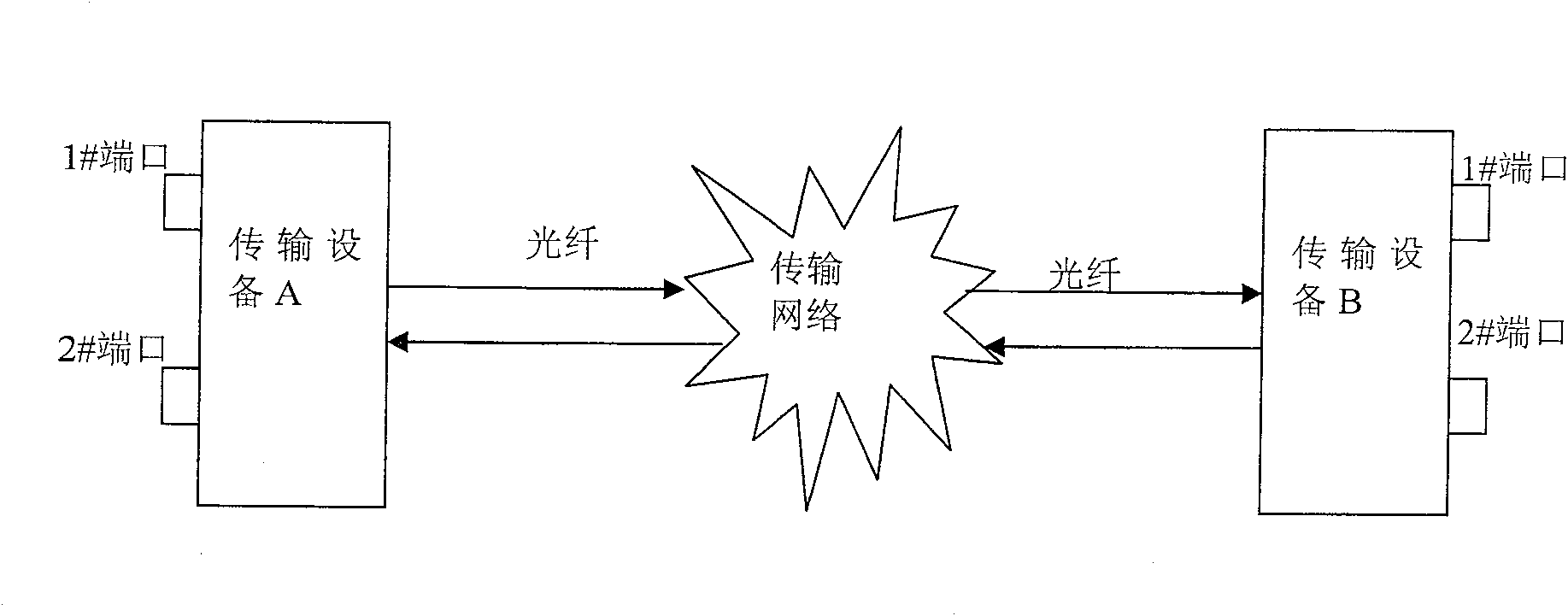
[0035] The transmission equipment may receive multiple types of service signals. In order to distinguish the service types and facilitate description, the service types that the transmission equipment may transmit can be numbered. For example, the transmission equipment may transmit a total of 12 types of services, which can be numbered as shown in the table One shown:
[0036] number(n)
business type
Service rate (Mbps)
Reference clock frequency
Rate(MHz)
business and participation
test clock speed
Ratio
1#
FE(100BASE-FX)
125
125
1∶1
2#
FDDI
125
125
1∶1
3#
ESCON
200
100
2∶1
4#
DVB-ASI
270
135
2∶1
5#
DVB-SDI
270
135
2∶1
6#
1GFC
1062.5
106.25
10∶1
7#
FICON
1062.5
106.25
10∶1
8#
2GFC
2125
...
Embodiment 2
[0063] Such as image 3 Shown is a schematic structural diagram of a device for realizing service type self-adaptation, which includes: a reference clock module, a service rate identification module, a control module, and a data service transmission processing module.
[0064] Wherein, the control module issues instructions to the reference clock module to control it to generate reference clock signals corresponding to different service types; and configure the reference clock multiplication ratio of the service rate identification module according to the generated reference clock signals. For example, if it is necessary to compare the received service with the GE service, the control module instructs the reference clock module to generate a reference clock signal with a frequency of 125MHz, and then sets the frequency multiplication ratio of the reference clock to 10:1 in the service rate identification module. When the service rate identification module identifies the servic...
Embodiment 3
[0073] Figure 4 Shown is a schematic diagram of the device structure of this embodiment. As shown in the figure, the difference between this device and the device shown in Embodiment 2 is that a service content identification module is added to the device, which is respectively connected with the reference clock module and the service rate identification module. , The control module is connected. When the transmission device needs to process the specific characteristics of the service, the module is used to identify the content of the service according to the characteristic information of the service, thereby determining the service type, and reporting the determined service type to the control module.
[0074] Optionally, the service content identification module in this embodiment may exist independently, or may be integrated with the service transmission processing module.
[0075] Optionally, the device may further include a service sampling module, which is used to copy...
PUM
 Login to View More
 Abstract
Description
Claims
Application Information
 Login to View More