

Simple sewage treatment device of alternate aeration basin and treatment technique thereof
A sewage treatment device and sewage treatment technology, applied in the direction of water/sewage multi-stage treatment, water/sludge/sewage treatment, aerobic and anaerobic process treatment, etc., can solve the problems of few applicable technologies and lack of technical standards, etc. To achieve the effect of short construction period, low infrastructure investment and automatic operation process
- Summary
- Abstract
- Description
- Claims
- Application Information
AI Technical Summary
Problems solved by technology
Method used
Image

Examples
Embodiment 1
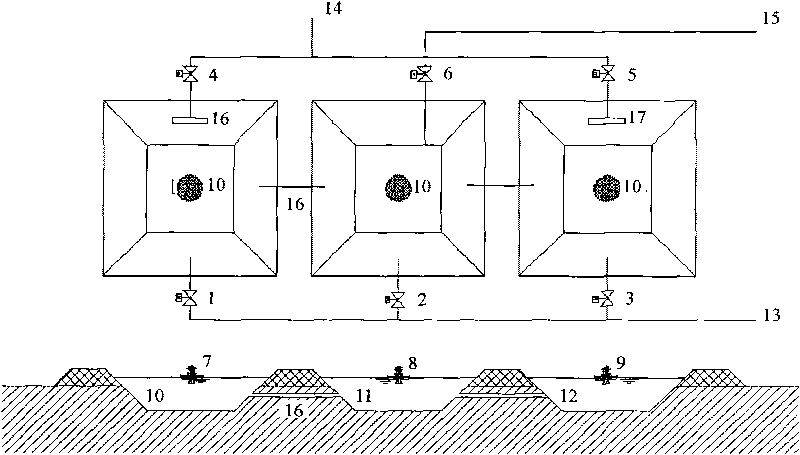
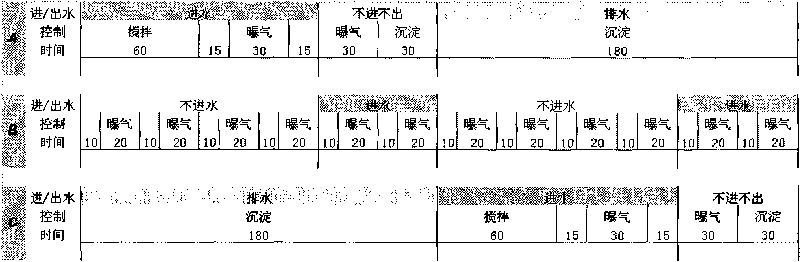
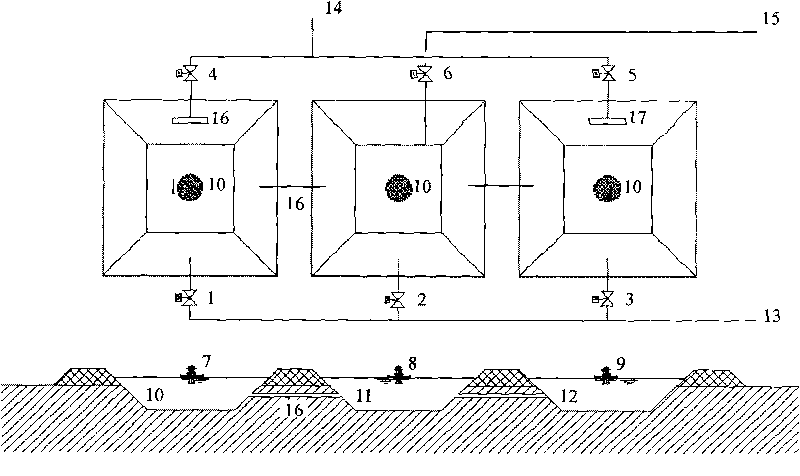
[0026] Embodiment 1: as figure 1 As shown, choose a natural pond or a leveled site located in the downwind direction of the built-up area of the township, and form three alternate aeration ponds with a water depth of 2-3m through excavation and piled up soil, which are respectively the first aeration pond 10, the second aeration pond Aeration pond 11 and the third aeration pond 13; Lay anti-seepage film around the three alternating aeration ponds, after installing connecting pipes, water inlet pipes, outlet pipes and mud discharge pipes, the first aeration pond 10 and the third aeration pond The three aeration ponds 12 are respectively connected with the second aeration pond 11 through connecting pipes. The water inlet valve 2 and the third water inlet valve 3 are connected to the water inlet pipe 13, the first outflow weir 16 and the first water outlet valve 4 are connected to the water outlet pipe 14 above the first aeration pond 10, and the water outlet pipe 14 is connect...
Embodiment 2
[0031] Embodiment 2: Using online feedback real-time control mode
[0032] The project in Embodiment 1 can also be operated in the real-time control mode with online feedback. Regardless of the design minimum day, design average day and design maximum day, the real-time operation control mode is as follows: the operation cycle is divided into upper and lower stages. , the ORP in the first aeration pond decreases and the pH increases; when and When the sewage enters from the second aeration pond, close the agitator of the first aeration pond, start the first aerator, the ORP in the first aeration pond rises, and the pH drops; and Close the first aerator to settle for 45 minutes and enter the second half cycle. In the above process, when DO3, the second aerator is turned off; the third aeration pond has always been used as a sedimentation pond, and the solid-liquid separation of the mixed liquid is completed here. The supernatant is discharged through the second outflow...
PUM
 Login to View More
 Abstract
Description
Claims
Application Information
 Login to View More