
Method for detecting peculiar smell caused by acetic acid and propionic acid in tobacco sheets
A technology for tobacco sheet and acetic acid, which is applied in the field of detecting food odor, can solve the problem of no tobacco sheet acetic acid and propionic acid detection methods, etc., and achieves the effects of simple operation, simple test operation and accurate results.
- Summary
- Abstract
- Description
- Claims
- Application Information
AI Technical Summary
Problems solved by technology
Method used
Image

Examples
specific Embodiment 1
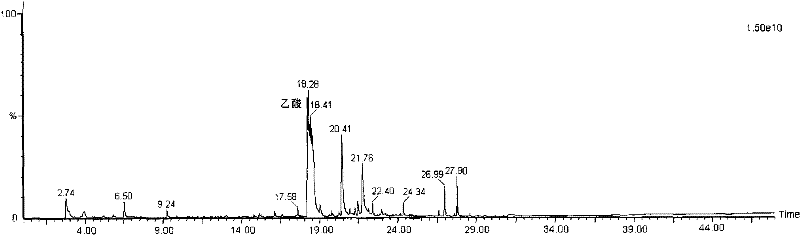
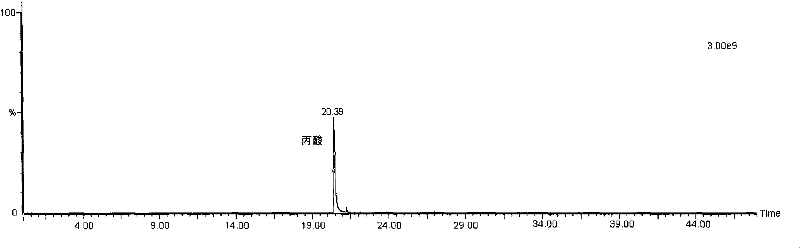
[0029] Test the normal flake samples without obvious peculiar smell and some flake samples with peculiar smell. Weigh 1 g of normal flakes and place them in a headspace vial and put them into O·I·Analytical 4552 liquid / solid autosampler. Set the temperature of XFERLine and US Valve to 150°C and 120°C respectively. Preheat the sheet at 40°C for 15 minutes, then blow it to the trap for 30 minutes, dry blow for 6 minutes to remove the water blown into the trap, and then heat the trap to 250°C for 2 minutes for desorption. After desorption, the trap was baked at 260°C for 10 minutes to remove residual substances in the trap. The desorbed substances enter the PerkinElmer Clarus 600 gas chromatograph along with He gas. After temperature programming was carried out according to step (5) in the summary of the invention, the sample separated by chromatography was analyzed by PerkinElmer Clarus 600T mass spectrometer. After completion, repeat the above process for the analysis of the...
specific Embodiment 2
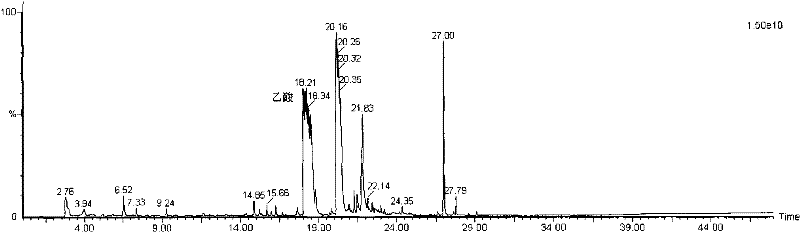
[0030] A certain substrate and the thin slice samples produced by using the substrate are tested. Weigh 1 g of the substrate and place it in a headspace vial and put it into an O·I·Analytical 4552 liquid / solid autosampler. Set the temperature of XFER Line and US Valve to 150°C and 120°C respectively. Preheat the sheet at 40°C for 15 minutes, then blow it to the trap for 30 minutes, dry blow for 6 minutes to remove the water blown into the trap, and then heat the trap to 250°C for 2 minutes for desorption. After desorption, the trap was baked at 260°C for 10 minutes to remove residual substances in the trap. The desorbed substances enter the PerkinElmer Clarus 600 gas chromatograph along with He gas. After temperature programming was carried out according to step (5) in the summary of the invention, the sample separated by chromatography was analyzed by PerkinElmer Clarus 600T mass spectrometer. After completion, repeat the above process for the analysis of the flake samples...
PUM
 Login to View More
 Abstract
Description
Claims
Application Information
 Login to View More