Fiberglass reinforced plastic telegraph pole

A technology of utility poles and glass fiber reinforced plastics, applied in the field of utility poles, can solve problems such as mechanical analysis and molding process that have not yet been discovered, and achieve the effects of meeting mechanical performance requirements, simple structure, and reduced load-bearing function

CN102134931AActive Publication Date: 2011-07-27AEROSPACE RES INST OF MATERIAL & PROCESSING TECH
7 Cites 4 Cited by

Patent Information

Authority / Receiving Office
CN · China
Patent Type
Applications(China)
Current Assignee / Owner
Publication Date
2011-07-27

Smart Images

  • Figure 1
    Figure 1
  • Figure 2
    Figure 2
  • Figure 3
    Figure 3
Patent Text Reader

Abstract

The invention provides a fiberglass reinforced plastic telegraph pole. The telegraph pole comprises a pole body, a cross arm, lead wire seats, hardware fittings, a clamp, an end cap and a sleeve, wherein the cross arm is arranged on the upper part of the pole body through the clamp; the end cap is arranged on the top end of the pole body; three lead wire seats and the hardware fittings are fixed at two ends of the cross arm and the end cap respectively through bolts; the sleeve is sleeved on the lower part of the pole body; lead wires are fixed between the lead wire seats and the hardware fittings; the pole body is of a hollow conical structure with a uniformly thickened wall, wall thickness variation delta is between 0.15 and 0.2 percent, the wall thickness variation dmax is the maximum wall thickness of the pole body, namely the wall thickness of the lowest end of the pole body, the wall thickness variation dmin is the minimum wall thickness of the pole body, namely the wall thickness of the top end of the pole body, and l is the bus length of the pole body. By adopting the design with a special variable thickness pole body structure, the materials play the best carrying function, and the manufacture cost is reduced; and in the pole body, the fiberglass reinforced plastic flange at the root of the pole body is integrally molded by adopting a winding method, while the telegraph pole is convenient to assemble with the ground, the mechanical performance requirement is met; and the pole body, the cross arm and the lead wire seats are produced by adopting different materials and molding processes, the designable performance, weight reduction and other function requirements are met while corrosion resistance and electric insulation of the telegraph pole are fulfilled.
Need to check novelty before this filing date? Find Prior Art

Description

technical field

[0001] The invention relates to a utility pole, in particular to a glass fiber reinforced plastic utility pole, which belongs to the technical field of composite material and utility pole manufacturing. Background technique

[0002] At present, the poles and towers widely used in domestic overhead transmission lines mainly include concrete poles, steel pipe poles, steel pipe concrete poles, lattice iron towers, etc. Traditional transmission poles and towers generally have defects such as heavy weight, perishability, corrosion or cracking. Difficult to operate and maintain, prone to various safety hazards.

[0003] Glass fiber reinforced resin-based composite materials have the characteristics of high strength, light weight, corrosion resistance, fatigue resistance, durability and electrical insulation performance, and are very suitable for manufacturing transmission towers. The main purposes of research on composite towers at this stage are as follows: [0...

Examples

Embodiment Construction

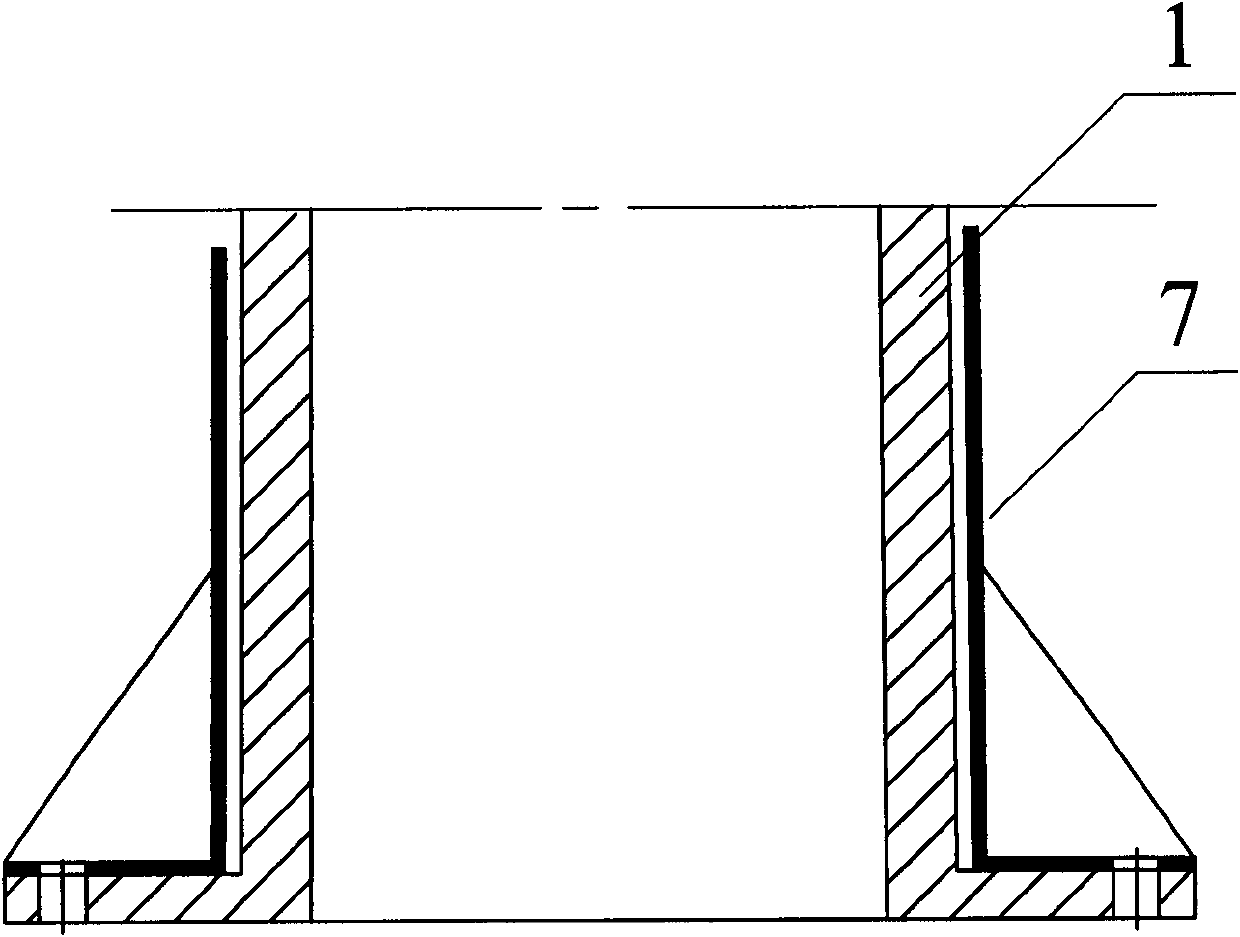
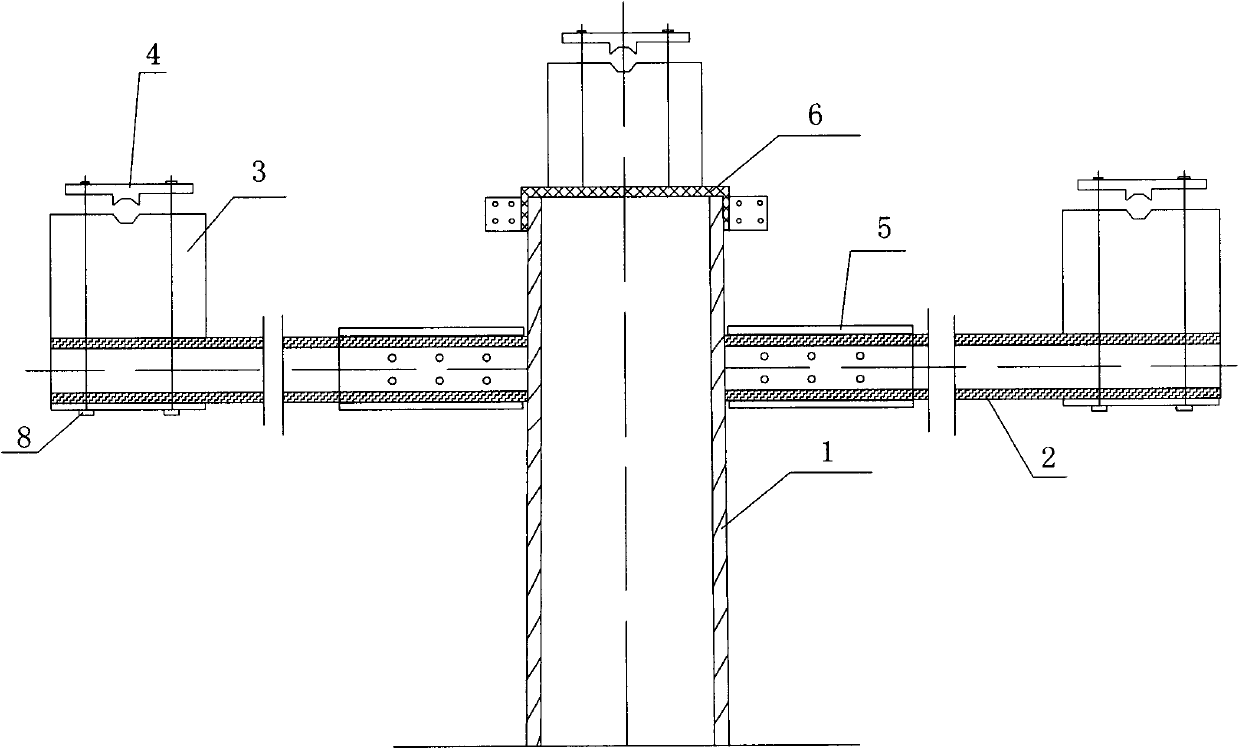
[0039] The invention as figure 2 , 3 As shown, it includes rod body 1, cross arm 2, wire seat 3, fittings 4, clamp 5, end cap 6 and sleeve 7, cross arm 2 is installed on the upper part of rod body 1 through clamp 5, and end cap is installed on the top of rod body 1 6. Three sets of wire holders 3 and fittings 4 are respectively fixed on the two ends of the cross arm 2 and the end cap 6 with screws 8, the lower part of the rod body 1 is fitted with the sleeve 7, and the wires are fixed between the wire holder 3 and the fittings 4.

[0040] 1. Rod body

[0041] The force characteristic of the rod body is that the force on the top of the rod body is the smallest, and the closer to the root of the rod body, the more serious the force is. Therefore, according to its stress characteristics, the rod body is designed in the form of a hollow tapered uniform variable thickness, that is, the thickness at the root of the rod body is the largest, and gradually decreases toward the top of ...