Circuit and method for measuring resistance value of resistive element
A resistance element, a technology for measuring resistance, applied in the direction of measuring resistance/reactance/impedance, measuring electrical variables, using directly heat-sensitive electric/magnetic elements, etc.
- Summary
- Abstract
- Description
- Claims
- Application Information
AI Technical Summary
Problems solved by technology
Method used
Image



Examples
no. 1 example
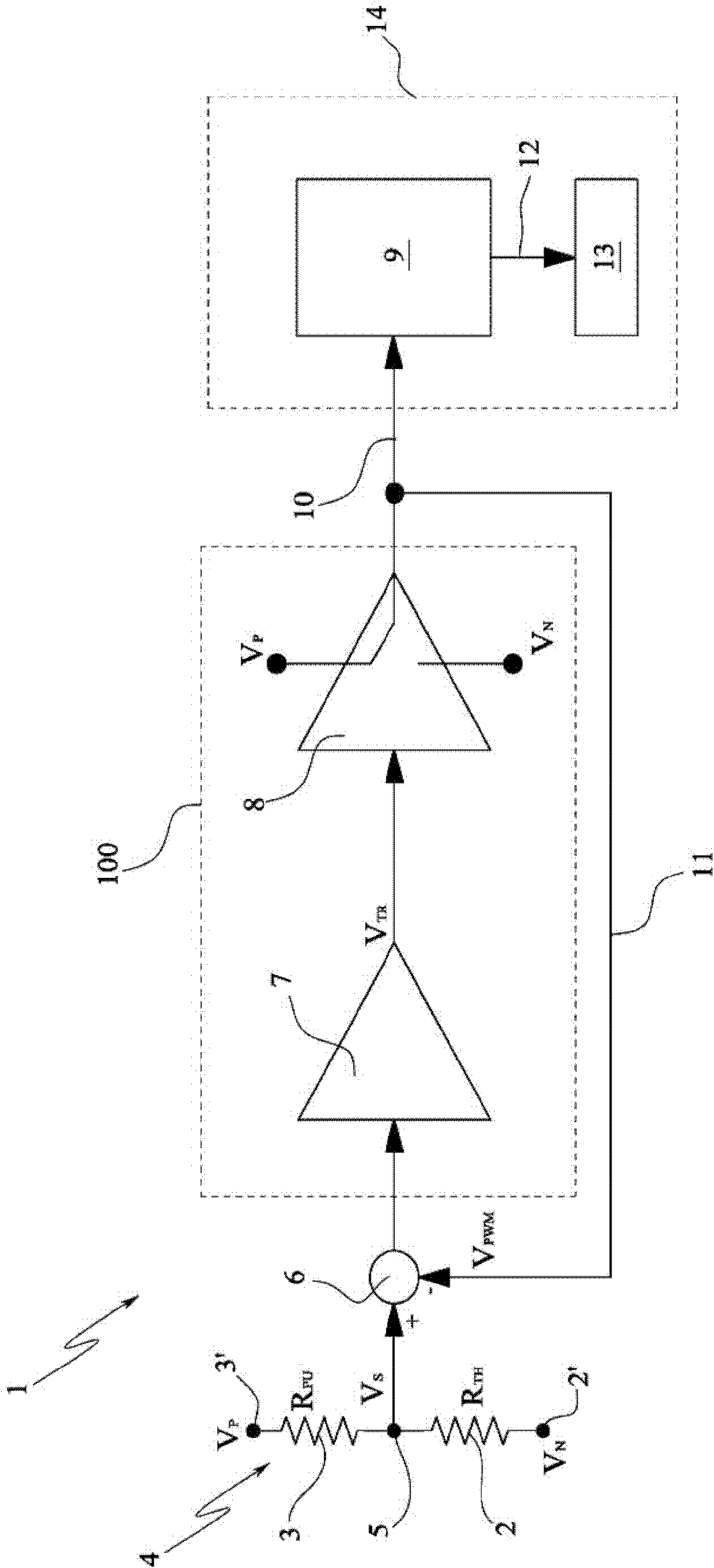
[0081] figure 1 A first embodiment of the invention is shown, which includes a method for measuring the resistance value R of the resistive element 2 TH Circuit 1.
[0082] Resistive element 2 is connected in series to have a known resistance value R PU The pull-up resistor 3 to form a voltage divider 4.
[0083] In order to achieve this purpose, the first voltage value V P Provided to the free terminal 3' of the pull-up resistor 3, and the lower second voltage value V N Provided to the free end 2 ′ of the resistive element 2 .
[0084] At the common node 5 of the resistive element 2 and the pull-up resistor 3, the voltage divider 4 produces a voltage signal V that can be calculated according to the following formula S :
[0085]
[0086] The common node 5 is connected to a first input of an adder 6 whose output is connected to the input of a generator pulse width modulation circuit 100 to generate a pulse width modulated (PWM) signal V PWM . The output of the pulse...
PUM
 Login to View More
 Abstract
Description
Claims
Application Information
 Login to View More