This helps you quickly interpret patents by identifying the three key elements:
Problems solved by technology
Method used
Benefits of technology
Problems solved by technology
[0013] However, the methods described in the above-mentioned Patent Documents 1 to 3 and 5 require time for rice washing and water absorption in the pre-steps to achieve sterilization in retort bags, and there is a problem in production efficiency.
In addition, the methods described in the above-mentioned Patent Documents 3 and 4 require a step of cooling the cooked rice, which has problems in production efficiency.
[0014] On the other hand, the production method described in Patent Document 2 is to fill a container or a bag with sticky rice after cooking, and the method described in Patent Document 3 is to fill a container or a bag with rice soaked in water, However, when filling the container or bag, it is necessary to measure the easily sticky rice, and there is a problem in realizing the production line in the production process.
In addition, the method described in Patent Document 5 is to fill the container with rice that has a water content of 15% to 40% and has been heat-treated after steps such as washing with water. However, since the processed rice is easy to stick, Therefore, the metering is unstable when filling the container, and there are problems in realizing the production line in the production process
Method used
the structure of the environmentally friendly knitted fabric provided by the present invention; figure 2 Flow chart of the yarn wrapping machine for environmentally friendly knitted fabrics and storage devices; image 3 Is the parameter map of the yarn covering machine
View more
Image
Smart Image Click on the blue labels to locate them in the text.
Viewing Examples
Smart Image
Click on the blue label to locate the original text in one second.
Reading with bidirectional positioning of images and text.
Smart Image
Examples
Experimental program
Comparison scheme
Effect test
Embodiment 1
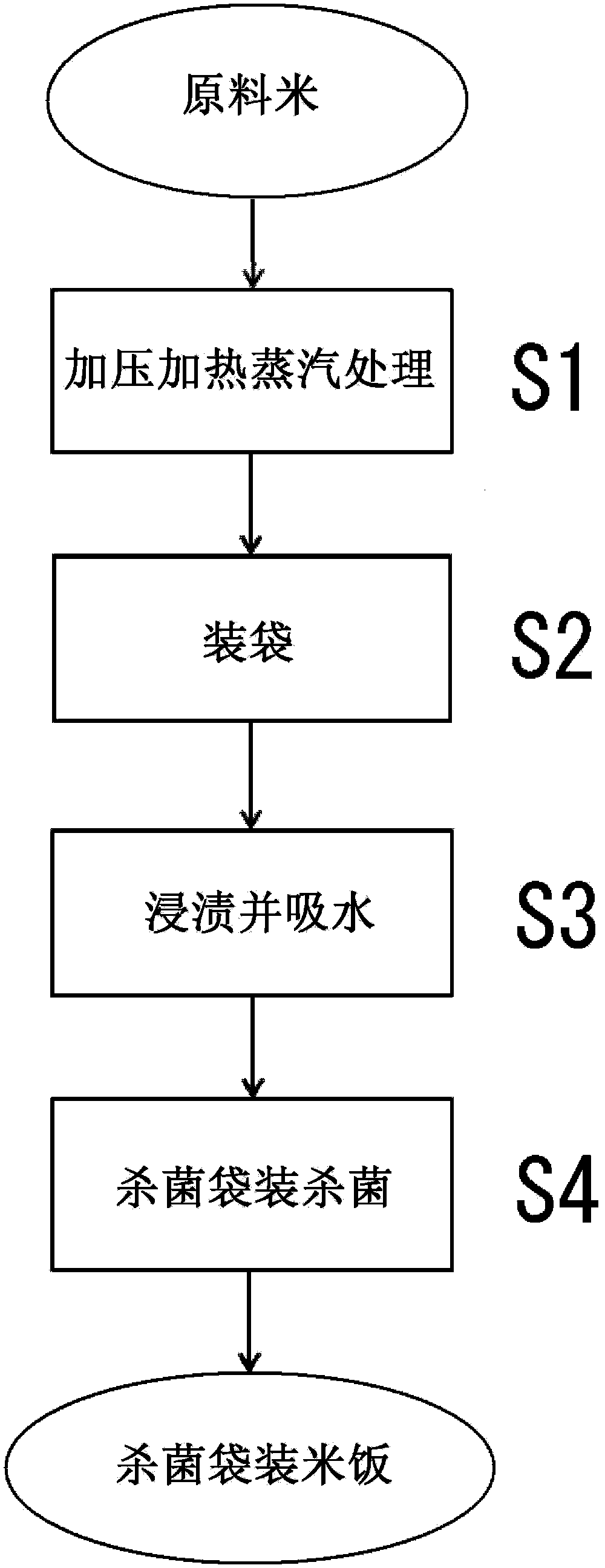
[0091] In order to obtain 500g of paella-style retort rice (rice with a core) with an inner content of 55% moisture, 178g of long-grain rice (Puntal rice produced in Spain) with a moisture content of 12% was used. The non-washed rice was placed in a retort (manufactured by Japan Biocon Co., Ltd., steam circulation cooking and sterilizing device 100-1B), and processed under pressurized heating steam at a pressure of 0.14 MPa and a temperature of 125°C for 2 minutes.
[0092] Then, the processed non-washed rice and 96g of warm water at 60°C and 226g of seasoning liquid at 60°C containing 68g of solids such as cuttlefish and shrimp were filled and sealed in a retort bag, and a 60% headspace was ensured.
[0093] Then, in order to make the water and the seasoning liquid absorb water and infiltrate the non-washed rice and the solid matter, slow souring was carried out for 25 minutes, and inversion was performed 5 times during that time.
[0097] To obtain 500g of retort-packed white rice (sticky rice) with a moisture content of 62% (sticky rice), 218g of long-grain rice (Puntal rice produced in Spain) with a moisture content of 13% was used, and the non-washed rice was Put it in a retort (manufactured by Nippon Biocon Co., Ltd., steam circulation cooking and sterilizing device 100-1B), and process it for 3 minutes under pressurized heating steam at a pressure of 0.18 MPa and a temperature of 130°C.
[0098] Then, 282 g of the treated non-washed rice and 80° C. of warm water were filled and sealed in a sterilization bag, and a head space of 60% was ensured.
[0099] Then, in order to absorb and infiltrate water into the non-washed rice, it was slowly soaked for 35 minutes, during which time it was reversed 5 times.
[0100] Finally, as usual, retort sterilization was carried out in which the temperature was raised for 22 minutes, the center of the product was heated at 115°C for 35 minutes, and then the temperat...
the structure of the environmentally friendly knitted fabric provided by the present invention; figure 2 Flow chart of the yarn wrapping machine for environmentally friendly knitted fabrics and storage devices; image 3 Is the parameter map of the yarn covering machine
Login to View More
PUM
Login to View More
Abstract
Provided is a method for producing retort rice that shortens the pretreatment time to achieve retort sterilization, improves production efficiency, and enables production steps to be lined up. This production method is characterized in that the uncooked rice is subjected to pressurized heating steam treatment, a thin alpha layer is formed on the surface of the rice grain, and the center portion is made porous, and the rice grain is immediately mixed with a predetermined amount of boiled rice without cooling. The rice liquid is filled and sealed in the container together, the rice grains are soaked in the rice cooking liquid and absorb water, the water absorption state of the rice grains and the amount of the rice cooking liquid in the container are adjusted, and sterilization is carried out in a retort bag.
Description
technical field [0001] The present invention relates to a method for producing retort rice using a heat-resistant container such as a retort bag, and to retort rice produced by the method. Background technique [0002] In recent years, various retort-packed rice that is soaked in hot water or can be eaten only by heating in a microwave oven has been sold on the market, and many methods of making the retort-packed rice have also been proposed (for example, refer to sudden patent documents 1-2). 5.). [0003] Patent Document 1 describes a method of manufacturing retort-packed rice by sequentially performing a heating and heating step, a heat sterilization step, and a cooling step. The sealed bag with an air content of 25-40% is heated to a predetermined temperature at a product temperature of 70-90°C every 1-2 minutes at a rotational speed of 1-15rpm and half-rotated to a predetermined temperature. The heating and sterilization step is to maintain the predetermined temperatur...
Claims
the structure of the environmentally friendly knitted fabric provided by the present invention; figure 2 Flow chart of the yarn wrapping machine for environmentally friendly knitted fabrics and storage devices; image 3 Is the parameter map of the yarn covering machine
Login to View More
Application Information
Patent Timeline
Application Date:The date an application was filed.
Publication Date:The date a patent or application was officially published.
First Publication Date:The earliest publication date of a patent with the same application number.
Issue Date:Publication date of the patent grant document.
PCT Entry Date:The Entry date of PCT National Phase.
Estimated Expiry Date:The statutory expiry date of a patent right according to the Patent Law, and it is the longest term of protection that the patent right can achieve without the termination of the patent right due to other reasons(Term extension factor has been taken into account ).
Invalid Date:Actual expiry date is based on effective date or publication date of legal transaction data of invalid patent.


 Login to View More
  Login to View More