Compressed storage and construction method of two-way multi-step deBruijn graph
What is AI technical title?
AI technical title is built by Patsnap AI team. It summarizes the technical point description of the patent document.
A compression storage, two-way multi-step technology, applied in special data processing applications, instruments, electrical digital data processing, etc., to reduce the memory consumption of a single machine and improve the speed of splicing.
Active Publication Date: 2013-05-08
SHENZHEN INST OF ADVANCED TECH
View PDF5 Cites 27 Cited by
Summary
Abstract
Description
Claims
Application Information
AI Technical Summary
This helps you quickly interpret patents by identifying the three key elements:
Problems solved by technology
Method used
Benefits of technology
Problems solved by technology
[0007] The technical problem to be solved by the present invention is to improve the running speed of sequence splicing in the prior art and reduce the memory consumption of a single machine
Method used
the structure of the environmentally friendly knitted fabric provided by the present invention; figure 2 Flow chart of the yarn wrapping machine for environmentally friendly knitted fabrics and storage devices; image 3 Is the parameter map of the yarn covering machine
View more
Image
Smart Image Click on the blue labels to locate them in the text.
Viewing Examples
Smart Image
Click on the blue label to locate the original text in one second.
Reading with bidirectional positioning of images and text.
Smart Image
Examples
Experimental program
Comparison scheme
Effect test
Embodiment 1
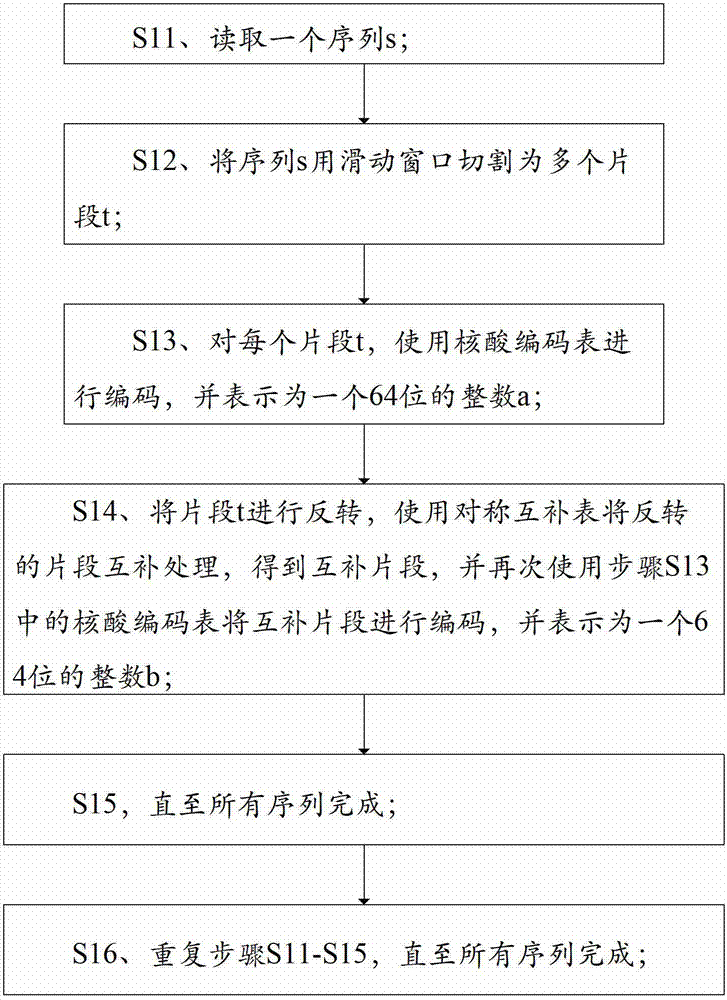
[0058] A method for compressing storage and constructing a bidirectional multi-step deBruijn graph provided by an embodiment of the present invention, comprising
[0059] Compress storage steps, specifically
[0060] S11. Read a sequence s;
[0061] S12. Cut the sequence s into multiple segments t with a sliding window of length k; where 0<k<32 and k is an odd number.
[0062] S13. For each fragment t, use the nucleic acid coding table {A:00, C:01, G:10, T:11} to encode, and represent it as a 64-bit integer a;
[0063] S14. Reverse the character string of segment t, and use the symmetrical complementary table {A->T, C->G, G->C, T->A} to change each character in the reversed character string into its Complementary characters, obtain the string v of complementary characters, and use the nucleic acid coding table in step S13 again to encode the string v, and represent it as a 64-bit integer b;
[0064] S15, taking the maximum number of the integer a and the integer b as the ma...
Embodiment 2
[0078] Another embodiment of the present invention provides a compression storage and construction method of a bidirectional multi-step deBruijn graph, including
[0079] Compress storage steps, specifically
[0080] S11. Read a sequence s;
[0081] S12. Cut the sequence s into multiple segments t with a sliding window of length k; where 0<k<32 and k is an odd number.
[0082] S13. For each fragment t, use the nucleic acid coding table {A:00, C:01, G:10, T:11} to encode, and represent it as a 64-bit integer a;
[0083] S14, reverse the segment t, use the symmetrical complementation table to complement the reversed segment to obtain a complementary segment, and use the nucleic acid coding table in step S13 to encode the complementary segment again, and express it as a 64-bit integer b ;
[0084] S15, taking the maximum number of the integer a and the integer b as the marker number of the k molecules of the segment t and the complementary segment v;
[0085] S16. Steps S11-S...
the structure of the environmentally friendly knitted fabric provided by the present invention; figure 2 Flow chart of the yarn wrapping machine for environmentally friendly knitted fabrics and storage devices; image 3 Is the parameter map of the yarn covering machine
Login to View More
PUM
Login to View More
Abstract
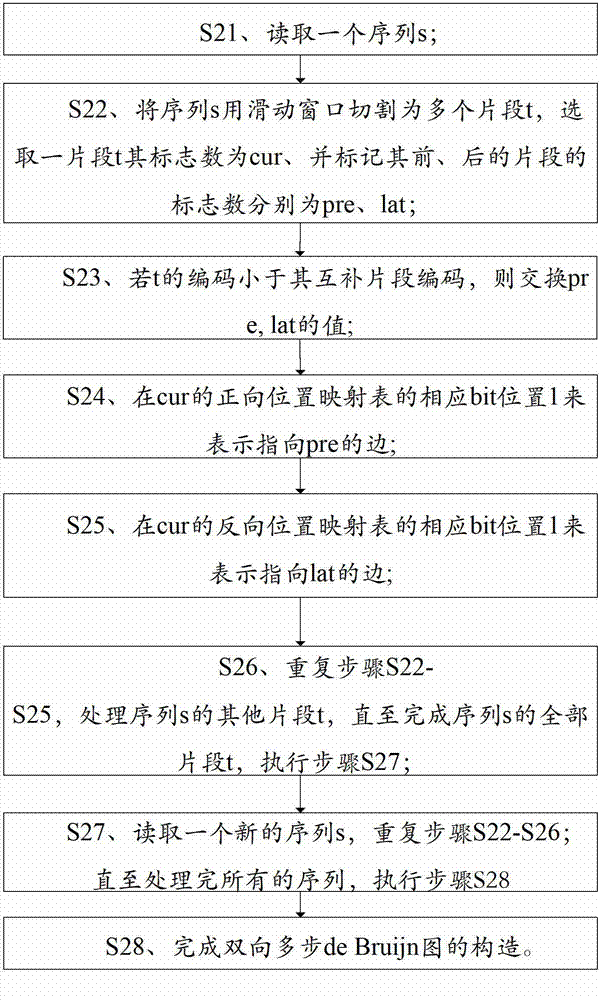
The invention relates to a compressed storage and construction method of a two-way multi-step de Bruijn graph, and the compressed storage and construction method of the two-way multi-step de Bruijn graph includes compressed storage steps and de Bruijn graph construction steps. The compressed storage and construction method of the two-way multi-step de Bruijn graph includes the steps of (1) carrying out a structure optimization for the de Bruijn graph by combining with the characteristics of the deoxyribonucleic acid (DNA) order complementary double-helix structure, and halving nodes of the graph to be stored by using two-way multi-step de Bruijn graph, (2) using a compressed storage technology of the two-way multi-step de Bruijn graph to enable memory consumption of storing the two-way multi-step de Bruijn graph to be controlled within 100 times size of a reference sequence so that the problem that the sequence-assembled original de Bruijn graph scale is enormous unusually so as to bring a storage pressure to the memory consumption can be solved, and (3) constructing two-way multi-step de Bruijn graph, the DNA sequence assembling problem being capable of being decomposed into the edge fusant problem, and suitable for parallel computing.
Description
【Technical field】 [0001] The invention relates to the field of gene sequencing, in particular to a compression storage and construction method of a bidirectional multi-step deBruijn graph. 【Background technique】 [0002] The sequence fragments generated by the next-generation gene sequencing technology have the characteristics of short sequences, high coverage, and additional paired-end information, which makes the original traditional sequence assembly technology unusable and increases the complexity and difficulty of sequence assembly technology. In the face of massive data, efficient sequence assembly technology has become the key to processingsequencing data. [0003] Sequence splicing technical problems are mainly transformed into graph theory knowledge for solution. At present, there are two main ways to solve the problem of sequence splicing technology. One approach is the traditional method of overlapping first and then expanding, that is, the OLC (Overlap-Layout-...
Claims
the structure of the environmentally friendly knitted fabric provided by the present invention; figure 2 Flow chart of the yarn wrapping machine for environmentally friendly knitted fabrics and storage devices; image 3 Is the parameter map of the yarn covering machine
Login to View More
Application Information
Patent Timeline
Application Date:The date an application was filed.
Publication Date:The date a patent or application was officially published.
First Publication Date:The earliest publication date of a patent with the same application number.
Issue Date:Publication date of the patent grant document.
PCT Entry Date:The Entry date of PCT National Phase.
Estimated Expiry Date:The statutory expiry date of a patent right according to the Patent Law, and it is the longest term of protection that the patent right can achieve without the termination of the patent right due to other reasons(Term extension factor has been taken into account ).
Invalid Date:Actual expiry date is based on effective date or publication date of legal transaction data of invalid patent.



 Login to View More
  Login to View More