
Photochromic polymers containing spiro group and its synthetic method
A photochromic and polymer technology, which is applied in the direction of color-changing fluorescent materials, chemical instruments and methods, etc., can solve the problems of fatigue resistance and low application range, and achieve good photochromic performance, molecular weight increase, and device film-forming performance Improved effect
- Summary
- Abstract
- Description
- Claims
- Application Information
AI Technical Summary
Problems solved by technology
Method used
Image

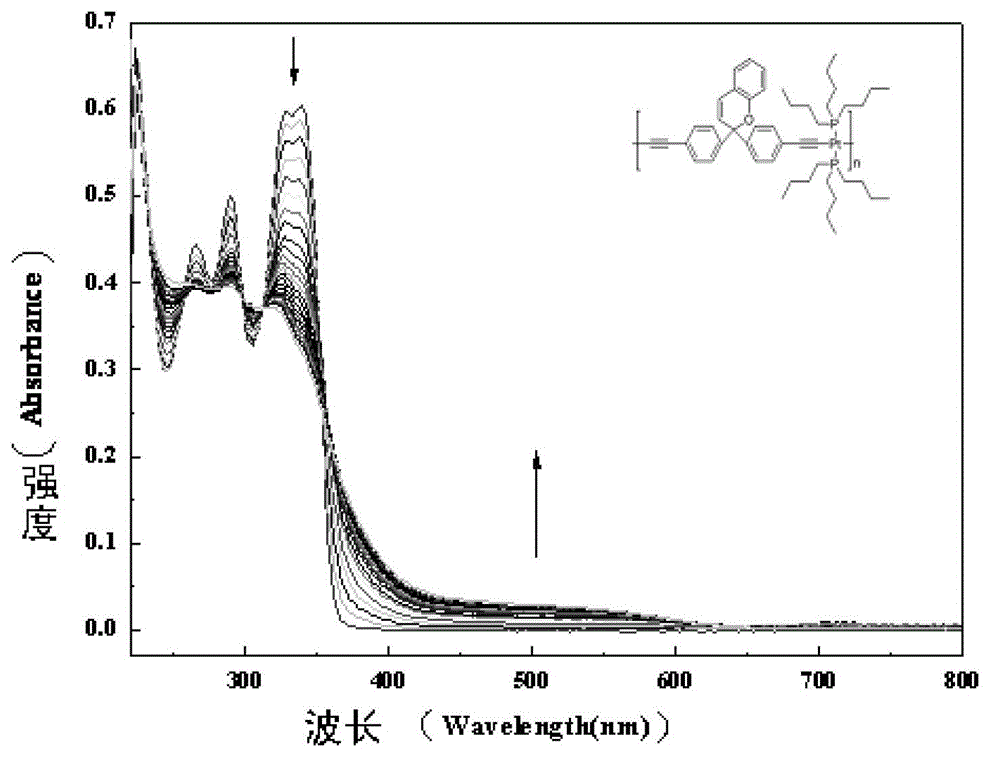
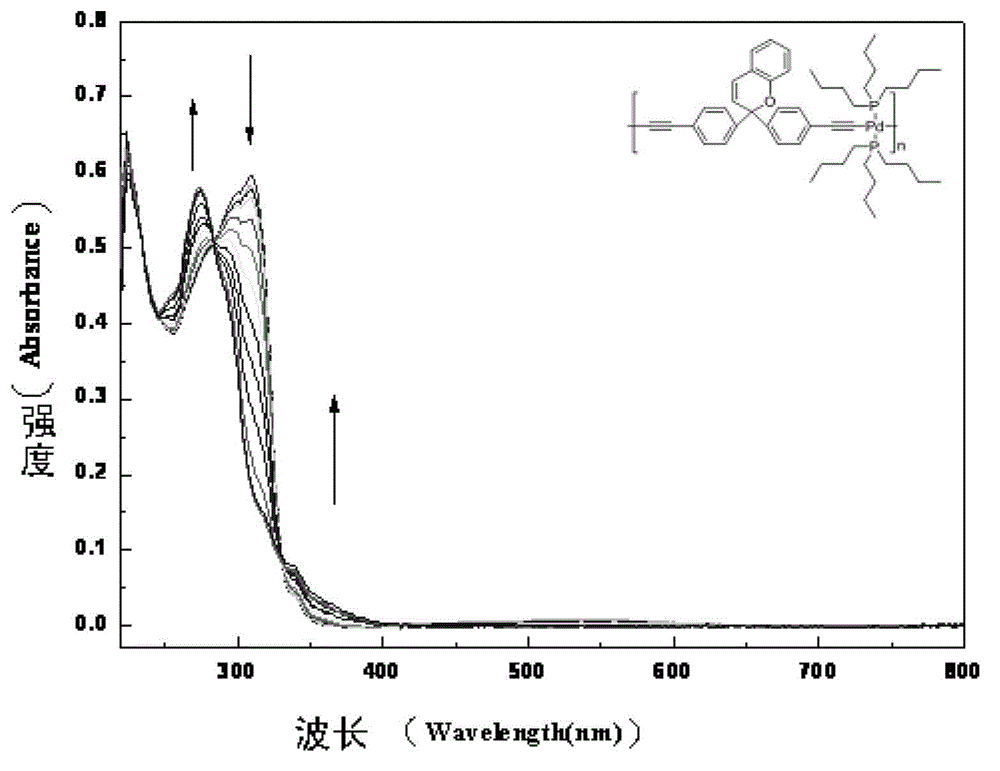
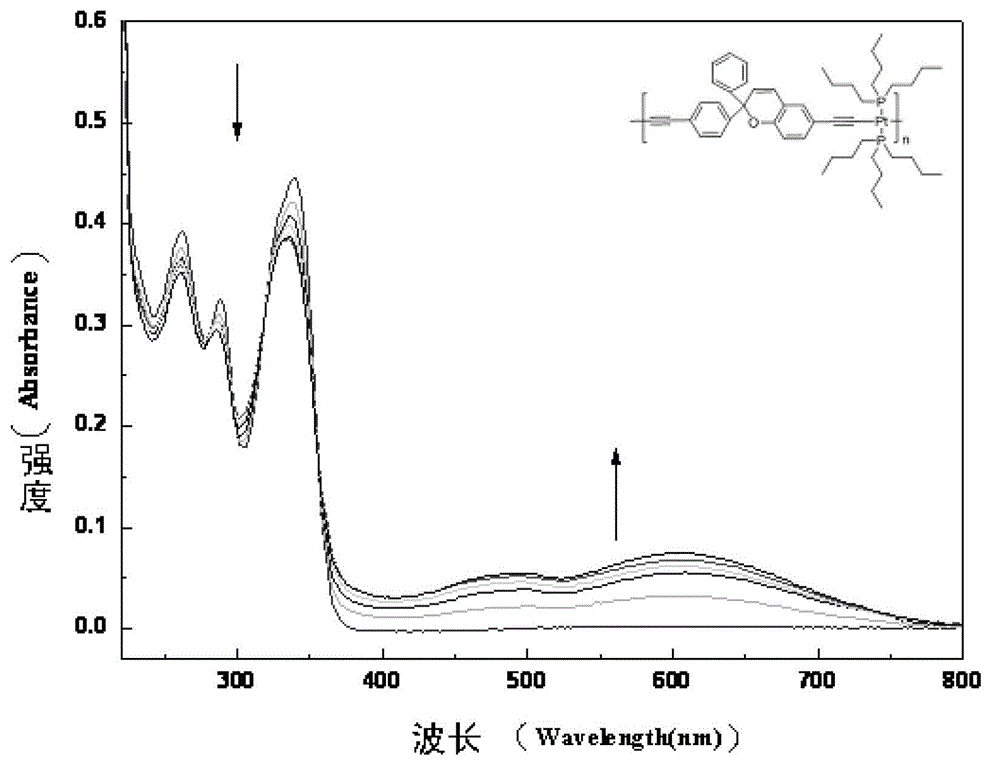
Examples
Embodiment 1
[0045] The synthetic method of photochromic polymer 1 containing spiro group, comprises the following steps:
[0046] Step 1. Using trimethylsilylacetylene as a raw material, react with butyl lithium and 4,4'-dibromobenzophenone at -78°C under nitrogen protection conditions to generate hydroxyl-containing terminal alkyne bonds in equal amounts compound;
[0047] The reaction formula is:
[0048]
[0049] The specific operation is: add 1.67g (17mmol) TMSA to a 250ml three-necked flask, add 30ml anhydrous tetrahydrofuran, cool to -78°C, slowly add 6.5ml (15.6mmol) of 2.4M butyllithium solution dropwise, and keep warm for 30min. 4.82 g (14.2 mmol) of 4,4'-dibromobenzophenone was added. After 12 hours, deionized water and 3.7 g (14.2 mmol) of tetrabutylammonium fluoride were added. The organic layer was extracted with dichloromethane, spin-dried and passed through the column with dichloromethane:petroleum ether=3:1 to obtain a light yellow solid m=5.23g, η=98%;
[0050] The...
Embodiment 2
[0087] The synthetic method of photochromic polymer 2 containing spiro group, comprises the following steps:
[0088] Step 1. Using trimethylsilylacetylene as a raw material, under the condition of nitrogen protection at -78°C, through the reaction of butyl lithium and 4-bromobenzophenone in equal amounts to generate a hydroxyl-containing terminal alkyne bond compound;
[0089] The reaction formula is:
[0090]
[0091] The specific operation is: add 1.67g (17mmol) TMSA to a 250ml three-necked flask, add 2.4g (24mmol) TMSA to a 250ml three-necked flask, add 30ml anhydrous tetrahydrofuran, and cool to -78°C. Add 8.8ml (22mmol) of 2.4M butyllithium solution dropwise slowly, and keep warm for 30min. Add 5.22 g (20 mmol) of 4 dibromobenzophenone. After 12 hours, deionized water and 5.23 g (20 mmol) of tetrabutylammonium fluoride were added. The organic layer was extracted with dichloromethane, spin-dried and passed through the column with dichloromethane:petroleum ether=3:1 ...
Embodiment 3
[0128] The synthetic method of photochromic polymer 3 containing spiro group, comprises the following steps:
[0129] Step 1, the same as Step 1 in Example 2 to obtain a hydroxyl-containing terminal acetylenic bond compound.
[0130] Step 2, the product obtained in step 1 is dehydrated with 4,4'-biphenyldiphenol under the catalysis of pyridine p-toluenesulfonate with a mole fraction ratio of 5% through three times the equivalent of dehydrating agent trimethyl ortho acid ring-closing reaction to obtain a corresponding spiro-type photochromic unit;
[0131] The reaction formula is:
[0132]
[0133] The specific operation is: add 1.5g (5.2mmol) of bromide, 0.46g (2.5mmol) of 4,4'-biphenol, 0.07g (0.28mmol) of pyridine p-toluenesulfonate (PPTS) into the reaction tube, nitrogen Under atmosphere, 1.7 ml (15.6 mmol) of trimethyl orthoacid was added, and then 25 ml of 1,2-dichloroethane was added, and the mixture was stirred at 85° C. for 12 hours. Pass through the column with ...
PUM
 Login to View More
 Abstract
Description
Claims
Application Information
 Login to View More