AI technical title is built by PatSnap AI team. It summarizes the technical point description of the patent document.
A liquid crystal display panel and auxiliary device technology, which is applied to the device for coating liquid on the surface, pre-treated surface, optics, etc., and can solve problems such as afterimages
Active Publication Date: 2013-12-25
BEIJING BOE OPTOELECTRONCIS TECH CO LTD
View PDF6 Cites 2 Cited by
Summary
Abstract
Description
Claims
Application Information
AI Technical Summary
This helps you quickly interpret patents by identifying the three key elements:
Problems solved by technology
Method used
Benefits of technology
Problems solved by technology
[0010] Embodiments of the present invention provide an auxiliary device for curing liquid crystal display panel frame sealant and a curing method, which are used to avoid the problem of afterimages caused by contact between liquid crystal molecules and frame sealant during the ultraviolet curing process of liquid crystal display panels, and improve the display of liquid crystal displays. quality
Method used
the structure of the environmentally friendly knitted fabric provided by the present invention; figure 2 Flow chart of the yarn wrapping machine for environmentally friendly knitted fabrics and storage devices; image 3 Is the parameter map of the yarn covering machine
View more
Image
Smart Image Click on the blue labels to locate them in the text.
Viewing Examples
Smart Image
Click on the blue label to locate the original text in one second.
Reading with bidirectional positioning of images and text.
Smart Image
Examples
Experimental program
Comparison scheme
Effect test
Embodiment 1
[0037] Embodiment 1: The curing auxiliary device includes two substrates.
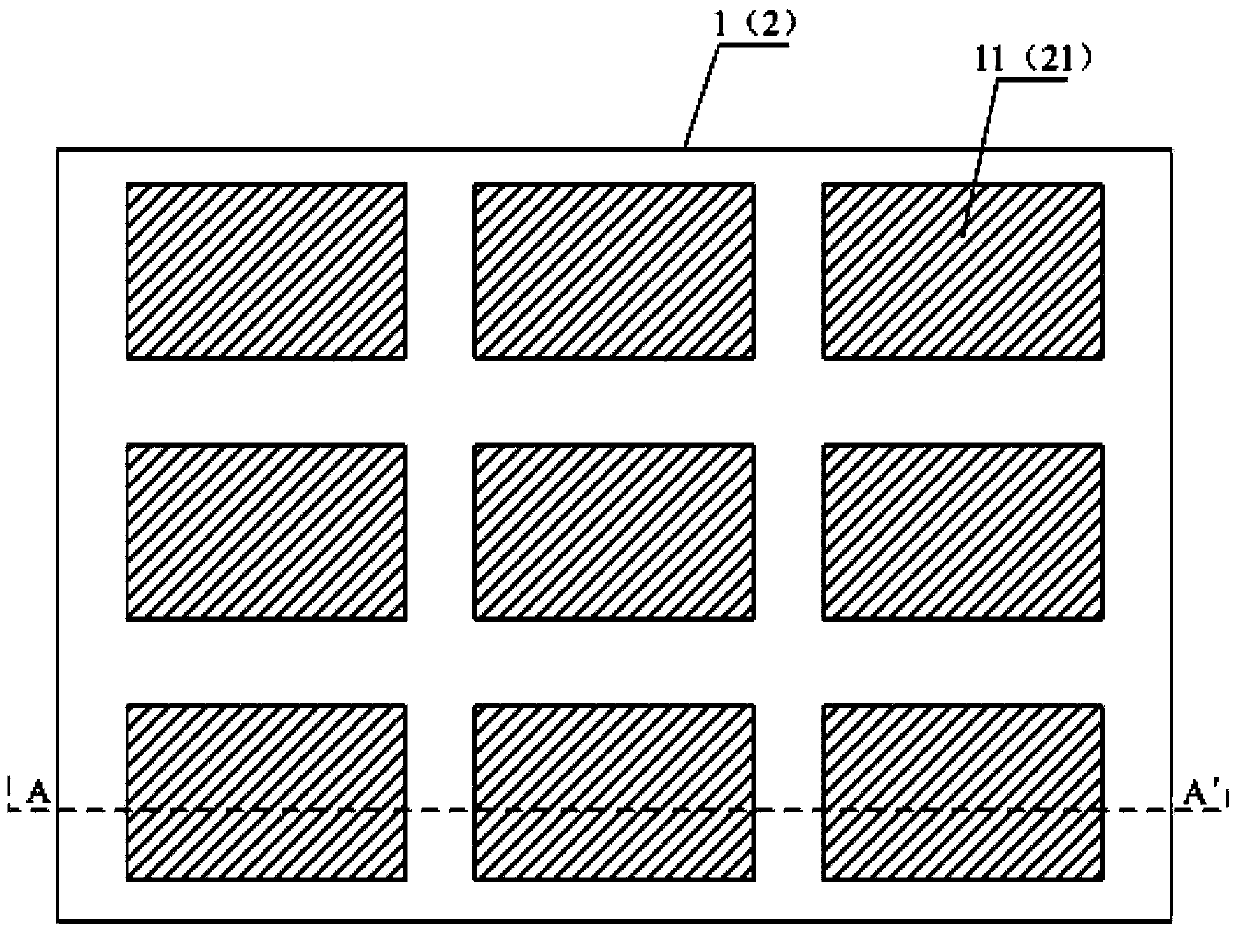
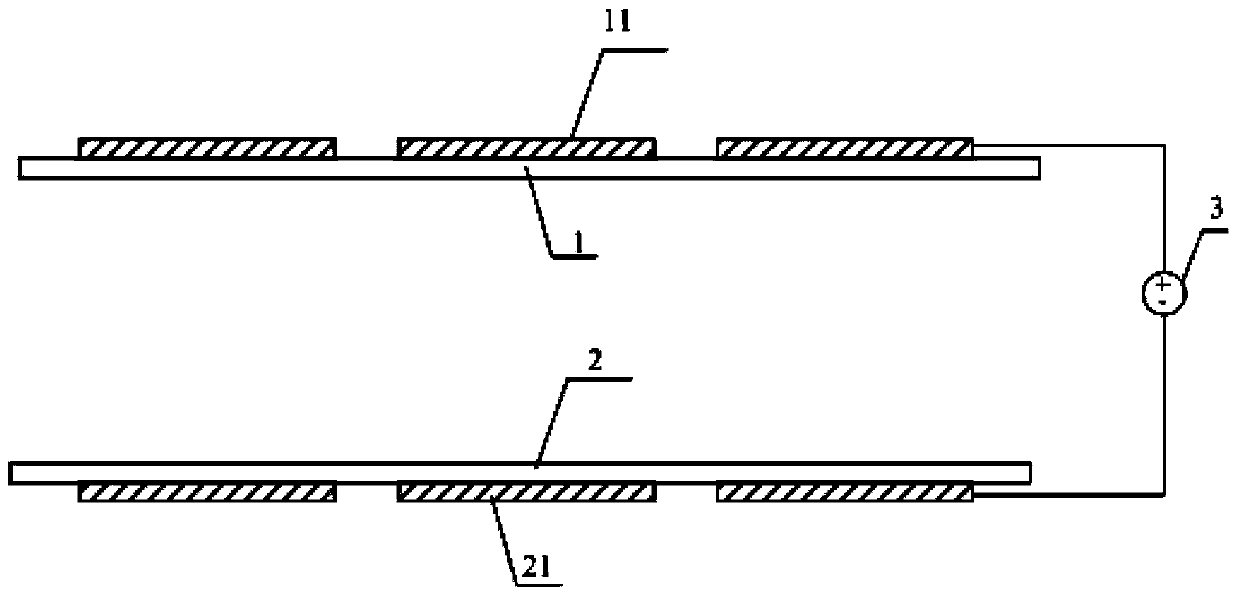
[0038] see figure 1 with figure 2 , figure 1 It is a schematic diagram of the top view of the curing auxiliary device, figure 2 for figure 1 A cross-sectional view of the curing aid shown in the A-A' direction, including:
[0039] The first substrate 1 and the second substrate 2 arranged oppositely;
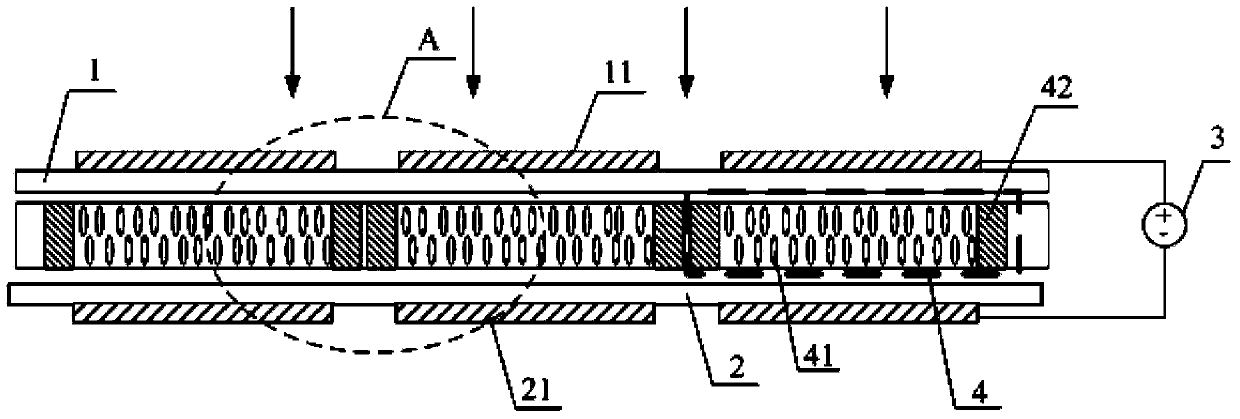
[0040] The first substrate 1 is provided with opaque regions distributed in a matrix and light-transmitting regions between adjacent opaque regions; each opaque region of the first substrate 1 is provided with a first electrode 11; the second substrate A second electrode 21 is provided on the region corresponding to the opaque region of the first substrate 1 on the first substrate 1 .
[0041] The first electrode and the second electrode may be planar, that is, electrodes without any openings; or
[0042] The first electrode is a planar electrode, and the second electrode is an electrode with an ...
Embodiment 2
[0071] Embodiment 2: The curing auxiliary device only includes one substrate.
[0072] see Figure 7 , curing aids include:
[0073] The first substrate 1, the opaque regions distributed in a matrix on the first substrate 1 and the translucent regions between adjacent opaque regions;
[0074] First electrodes 110 and second electrodes 120 arranged at intervals are arranged on each opaque area of the first substrate 1 .
[0075] At the same time, voltages are respectively applied to the first electrode 110 and the second electrode 120 , so that a horizontal electric field is formed between the first electrode 110 and the second electrode 120 , and the liquid crystal molecules are distributed in the opaque area covered by the electric field.
[0076] Preferably, see Figure 7 , the opaque area is provided with a reflective layer 15 covering the entire opaque area.
[0077] Preferably, each electrode includes a plurality of strip electrodes extending along the same directio...
the structure of the environmentally friendly knitted fabric provided by the present invention; figure 2 Flow chart of the yarn wrapping machine for environmentally friendly knitted fabrics and storage devices; image 3 Is the parameter map of the yarn covering machine
Login to View More
PUM
Login to View More
Abstract
The invention discloses a liquid crystal display panel frame sealing adhesive curing auxiliary device and curing method which are used for solving the problem of residual images caused by contact of liquid crystal molecules and frame sealing adhesives in the ultraviolet curing process of a liquid crystal display panel, so that display quality of a liquid crystal display is improved. The liquid crystal display panel frame sealing adhesive curing auxiliary device comprises a first substrate, a first electrode and a second electrode, the first substrate comprises light-proof areas in matrix distribution and light-transmitting areas positioned among the adjacent light-proof areas, at least one of the first electrode and the second electrode is positioned on the first substrate, and an electric field is formed between the first electrode and the second electrode.
Description
technical field [0001] The invention relates to the field of display technology, in particular to an auxiliary curing device and curing method for liquid crystal display panel sealant. Background technique [0002] In the field of display technology, such as Thin Film Transistor-Liquid Crystal Display (TFT-LCD) technology field, with the development of liquid crystal display technology, people put forward higher requirements for the display quality of liquid crystal display. Defective phenomena of liquid crystal displays, such as afterimages, are one of the factors restricting display quality. [0003] The so-called afterimage refers to image afterimage. Afterimage is a phenomenon that a static picture remains on the screen for a long time because the liquid crystal molecules cannot be deflected under the control of the signalvoltage. When the liquid crystal molecules are polluted, it is likely to cause the afterimage problem of the liquid crystal display. [0004] After ...
Claims
the structure of the environmentally friendly knitted fabric provided by the present invention; figure 2 Flow chart of the yarn wrapping machine for environmentally friendly knitted fabrics and storage devices; image 3 Is the parameter map of the yarn covering machine
Login to View More
Application Information
Patent Timeline
Application Date:The date an application was filed.
Publication Date:The date a patent or application was officially published.
First Publication Date:The earliest publication date of a patent with the same application number.
Issue Date:Publication date of the patent grant document.
PCT Entry Date:The Entry date of PCT National Phase.
Estimated Expiry Date:The statutory expiry date of a patent right according to the Patent Law, and it is the longest term of protection that the patent right can achieve without the termination of the patent right due to other reasons(Term extension factor has been taken into account ).
Invalid Date:Actual expiry date is based on effective date or publication date of legal transaction data of invalid patent.



 Login to View More
  Login to View More