Porcelain white glass and production technique thereof
What is AI technical title?
AI technical title is built by Patsnap AI team. It summarizes the technical point description of the patent document.
A technology of porcelain white glass and its production process, which is applied in the field of opalescent glass and its production process to achieve the effects of improving product quality, saving costs, and reducing costs
Active Publication Date: 2014-01-01
吴江光华玻璃厂
View PDF3 Cites 9 Cited by
Summary
Abstract
Description
Claims
Application Information
AI Technical Summary
This helps you quickly interpret patents by identifying the three key elements:
Problems solved by technology
Method used
Benefits of technology
Problems solved by technology
It has obvious glass characteristics, and is generally used for lighting equipment and equipment that needs to transmit light without seeing objects, but it is not suitable for making glass products such as cosmetic bottles, wine bottles, and wine glasses that require high appearance
Method used
the structure of the environmentally friendly knitted fabric provided by the present invention; figure 2 Flow chart of the yarn wrapping machine for environmentally friendly knitted fabrics and storage devices; image 3 Is the parameter map of the yarn covering machine
View more
Image
Smart Image Click on the blue labels to locate them in the text.
Viewing Examples
Smart Image
Click on the blue label to locate the original text in one second.
Reading with bidirectional positioning of images and text.
Smart Image
Examples
Experimental program
Comparison scheme
Effect test
Embodiment 1
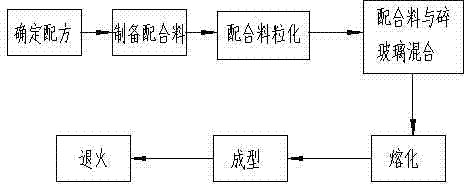
[0030] Such as figure 1 Shown, a kind of porcelain white glass production technique comprises the steps:
[0031] (1) Determine the formula and prepare the batch materials:
[0032] The formula of porcelain white glass includes by weight percentage: 60% batch material, and 40% broken glass. The batch consists of the following components in parts by weight: 58 parts of quartz sand, 14.5 parts of soda ash, 10 parts of aluminum hydroxide, 9.5 parts of sodium fluorosilicate, 6 parts of fluorite, 1 part of Bariumsulfate, 1 part of sodium nitrate, 2.4 parts of calcite, 0.6 part of compound clarifying agent.
[0033] The corresponding raw materials are put into the mixing machine according to the corresponding ratio in the porcelain white glass formula to make batch materials, and the batch materials are in powder form. It can control the uniformity of the batch material to ≥95%, and the water content is 4-6%, which is beneficial to enhance the appearance of the final glass produ...
Embodiment 2
[0040] A porcelain white glass production process, the difference from Example 1 is that the batch material is composed of the following components in parts by weight:
[0043] A porcelain white glass production process, the difference from Example 1 is that the batch material is composed of the following components in parts by weight:
[0044] 55 parts of quartz sand, 15.8 parts of soda ash, 9 parts of aluminum hydroxide, 10 parts of sodium fluorosilicate, 5.5 parts of fluorite, 0.5 parts of sodium nitrate, and 0.5 parts of composite clarifying agent.
[0045] It should be noted that: in the present invention, porcelain white cullet refers to fragments of porcelain white glass, and colorless cullet refers to fragments of colorless glass. In the presen...
the structure of the environmentally friendly knitted fabric provided by the present invention; figure 2 Flow chart of the yarn wrapping machine for environmentally friendly knitted fabrics and storage devices; image 3 Is the parameter map of the yarn covering machine
Login to View More
PUM
Login to View More
Abstract
The invention relates to a porcelain white glass and a production technique thereof. The production technique comprises the following steps: (1) preparation of mixture; (2) melting: melting the mixture and glass cullet in a kiln; (3) forming: forming in a glass forming device; and (4) annealing: annealing in an annealing kiln. The porcelain white glass is prepared from the following raw materials in percentage by weight: 60-90% of mixture and 10-40% of glass cullet. The mixture comprises the following components in parts by weight: 50-60 parts of quartz sand, 13.5-16 parts of soda ash, 10-12 parts of aluminum hydroxide, 9-11 parts of sodium fluosilicate, 5-7 parts of fluorite, 0-1.5 parts of bariumsulfate, 0.5-2 parts of sodiumnitrate, 0-3 parts of calcite and 0.3-0.7 part of composite clarifier. The porcelain white glass with high-whiteness porcelain appearance effect can be obtained by finely regulating and controlling the raw material formula and technological parameters.
Description
technical field [0001] The invention relates to the field of glass manufacturing, in particular to opal glass and a production process thereof. Background technique [0002] Opal glass is a translucent milky white glass that looks like jade. It has obvious glass characteristics, and is generally used for lighting equipment and equipment that needs to pass through light without seeing objects, but it is not suitable for making glass products such as cosmetic bottles, wine bottles, and wine glasses that require high appearance. Contents of the invention [0003] The invention overcomes the disadvantages of the prior art, provides a porcelain white glass production process, and also provides a porcelain white glass produced by the production process. [0004] In order to achieve the above object, the technical solution adopted in the present invention is: a production process of porcelain white glass, which is characterized in that it comprises the following steps: [0005]...
Claims
the structure of the environmentally friendly knitted fabric provided by the present invention; figure 2 Flow chart of the yarn wrapping machine for environmentally friendly knitted fabrics and storage devices; image 3 Is the parameter map of the yarn covering machine
Login to View More
Application Information
Patent Timeline
Application Date:The date an application was filed.
Publication Date:The date a patent or application was officially published.
First Publication Date:The earliest publication date of a patent with the same application number.
Issue Date:Publication date of the patent grant document.
PCT Entry Date:The Entry date of PCT National Phase.
Estimated Expiry Date:The statutory expiry date of a patent right according to the Patent Law, and it is the longest term of protection that the patent right can achieve without the termination of the patent right due to other reasons(Term extension factor has been taken into account ).
Invalid Date:Actual expiry date is based on effective date or publication date of legal transaction data of invalid patent.


 Login to View More
  Login to View More