
Wood rot type edible fungi culture medium and preparation method thereof
A technology of cultivation substrate and edible fungus, applied in application, fertilizer mixture, fertilization device, etc., can solve the problems of difficult treatment of industrial biomass waste, poor operability, environmental pollution, etc., and achieve high edible value and medicinal value , reduce the contamination rate of miscellaneous bacteria, and have significant economic benefits
- Summary
- Abstract
- Description
- Claims
- Application Information
AI Technical Summary
Problems solved by technology
Method used
Image

Examples
Embodiment 1
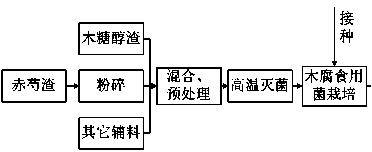
[0037] (1) Grinding of Radix Paeoniae Rubra: The residue of Radix Paeoniae Rubra is crushed into particles with a size of 0.5 mm by an edible fungus sawdust grinder.
[0038] (2) Substrate formula of wood rot type edible fungus: 58% of red peony residue, 30% of xylitol residue, 10% of bran, 1% of corn flour, 0.5% of calcium carbonate, and 0.5% of gypsum. Mix all materials evenly.
[0039] (3) Add lime milk and water to adjust the pH to 7, and control the moisture content to 60%.
[0040] (4) Mixing and pretreatment: Mix all materials evenly according to the above formula.
[0041] (5) High-temperature sterilization: After the matrix is bagged, 0.15MP is used for high-temperature sterilization at 125°C for 2 hours.
[0042] (6) Cultivation of wood-rot edible fungi: After the substrate is cooled, inoculate Pleurotus eryngii, and the management and fruiting process are carried out according to conventional cultivation techniques. The biological efficiency was 75%. The culti...
Embodiment 2
[0044] (1) Grinding of Radix Paeoniae Rubra: The residue of Radix Paeoniae Rubra is crushed into particles with a size of 3mm by an edible fungus sawdust grinder.
[0045] (2) Matrix formula of wood rot type edible fungus: 70% of red peony residue, 12.8% of xylitol residue, 15% of bran, 1% of corn flour, 1% of calcium carbonate, and 0.2% of gypsum. Add milk of lime and water to adjust the pH to 8 and control the moisture content to 65%.
[0046] (3) Mixing and pretreatment: Mix all materials evenly according to the above formula.
[0047] (4) High-temperature sterilization: After the matrix is bagged, 0.15MP is used for high-temperature sterilization at 125°C for 2 hours.
[0048] (5) Cultivation of wood-rot edible fungi: After the substrate is cooled, inoculate Flammulina velutipes.
[0049] (6) Other steps are carried out according to Example 1. Biological efficiency is 105%
Embodiment 3
[0051](1) Grinding of Radix Paeoniae Rubra: The residue of Radix Paeoniae Rubra is crushed into 1mm-sized particles by an edible fungus sawdust grinder.
[0052] (2) Wood rot type edible fungus matrix formula: 45% of red peony residue, 32% of xylitol residue, 5% of bran, 15% of cottonseed hull, 1% of corn flour, 1% of calcium carbonate, and 1% of gypsum. Add milk of lime and water to adjust the pH to 10 and control the moisture content to 70%.
[0053] (3) Mixing and pretreatment: Mix all materials evenly according to the above formula.
[0054] (4) High-temperature sterilization: After the matrix is bagged, 0.15MP is used for high-temperature sterilization at 125°C for 2 hours.
[0055] (5) Cultivation of wood-rot edible fungi: After the substrate is cooled, oyster mushrooms are inoculated, and the management and fruiting process is carried out according to conventional cultivation techniques. The biological efficiency can reach 95%. The first-grade fungus bran formed af...
PUM
 Login to View More
 Abstract
Description
Claims
Application Information
 Login to View More