Double layer composite melt-blown non-woven fabric

A melt-blown non-woven fabric, oblique diameter technology, applied in non-woven fabrics, textiles and papermaking, etc., can solve problems such as user inconvenience, process obstacles, unfavorable production, etc., to improve moisture absorption, fast moisture absorption, reduce surface The effect of specific resistance

CN103774346AInactive Publication Date: 2014-05-07JIANGSU SHENGFANG NANO MATERIAL TECH CO LTD
4 Cites 5 Cited by

Patent Information

Authority / Receiving Office
CN · China
Patent Type
Applications(China)
Current Assignee / Owner
Publication Date
2014-05-07
Estimated Expiration
Not applicable · inactive patent

Smart Images

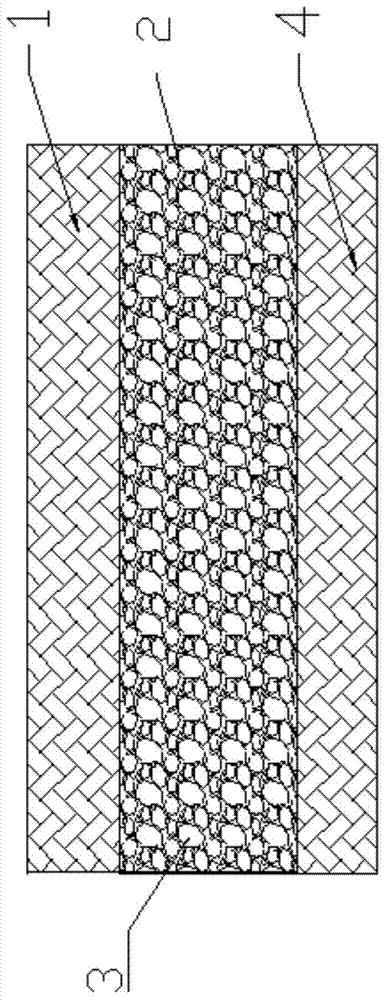
  • Figure 1
    Figure 1
Patent Text Reader

Abstract

The invention discloses a double layer composite melt-blown non-woven fabric, comprising a first substrate layer, a multi-layer oblique injection composite superfine staple fiber layer and a second substrate layer sequentially arranged from the top down. The double layer composite melt-blown non-woven fabric is further provided with a water storage fiber substrate layer between the two substrate layers, so that the hygroscopicity of the fiber surface is improved, the surface ratio resistance is lowered, and the surface static is reduced. Meanwhile, when the double layers are compounded, the superfine staple fiber mesh is included between the upper and lower layers, so that the performance intensity and application functions of the non-woven fabric are increased and added, and the non-woven fabric is ensured to have a soft and uniform fabric surface and has the advantages of rapid moisture absorption speed and being anti-static and flame-retardant.
Need to check novelty before this filing date? Find Prior Art

Description

technical field

[0001] The invention relates to a two-component composite melt-blown nonwoven fabric. Background technique

[0002] Non-woven fabric is a fabric formed without spinning and weaving. It is a composite fiber network structure formed by directional spinning or irregular melt-blowing of short fibers or filaments formed by modifying polypropylene materials. Then it is reinforced by mechanical hot rolling, spunbond or chemical methods. Compared with the traditional process, it has the characteristics of short process flow, fast production speed, high output, low cost and wide application. At present, nonwoven fabrics are widely used in medical and sanitary fabrics, home decoration fabrics, and agricultural fabrics. However, this kind of fiber or filament will generate static electricity due to friction during processing, which will bring obstacles and troubles to the subsequent process, which is not conducive to production. At the same time, it will also bring ma...

Examples

Embodiment Construction

[0014] A two-component composite melt-blown nonwoven fabric includes a first matrix layer 1, a multi-layer oblique jet composite ultrafine short fiber layer 2 and a second matrix layer 4 arranged in sequence from top to bottom.

[0015] Preferably, a water-storage fiber matrix layer 3 is also compounded in the multi-layer oblique-diameter jetted intersecting superfine short fiber layer.

[0016] Preferably, the water-storage fiber matrix layer 3 is interlaced with the multi-layer inclined-diameter injection composite ultrafine short fiber layer to form a whole.

[0017] The two-component composite melt-blown nonwoven fabric is made of short fibers or filaments formed by modifying polypropylene materials for directional spinning or irregular melt-blown struts to form a multi-layer oblique jet composite ultra-fine short fiber layer and storage. The composite fiber network structure composed of water fiber matrix layer, and then the two matrix layers are reinforced by mechanical ...