
Cordyceps sinensis hirsutella-sinensis laccase, encoding gene and application of two
A technology of Trichosporum and Cordyceps sinensis, which is applied in the field of laccase, can solve the problem of not being retrieved, and achieve high expression, great application prospects, and the effect of expanding biological applications
- Summary
- Abstract
- Description
- Claims
- Application Information
AI Technical Summary
Problems solved by technology
Method used
Image

Examples
Embodiment 1
[0045] Example 1: Cultivation of "Bailing" production fungus Cordyceps sinensis
[0046] Source of the strain: Firstly, the natural Cordyceps sinensis was collected from Qinghai, and brought back to Hangzhou for isolation and screening, and the L0106 strain was obtained, and the strain was identified as Hirsutella sinensis, which was preserved in a typical culture in China The collection center, the deposit number is CCTCC No: M2011278, which has been disclosed in the previously applied patent CN102373190A.
[0047] This bacterial classification is inoculated on the slant, and the culture medium formula (this is the liquid formula before solidification, makes the slant after being prepared according to the following ratio) is: glucose 2.0% (w / v, 1% means that 100mL culture medium contains 1g, the same below), corn flour 1.0%, potato juice 0.5%, dextrin 0.5%, yeast powder 0.5%, bran 1.0%, silkworm chrysalis powder 2.0%, peptone 1.0%, magnesium sulfate 0.05%, potassium dihydroge...
Embodiment 2
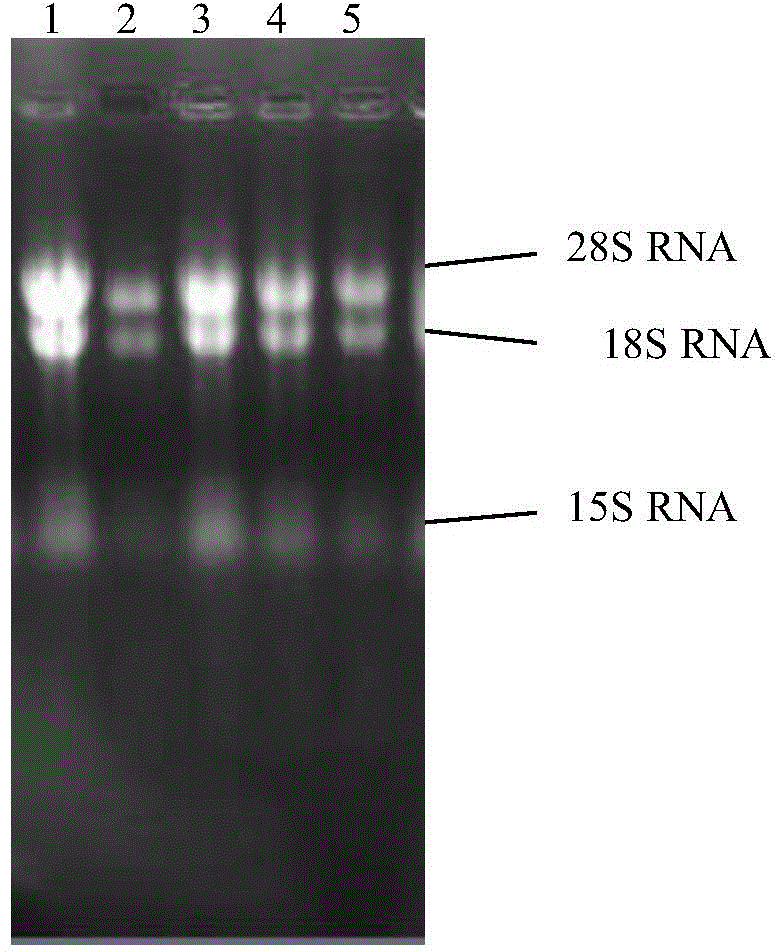
[0048] Example 2: Extraction of total RNA of "Bailing" production fungus Cordyceps sinensis
[0049] Extract total RNA with TRIzol reagent, the steps are as follows:
[0050] 1) Grinding with liquid nitrogen: Put 1 g of fresh bacteria into a mortar, add liquid nitrogen repeatedly to grind until powdery, dispense into pre-cooled 1.5 mL centrifuge tubes, add 1 mL of TRIzol reagent, mix well, and stand on ice. Set aside for 5 minutes to completely separate the nucleic acid-protein complex.
[0051] 2) RNA isolation: Add 0.2 mL of chloroform, shake vigorously for 15 s, let stand on ice for 2-3 min, centrifuge at 4°C, 12000 rpm for 15 min, separate the layers, and take the upper aqueous phase, about 600 μL.
[0052] 3) RNA precipitation: add 500 μL of isopropanol, let stand on ice for 10 minutes, centrifuge at 12000 rpm at 4°C for 10 minutes, and discard the supernatant.
[0053] 4) RNA washing: add 1 mL of 75% (v / v) ethanol, suspend the precipitate, let stand on ice for 10 min, ...
Embodiment 3
[0055] Example 3: Sequencing of the RNA sample of "Bailing" production fungus Cordyceps sinensis
[0056] After extracting the total RNA from the sample, the mRNA was enriched with Oligo(dT) magnetic beads. Add fragmentation buffer to break mRNA into short fragments (200-700bp), use mRNA as a template, use six-base random primers (random hexamers) to synthesize the first cDNA strand, then synthesize the second cDNA strand, and then pass through QiaQuick PCR After the kit is purified and eluted with EB buffer, end repair is performed, polyA is added and sequencing adapters are connected, and then agarose gel electrophoresis is used for fragment size selection, and finally PCR amplification is performed. The built sequencing library is carried out with Illumina GA IIx sequencing. The original image data obtained by sequencing is converted into sequence data through base calling, that is, raw data or raw reads. The reads containing only the adapter sequence in the original sequ...
PUM
| Property | Measurement | Unit |
|---|---|---|
| molecular weight | aaaaa | aaaaa |
Abstract
Description
Claims
Application Information
 Login to View More