Method for improving hard water resistance of magnesium aluminum silicateinorganic gel

A magnesium aluminum silicate and inorganic gel technology, which is applied in the field of improving the hard water resistance of magnesium aluminum silicate inorganic gel, can solve problems such as decline, collapse of "card palace" network structure, thixotropy of gel products, etc., to achieve Effects of extended application range, low cost, and increased dispersion rate

CN104478365AActive Publication Date: 2015-04-01苏州中材非金属矿工业设计研究院有限公司
6 Cites 6 Cited by

Patent Information

Authority / Receiving Office
CN · China
Patent Type
Applications(China)
Current Assignee / Owner
Publication Date
2015-04-01

Smart Images

  • Figure 1
    Figure 1
Patent Text Reader

Abstract

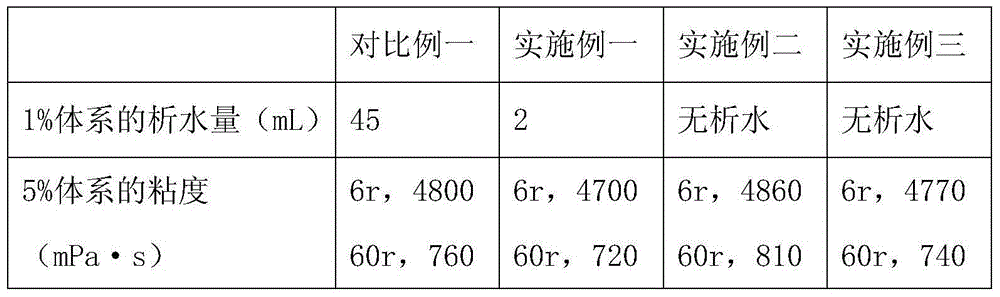
The invention discloses a method for improving hard water resistance of magnesium aluminum silicate inorganic gel. The method comprises steps as follows: (1) adding a modifier to a powdered magnesium aluminum silicate inorganic gel, wherein the modifier is selected from one or more of sodium carbonate, sodium fluoride, sodium phosphate, sodium oxalate, sodium citrate and sodium ethylene diaminetetraacetic acid; (2) after full stirring, heating the gel to the temperature of 30-80 DEG C for 5-20 min while stirring; (3) cooling the gel to the room temperature to obtain the modified magnesium aluminum silicate product. A 1% standard hard water dispersion system is prepared fromthe modified inorganic gel product prepared with the method, and the precipitation quantity of clear water is obviously reduced or even no clear water is precipitatedafter the system is left to stand for 24 h, so that the gel has excellent suspension property in the hard water system, and the problem that existing magnesium aluminum silicate inorganic gel cannot be applied to hard water is solved.
Need to check novelty before this filing date? Find Prior Art

Description

technical field

[0001] The invention relates to a method for improving the hard water resistance of magnesium aluminum silicate inorganic gel. Background technique

[0002] In the prior art, magnesium aluminum silicate inorganic gel is a kind of clay mineral containing magnesium aluminum silicate as raw material, such as smectite, bentonite, bentonite, etc., after raw material crushing, pulping, separation and purification, gelatin The natural inorganic gel product with a certain purity is obtained through processes such as melting and drying.

[0003] Qiu Jun et al. disclosed "Preparation of High Performance Montmorillonite Inorganic Mineral Gel" in the 6th issue of "Chemical Minerals and Processing" in 2007. In this paper, a montmorillonite inorganic mineral gel with excellent performance was prepared by using a purified calcium-based bentonite in Shandong as raw material through sodium, phosphating and gelation processes.

[0004] Chinese invention patent application CN...

Examples

Embodiment 1

[0023] A method for improving the hard water resistance of magnesium aluminum silicate inorganic gel, comprising the following steps: adding 1kg of magnesium aluminum silicate inorganic gel powder and 100g of sodium citrate into a mixer, stirring at a high speed, and heating up while stirring to 60°C, keep for 15 minutes, and cool to room temperature to obtain the modified product.

Embodiment 2

[0025] A method for improving the hard water resistance of magnesium aluminum silicate inorganic gel, comprising the following steps: adding 1kg of magnesium aluminum silicate inorganic gel powder and 100g of sodium oxalate into a mixer, stirring at a high speed, and heating up to Keep at 60°C for 15 minutes, and cool to room temperature to obtain the modified product.

Embodiment 3

[0027] A method for improving the hard water resistance of magnesium aluminum silicate inorganic gel, comprising the steps of: adding 1kg of magnesium aluminum silicate inorganic gel powder, 80g of sodium oxalate, and 20g of sodium citrate into a mixer, and stirring at a high speed, Raise the temperature to 60°C while stirring, keep it for 15 minutes, and cool to room temperature to obtain the modified product.