Unlock instant, AI-driven research and patent intelligence for your innovation.

Pneumatic muscle based intelligent wearable lower limb

A pneumatic muscle and lower limb technology, applied in the field of rehabilitation systems, can solve the problems of bulkiness, thick joints, unfavorable compactness and miniaturization of robots, etc., and achieve the effect of efficient rehabilitation training.

Inactive Publication Date: 2015-04-08
UNIV OF ELECTRONICS SCI & TECH OF CHINA
View PDF8 Cites 26 Cited by
  • Summary
  • Abstract
  • Description
  • Claims
  • Application Information

AI Technical Summary

Problems solved by technology

Motors can achieve precise motion control and are widely used in upper limb rehabilitation robots; however, the torque / mass of motors is relatively low. The rotating joint arm of a rehabilitation robot driven by a motor belongs to the motor-gear-link mechanism, and the motor is concentrated at the joint And the deceleration mechanism makes the joints thick and heavy, and the driving voltage of the motor is high, which is not conducive to the compactness and miniaturization of the robot structure; and the volume of the motor is inversely proportional to the price. To design a lightweight upper limb rehabilitation robot, it is necessary to Choose an expensive micro motor, and the maintenance cost is high; at the same time, the motor drive mode has potential safety hazards, which increases the complexity of the control system
The artificial pneumatic muscle based on muscle bionics simulates the working form of human skeletal muscle. It has good flexibility, high power / mass ratio, strong direct drive capability, good flexibility, low cost, high reliability, easy maintenance and management, light weight and low price. Low cost and other advantages, although its response speed is relatively slow, it can just meet the low-speed working requirements of upper limb rehabilitation robots
[0008] In summary, the current lower limb rehabilitation training robots have not used pneumatic muscles to drive rehabilitation training robots according to the specific conditions of the patient's lower limbs. These robots are either fixed and unable to walk, or they are only driven forcibly, which is not conducive to the rehabilitation of patients. To some extent, the patient's leg may be strained due to the rough and tugging of the rehabilitation machine

Method used

the structure of the environmentally friendly knitted fabric provided by the present invention; figure 2 Flow chart of the yarn wrapping machine for environmentally friendly knitted fabrics and storage devices; image 3 Is the parameter map of the yarn covering machine
View more

Image

Smart Image Click on the blue labels to locate them in the text.
Viewing Examples
Smart Image
  • Pneumatic muscle based intelligent wearable lower limb
  • Pneumatic muscle based intelligent wearable lower limb
  • Pneumatic muscle based intelligent wearable lower limb

Examples

Experimental program
Comparison scheme
Effect test

Embodiment

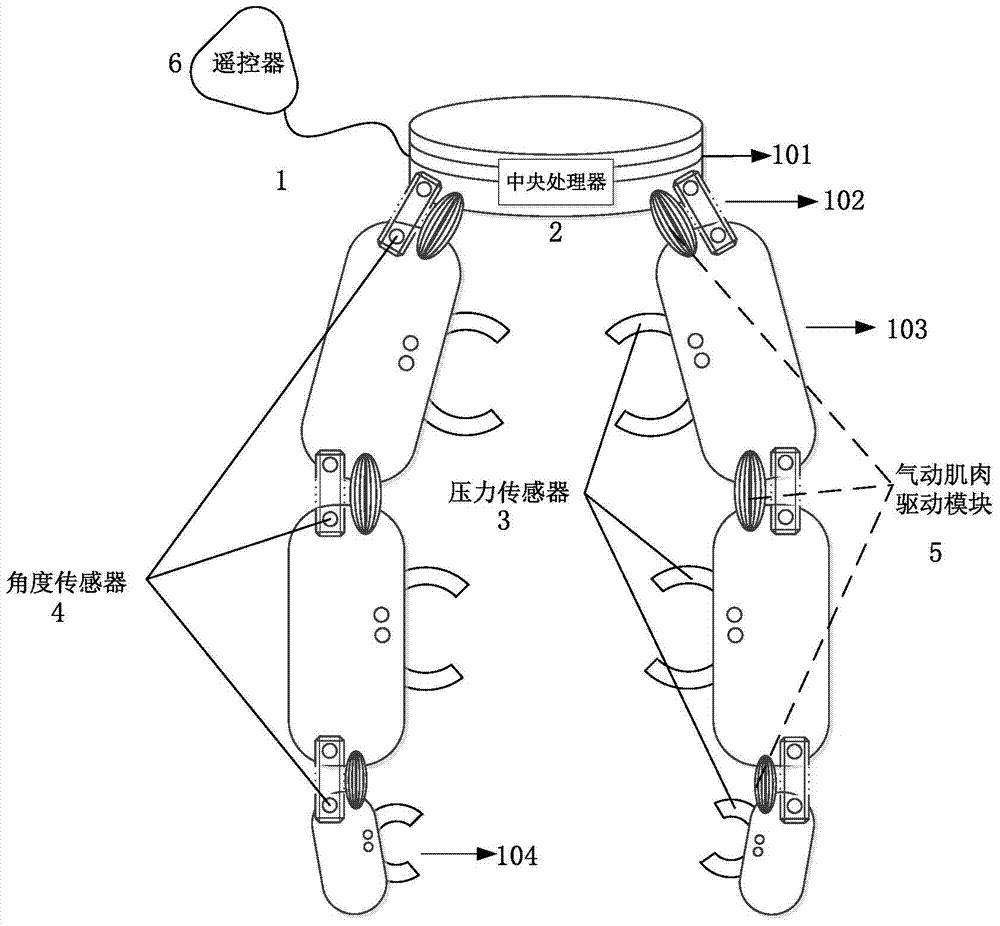
[0031] The human walking process is realized by relying on muscles and bones under the control of the nervous system. From the perspective of mechanism, the human walking process is a complex movement of a multi-degree-of-freedom space mechanism. In the present invention, after the human leg and the exoskeleton mechanical leg are connected, the exoskeleton mechanical leg imitates the gait of the human leg to drive the human leg to move.

[0032] According to the assumption of the dynamic model, both the human leg and the exoskeleton mechanical leg are considered to move on the sagittal plane, that is, the hip, knee, and ankle joints are only flexing and extending, and the actions of each joint in each movement can be decomposed , Statistics to establish a certain model. In each walk, the angle of each joint connection is within a certain range. According to the algorithm, the movement of each joint is decomposed during each walk, and the angle and strength generated during wal...

example

[0047] In this embodiment, after the patient wears the smart wearable lower limbs, the pressure sensor starts to detect the power of the patient's movement, and the angle sensor also detects the movement direction of the patient's joints and the angle θ generated by the movement. In this embodiment , The pressure sensor adopts HBM's U9B pull and pressure sensor, and the angle sensor adopts sst810 dynamic inclination sensor.

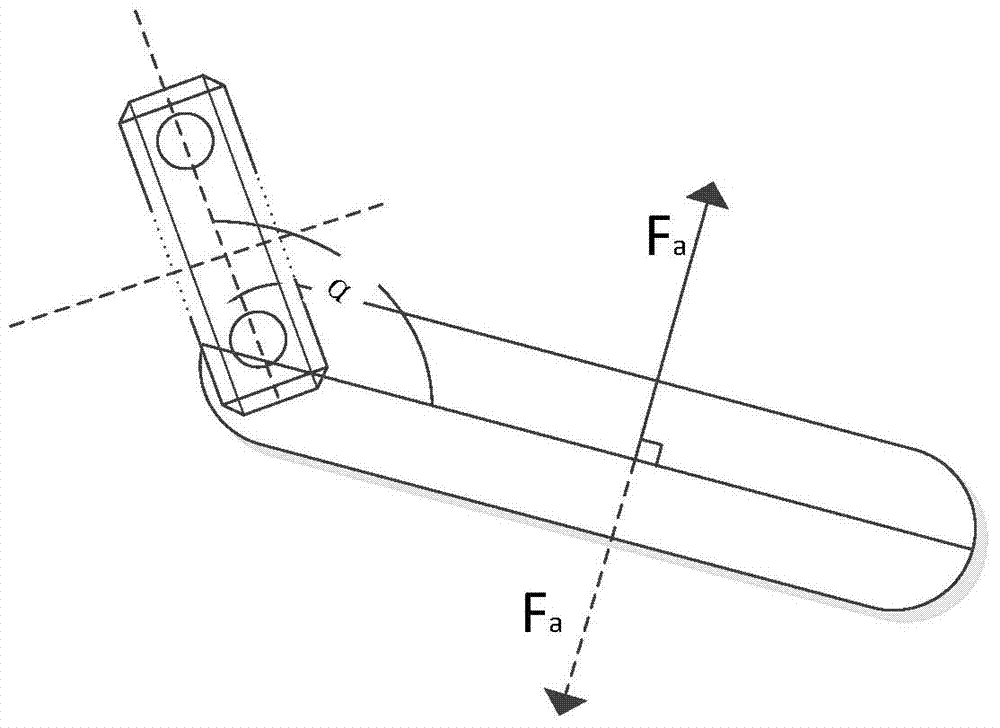
[0048] Such as figure 2 As shown, the active force F detected by the pressure sensor a Can be up or down, but always perpendicular to the fixed plate.

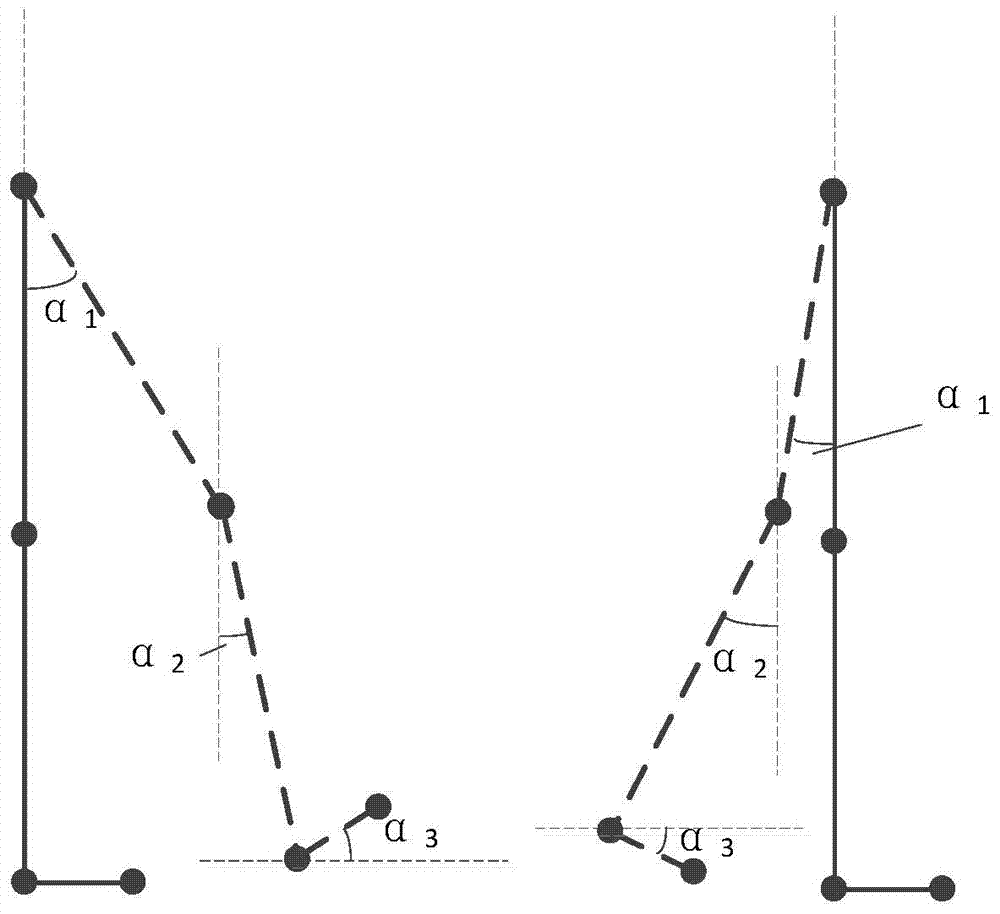
[0049] Such as image 3 As shown, it is assumed that the legs are perpendicular to the horizontal line when standing upright, and the feet are parallel to the horizontal line (the actual leg-shaped angle sensor collects the change angle of the thigh fixed plate as α 1 , the changing angle of the calf fixation plate is α 2 , the change angle of the foot is α 3 , the active force acquired by the press...

the structure of the environmentally friendly knitted fabric provided by the present invention; figure 2 Flow chart of the yarn wrapping machine for environmentally friendly knitted fabrics and storage devices; image 3 Is the parameter map of the yarn covering machine
Login to View More

PUM

No PUM Login to View More

Abstract

The invention discloses a pneumatic muscle based intelligent wearable lower limb. According to the intelligent wearable lower limb, a wearable lower limb exoskeleton is worn on lower limbs of a patient; pressure sensors and angle sensors are adopted to collect relevant data when the patient moves; a central processing unit is adopted to calculate and process data collected by the pressure sensors and the angle sensors to obtain a movement instruction of the patient and to send the movement instruction to pneumatic muscle driving modules, and the lower limbs of the patient are controlled to move under the driving of the pneumatic muscle driving modules; the patient can also directly control movement of the lower limbs through a peripheral remote control module; by adopting the manner of pneumatic muscle driving, rehabilitation training of the patient can be more efficient, and pneumatic muscle further has the characteristics of being light, handy, flexible, soft and the like.

Description

technical field [0001] The invention belongs to the technical field of rehabilitation systems, and more specifically relates to an intelligent wearable lower limb based on pneumatic muscles. Background technique [0002] Rehabilitation medicine is an emerging discipline that emerged in the middle of the 20th century. Its purpose is to reduce and eliminate the dysfunction of patients through various means such as physical therapy, exercise therapy, life training, skill training, speech training and psychological counseling, so as to make the remaining parts of the body function better. Get the most out of it, make up for and rebuild the patient's functional loss, and achieve the greatest possible self-care, labor and work abilities. [0003] According to statistics, there are currently 8.77 million patients with limb dysfunction caused by stroke, spinal cord injury and various accidents in my country, and more than half of them can improve their limb function through training...

Claims

the structure of the environmentally friendly knitted fabric provided by the present invention; figure 2 Flow chart of the yarn wrapping machine for environmentally friendly knitted fabrics and storage devices; image 3 Is the parameter map of the yarn covering machine
Login to View More

Application Information

Patent Timeline
no application Login to View More
IPC IPC(8): A61H1/02A61H3/00
Inventor 郑文锋屈熹何欣燕李晓璐刘珊杨波郝志莉刘昶林鹏
Owner UNIV OF ELECTRONICS SCI & TECH OF CHINA