Liquid scintillator detector n/gamma ray screening method based on support vector machine

A liquid scintillator, support vector machine technology, used in X / γ / cosmic radiation measurement, instruments, measuring devices and other directions

CN104536032AInactive Publication Date: 2015-04-22SICHUAN UNIV
4 Cites 17 Cited by

Patent Information

Authority / Receiving Office
CN · China
Patent Type
Applications(China)
Current Assignee / Owner
Publication Date
2015-04-22
Estimated Expiration
Not applicable · inactive patent

Smart Images

  • Figure 1
    Figure 1
  • Figure 2
    Figure 2
  • Figure 3
    Figure 3
Patent Text Reader

Abstract

The invention provides a liquid scintillator detector n / gamma ray screening method based on a support vector machine. The method includes the following steps that firstly, signals are collected, the signals generated by a neutron source are collected through a liquid scintillator detector, and the collected signals are transformed into pulse signals; secondly, neutrons and gamma rays are screened through a charge comparison method, the pulse signals obtained in the first step are screened through a traditional charge comparison method, and the lower limit of the screening energy of the neutrons and the gamma rays of the charge comparison method is determined; thirdly, an M matrix is obtained; fourthly, LIBSVM software is used for conducting classification forecasting on the neutrons and the gamma rays. The liquid scintillator detector n / gamma ray screening method can distinguish signals with energy below a screening threshold value in the traditional method, and therefore the accuracy of neutron flux measuring is easily improved.
Need to check novelty before this filing date? Find Prior Art

Description

technical field

[0001] The invention belongs to the technical field of neutron radiation detection, in particular to a liquid scintillator detector n / γ-ray screening method based on a support vector machine. Background technique

[0002] In 1931, British physicist James Hadwick discovered the existence of neutrons (n). In the following decades, neutron detection technology has been extensively and deeply researched and applied. At present, neutron detection technology has been widely used in well logging, contraband detection, environmental radiation detection, medicine and military and other fields. However, due to the inelastic scattering of neutrons and the surrounding environment, the radiation capture of slowed neutrons, etc., the occasions where neutrons exist are almost always accompanied by a large amount of gamma-ray (γ-ray) background. It is also very sensitive. To accurately determine the neutron flux in the environment, the influence of gamma rays on neutron fl...

Examples

Embodiment

[0058] The operation steps of this embodiment are as follows:

[0059] (1) Acquisition of experimental data

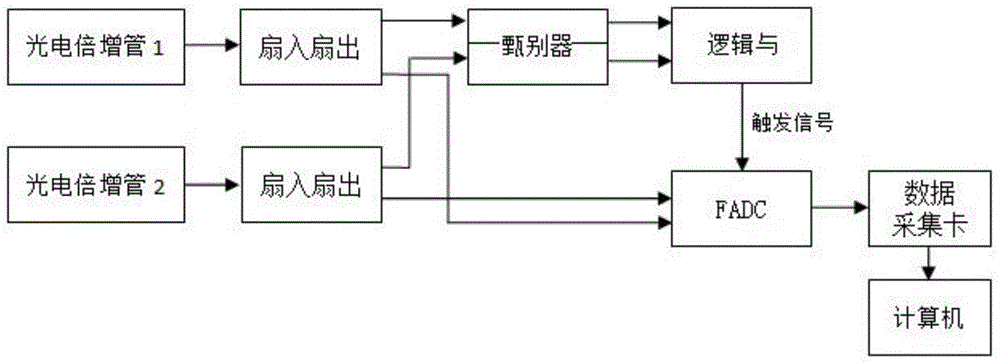
[0060] figure 1 It is a schematic diagram of the connection of the signal acquisition system of this embodiment. The detector is composed of a liquid scintillator and two identical photomultiplier tubes. The detector is placed in a lead shield with a thickness of 50mm, and the americium beryllium (Am-Be) neutron source is placed 130cm from the center of the detector. , the signal generated by the Am-Be neutron source in the liquid scintillator is multiplied in the photomultiplier tube 1 and the photomultiplier tube 2 respectively, and after passing through the fan-in and fan-out device (FIFO), it is output by the output terminals of the photomultiplier tube 1 and 2 Each of the signals becomes two identical signals, that is, a total of four signals are obtained; among them, each signal output by the fan-in and fan-out device is converted into a square wave signal thro...