
A kind of hydrocracking method
A hydrocracking and hydrorefining technology, applied in hydrotreating process, petroleum industry, treatment of hydrocarbon oil, etc., can solve problems such as difficulty in taking into account the quality of reformate and tail oil products, poor hydrogenation selectivity, etc. The effect of avoiding further cracking, increasing cracking rate and reducing hydrogen consumption
- Summary
- Abstract
- Description
- Claims
- Application Information
AI Technical Summary
Problems solved by technology
Method used
Image

Examples
Embodiment 1-3
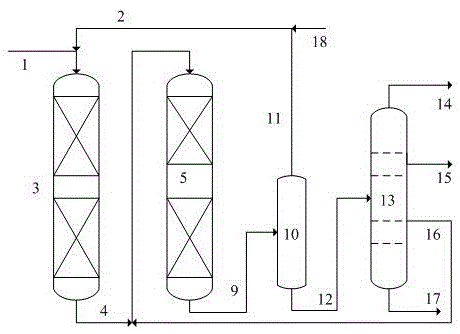
[0035] Embodiment 1-3 adopts such as figure 1 process shown.
[0036] Embodiment 1-3 In the hydrocracking reactor, three kinds of cracking catalysts of catalyst A, catalyst B and catalyst C in Table 1 are graded and loaded respectively according to the order of the catalyst bed from top to bottom. In the three examples, catalyst A The ratios of Catalyst B and Catalyst C are 1:1:1; 1:2:1 and 1:1:2, respectively. The composition and properties of the catalyst are shown in Table 1, the properties of the raw materials used are shown in Table 2, and the reaction conditions and reaction results of Examples 1-3 are shown in Table 3 and Table 4 below.
Embodiment 4
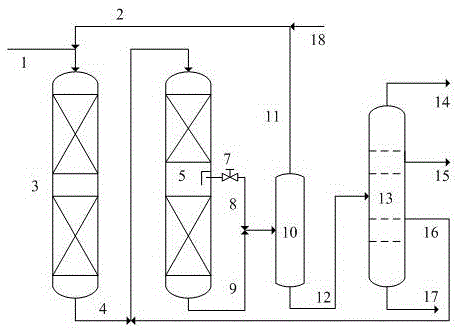
[0038] use figure 2 Process flow shown. Feedstock oil, and catalyst used are the same as embodiment 3. Among them, a gas extraction pipeline is set between two cracking catalyst beds, such as figure 1 shown. Others are the same as embodiment 3. The amount of gas phase material drawn from the gas phase extraction pipeline is 30% of the amount of circulating hydrogen.
[0039] Table 1 Composition and main properties of cracking catalysts.
[0040] project Catalyst A Catalyst B Catalyst C Chemical composition, mass% NiO 8 5 3 WO 3 24 20 18 carrier Aluminum oxide Aluminum oxide Aluminum oxide cracking components Y molecular sieve Y molecular sieve Y molecular sieve Content, m% 65 50 40 Cracking catalyst average pore size, nm 5.0 7.0 9.0
[0041] Table 2 Raw oil properties.
[0042] Raw oil Raw oil Density, g / cm 3 0.9024 Distillation range, ℃ 321~528 C, m% 86....
PUM
| Property | Measurement | Unit |
|---|---|---|
| specific surface area | aaaaa | aaaaa |
| crystallinity | aaaaa | aaaaa |
Abstract
Description
Claims
Application Information
 Login to View More