Planar array antenna setting method oriented at wireless energy transmission system
A planar array antenna and wireless energy transmission technology, which is applied in the directions of antenna arrays, antennas, and electrical components that are powered independently, can solve the problems of small excitation amplitude, difficulty in implementation, and low utilization of array apertures, and achieve low sidelobe currents. The effect of flatness, reduced complexity, and easy engineering realization
- Summary
- Abstract
- Description
- Claims
- Application Information
AI Technical Summary
Problems solved by technology
Method used
Image

Examples
specific Embodiment 1
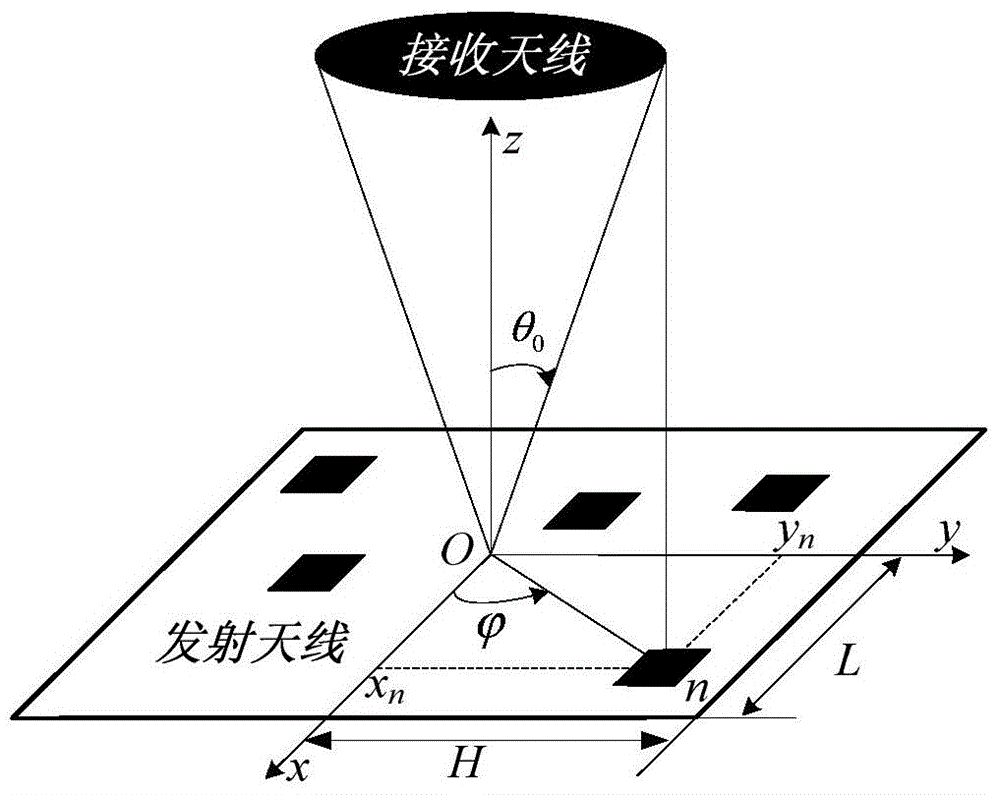
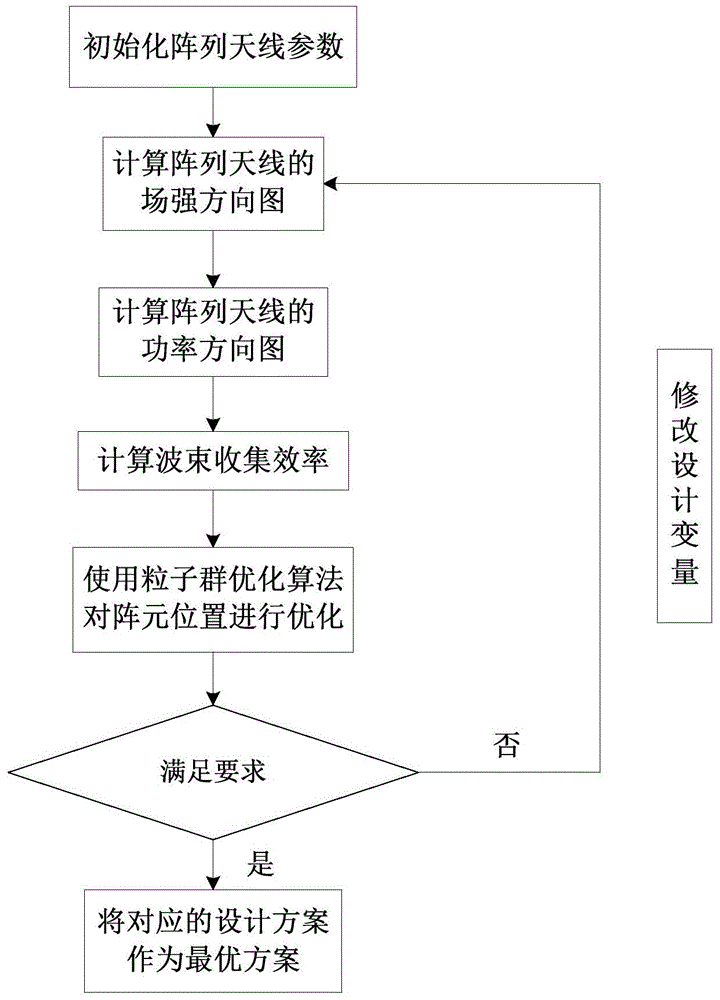
[0058] Such as figure 1 and figure 2 As shown, a planar array antenna array method for a wireless energy transmission system includes the following steps:
[0059] (1) Calculate the field strength pattern of the array antenna
[0060] If the array antenna has 4N array elements and is located in the xoy plane, the positions of all array elements are symmetrical about the x-axis and y-axis and each array element is isotropic, the field strength pattern F(u,v) of the array antenna is according to Formula (1-1) yields:
[0061]
[0062] where I n , and (x n ,y n ) are the excitation amplitude, phase and position coordinates of the nth array element respectively; k = 2 π λ , λ is the antenna operating wavelength, θ and are the elevation angle and azimuth angle of the observation point, j is the imaginary unit, k represents the wave number;
[0063] If the excit...
specific Embodiment 2
[0093] A planar array antenna array method for a wireless energy transmission system, comprising the following steps:
[0094] (1) Calculate the field strength pattern of the array antenna
[0095] If the array antenna has 4N array elements and is located in the xoy plane, the positions of all array elements are symmetrical about the x-axis and y-axis and each array element is isotropic, the field strength pattern F(u,v) of the array antenna is according to Formula (1-1) yields:
[0096]
[0097] where I n , and (x n ,y n ) are the excitation amplitude, phase and position coordinates of the nth array element respectively; λ is the antenna operating wavelength, θ and are the elevation angle and azimuth angle of the observation point, j is the imaginary unit, k represents the wave number;
[0098] If the excitations of all elements of the array antenna are evenly distributed without loss of generality, then I n = 1, Then formula (1-1) can be simplified as:
...
PUM
 Login to View More
 Abstract
Description
Claims
Application Information
 Login to View More
 - R&D
- Intellectual Property
- Life Sciences
- Materials
- Tech Scout
- Unparalleled Data Quality
- Higher Quality Content
- 60% Fewer Hallucinations
Browse by: Latest US Patents, China's latest patents, Technical Efficacy Thesaurus, Application Domain, Technology Topic, Popular Technical Reports.
© 2025 PatSnap. All rights reserved.Legal|Privacy policy|Modern Slavery Act Transparency Statement|Sitemap|About US| Contact US: help@patsnap.com