A kind of preparation method of cast iron cage with self-lubricating performance
What is AI technical title?
AI technical title is built by PatSnap AI team. It summarizes the technical point description of the patent document.
A cage and cast iron technology, applied in the field of mold hardware accessories, can solve the problems of high implementation cost and complicated preparation process
Inactive Publication Date: 2017-08-01
苏州市大力电器有限公司
View PDF6 Cites 0 Cited by
Summary
Abstract
Description
Claims
Application Information
AI Technical Summary
This helps you quickly interpret patents by identifying the three key elements:
Problems solved by technology
Method used
Benefits of technology
Problems solved by technology
The purpose of reducing wear can be achieved by using lubricant or improving the structure of the cage, but the implementation cost of the above measures is high, or the preparation process is complicated, and it cannot fundamentally solve the problem of cage lubrication
Method used
the structure of the environmentally friendly knitted fabric provided by the present invention; figure 2 Flow chart of the yarn wrapping machine for environmentally friendly knitted fabrics and storage devices; image 3 Is the parameter map of the yarn covering machine
View more
Image
Smart Image Click on the blue labels to locate them in the text.
Viewing Examples
Smart Image
Click on the blue label to locate the original text in one second.
Reading with bidirectional positioning of images and text.
Smart Image
Examples
Experimental program
Comparison scheme
Effect test
Embodiment 1
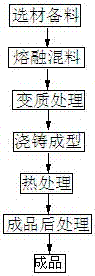
[0018] The specific manufacturing steps of the self-lubricating cast iron cage mentioned in the present invention are as follows:
[0019] a) Material selection and preparation, the main components and percentage ratio of the cast iron cage are: C 3.6%, Si 2.1%, Mn0.7%, Mg 4.5%, RESiFe 1.7%, 75SiFe 1%, MoS2 4%, Trace alloy 0.3%, impurity less than 0.05%, the rest is Fe; among them, Mg and RESiFe components are used as nodulizers for cage materials; 75SiFe components are used as inoculants for cage materials; MoS2 components are used as self-lubricating agents for cage materials; Trace alloys include Cu, Cr, Mo, Ni, Zn, Bi, Sb, Pb, etc.; impurities include P and S, the content of P is controlled below 0.03%, and the content of S is controlled at 0.01%-0.02%;
[0020] b) Melting and mixing, first, add a certain amount of scrap steel and pig iron to the medium-frequency induction furnace, the temperature of the induction furnace is controlled at 1350°C-1380°C, completely melt and...
Embodiment 2
[0026] The specific manufacturing steps of the self-lubricating cast iron cage mentioned in the present invention are as follows:
[0027] a) Material selection and preparation, the main components and percentage ratio of the cast iron cage are: C 3.7%, Si 2.2%, Mn0.75%, Mg 5%, RESiFe 1.5%, 75SiFe 1.2%, MoS2 4.5% , trace alloy 0.25%, impurities below 0.05%, and the rest is Fe; among them, Mg and RESiFe components are used as nodularizers for cage materials; 75SiFe components are used as inoculants for cage materials; MoS2 components are used as self-lubricating agents for cage materials ; Trace alloys include Cu, Cr, Mo, Ni, Zn, Bi, Sb, Pb, etc.; impurities include P and S, the content of P is controlled below 0.03%, and the content of S is controlled at 0.01%-0.02%;
[0028] b) Melting and mixing, first, add a certain amount of scrap steel and pig iron to the medium-frequency induction furnace, and the temperature of the induction furnace is controlled at 1380°C-1400°C to com...
the structure of the environmentally friendly knitted fabric provided by the present invention; figure 2 Flow chart of the yarn wrapping machine for environmentally friendly knitted fabrics and storage devices; image 3 Is the parameter map of the yarn covering machine
Login to View More
PUM
Login to View More
Abstract
The invention discloses a method for preparing a self-lubricating cast iron cage. The preparation method includes the following steps: a) material selection and preparation, b) melting and mixing, c) modification treatment, d) casting and molding, e) heat treatment, f) Post-processing of finished products. The invention discloses a method for preparing a cast iron cage with self-lubricating properties. The preparation method has reasonable process arrangement, simple process implementation, and moderate preparation cost. The added alloy elements can comprehensively improve various performances of the cage, forming a A more stable and excellent strengthening phase, while the MoS2 component endows the cage with good self-lubrication performance, which effectively improves the wear resistance and service life of the cage.
Description
technical field [0001] The invention relates to a preparation method of a cage, in particular to a preparation method of a cast iron cage with self-lubricating performance, and belongs to the technical field of mold hardware accessories. Background technique [0002] The bearing cage refers to the bearing part that partially wraps all or part of the rolling body and moves with it. It is used to isolate the rolling body, and usually guides the rolling body and keeps it in the bearing. The strength and stability of the bearing cage directly Affect the quality and service life of the bearing. When the rolling bearing is working, the bearing heats up and wears due to sliding friction. Especially under high temperature operating conditions, the action of inertial centrifugal force intensifies the friction, wear and heat. In severe cases, the cage will be burned or broken, resulting in the bearing not working properly. Therefore, in addition to a certain strength, the material of...
Claims
the structure of the environmentally friendly knitted fabric provided by the present invention; figure 2 Flow chart of the yarn wrapping machine for environmentally friendly knitted fabrics and storage devices; image 3 Is the parameter map of the yarn covering machine
Login to View More
Application Information
Patent Timeline
Application Date:The date an application was filed.
Publication Date:The date a patent or application was officially published.
First Publication Date:The earliest publication date of a patent with the same application number.
Issue Date:Publication date of the patent grant document.
PCT Entry Date:The Entry date of PCT National Phase.
Estimated Expiry Date:The statutory expiry date of a patent right according to the Patent Law, and it is the longest term of protection that the patent right can achieve without the termination of the patent right due to other reasons(Term extension factor has been taken into account ).
Invalid Date:Actual expiry date is based on effective date or publication date of legal transaction data of invalid patent.



 Login to View More
  Login to View More