
A kind of synthetic method of highly transparent polysulfone resin containing cycloalkane group substituted phenol
A cycloalkane-based, polysulfone resin technology, applied in the field of industrial synthesis of highly transparent polysulfone resin, can solve the problems of low transmittance of thin products, improvement of polysulfone plastic transparency, product performance decline, etc., to save purchases Cost, large market value, effect of reducing crystallinity
- Summary
- Abstract
- Description
- Claims
- Application Information
AI Technical Summary
Problems solved by technology
Method used
Image


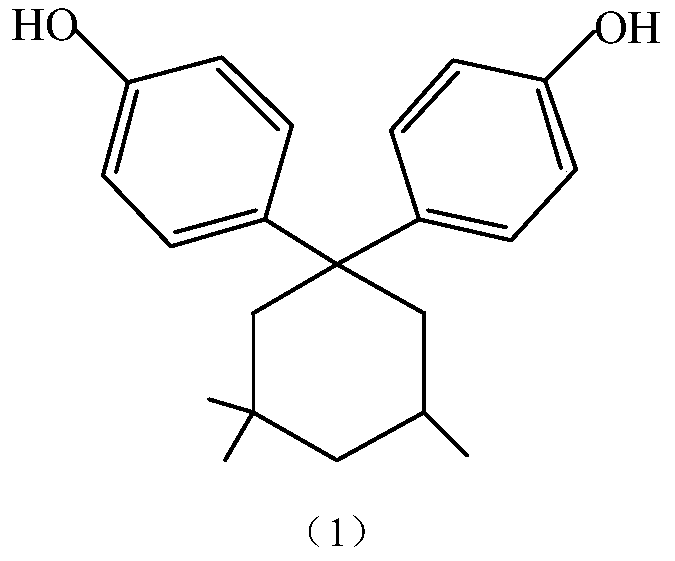
Examples
Embodiment 1
[0031] In a 300-liter stainless steel reaction kettle equipped with a nitrogen pipe, a condensing water separator and a high-efficiency stirrer, first add 100.0kg of N-methylpyrrolidone and start stirring to raise the temperature to 80°C, and then add 35.0kg of 4,4'-dichloro Diphenyl sulfone, 27.8kg bisphenol A, after the monomers are completely dissolved, add 14.0kg sodium carbonate to the system, then add 60.0 liters of o-trimethylbenzene, continue to stir and heat up to 180°C, the salt-forming reaction begins, and the system generates The water and o-trimethylbenzene are azeotropic, and cooling water begins to drip from the condenser tube, and the layers are separated in the water separator. After the upper layer of o-trimethylbenzene changes from turbid to clear, continue to reflux for another 20 minutes to ensure that the salt-forming reaction is complete. , 1 hour in the salt-forming stage, and the solid content of the system in the salt-forming reaction stage is 25%; aft...
Embodiment 2
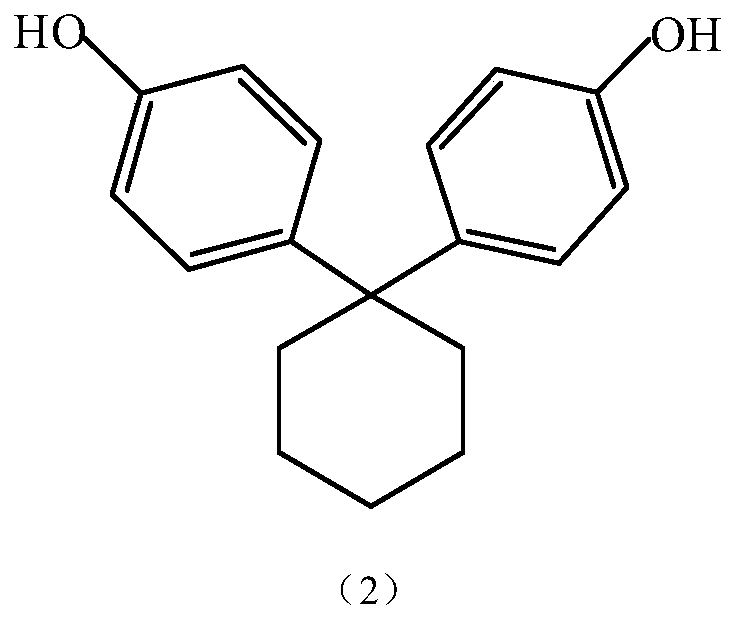
[0036] Same as Example 1, except that 80.0 kg of N-methylpyrrolidone, 56.0 liters of m-trimethylbenzene, and 260 g of naphthenic bisphenol (2), the solid content of the system in the polymerization stage is 38%, and other conditions are the same.
[0037] The cycloalkane bisphenol (2) structure is as follows:
[0038]
[0039] The melt index of the obtained PSU resin was MI=14.0g / 10min (343.0°C, 2.16kg); the light transmittance was 96% (measured by ASTM D 1003:2007).
[0040] Same as Example 1, except that N-methylpyrrolidone is 75.0 kg, 64.0 liters of mesitylene, 270 g of naphthenic bisphenols (3), and the solid content of the system in the polymerization stage is 40%, other conditions are the same.
[0041] The cycloalkane bisphenol (3) structure is as follows:
[0042]
[0043] The melt index of the obtained PSU resin was MI=16.0g / 10min (343.0°C, 2.16kg); the light transmittance was 97% (measured by ASTM D 1003:2007).
PUM
| Property | Measurement | Unit |
|---|---|---|
| boiling point | aaaaa | aaaaa |
| boiling point | aaaaa | aaaaa |
| melt flow index | aaaaa | aaaaa |
Abstract
Description
Claims
Application Information
 Login to View More