Steelmaking-continuous casting scheduling method utilizing priority policy hybrid genetic algorithm

A hybrid genetic algorithm and production scheduling technology, applied in the field of steelmaking and continuous casting production scheduling, can solve problems such as equipment selection uncertainty, time uncertainty, and difficult execution of production scheduling plans

CN105550751AActive Publication Date: 2016-05-04CHONGQING UNIV
4 Cites 53 Cited by

Patent Information

Authority / Receiving Office
CN · China
Current Assignee / Owner
Publication Date
2016-05-04

Smart Images

  • Figure 1
    Figure 1
  • Figure 2
    Figure 2
  • Figure 3
    Figure 3
Patent Text Reader

Abstract

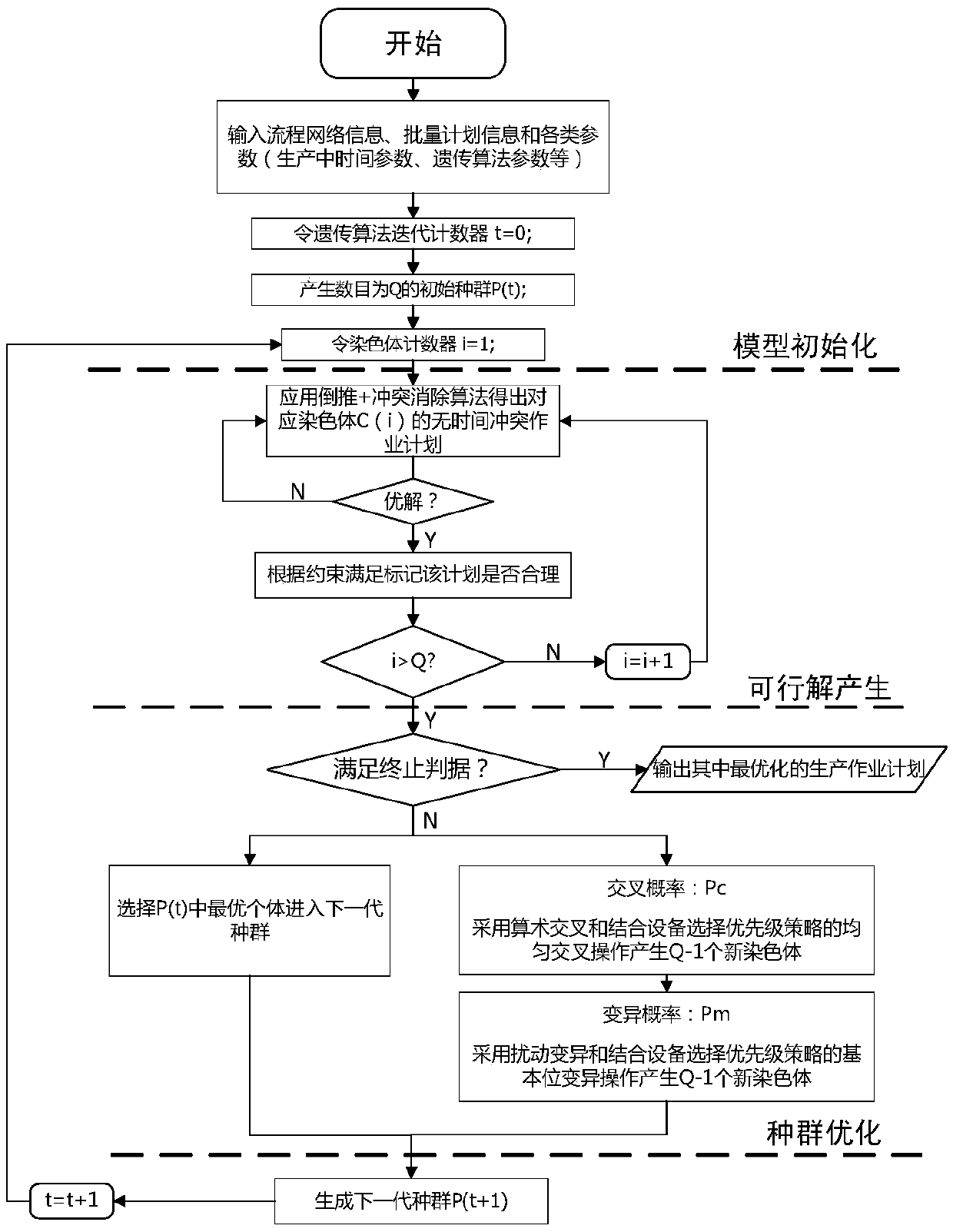
The invention proposes a steelmaking-continuous casting scheduling method utilizing a priority policy hybrid genetic algorithm. The method comprises the following steps: establishing a production scheduling plan target function; establishing a constraint condition set; performing iterative calculation on the target function by utilizing the priority policy hybrid genetic algorithm; and calculating decision variables. The calculation of the decision variables specifically comprises the steps of performing model initialization; calculating a feasible solution: designing a segmented combined real number code composed of casting time information of a continuous casting machine and information of a heat machining device, randomly generating operation time according to a distribution law, and obtaining a time conflict-free scheduling plan by backward inference calculation and conflict elimination methods; and performing population genetic optimization: quantitatively describing a matching relationship among machining devices in reality by using processing weight assignment of a task executable device, and introducing the matching relationship to genetic operation in the form of a device selection priority policy to perform population evolution. The method can solve the problem of uncertainty of device selection and operation time in production to obtain an optimized executable production scheduling plan.
Need to check novelty before this filing date? Find Prior Art

Description

technical field

[0001] The invention relates to the technical field of metallurgical control, in particular to a steelmaking and continuous casting production scheduling method using a priority strategy hybrid genetic algorithm. Background technique

[0002] Steelmaking and continuous casting production scheduling is an important part of production management in iron and steel enterprises. In actual production, due to various uncertainties in the production environment and production conditions, the production scheduling plan will be difficult to execute or the effect of execution will be limited. Therefore, it is of great significance to study the reasonable and efficient formulation method of executable production scheduling plan to improve the overall operating efficiency of the production system and reduce material consumption, energy consumption and cost.

[0003] In recent years, the production scheduling problem of steelmaking and continuous casting has become a rese...

Examples

Embodiment Construction

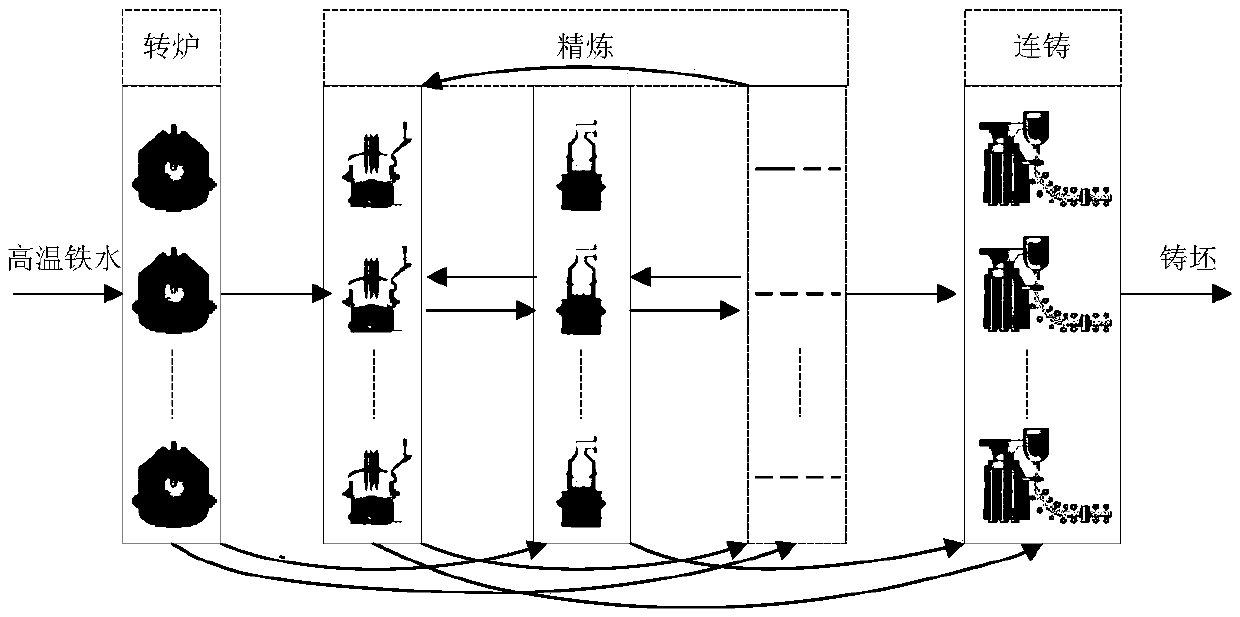
[0032] Embodiments of the present invention are described in detail below, examples of which are shown in the drawings, wherein the same or similar reference numerals designate the same or similar elements or elements having the same or similar functions throughout. The embodiments described below by referring to the figures are exemplary only for explaining the present invention and should not be construed as limiting the present invention.

[0033] figure 1 It is the three production links mainly included in the existing steelmaking-continuous casting process: steelmaking, refining and continuous casting. The steelmaking and continuous casting links each include a parallel unit, while the refining link generally includes multiple parallel units to meet different refining process requirements. General steelmaking-continuous casting production process such as figure 1 Shown: The high-temperature molten iron transported from the blast furnace is mixed into the converter for s...