
A device for testing stability of emulsions and liquid marbles and a method therefor
A technology of emulsion stability and liquid marbles, applied in measuring devices, material analysis through electromagnetic means, instruments, etc., can solve the problems of high implementation cost and poor precision, and achieve high precision, simple operation and cost saving Effect
- Summary
- Abstract
- Description
- Claims
- Application Information
AI Technical Summary
Problems solved by technology
Method used
Image

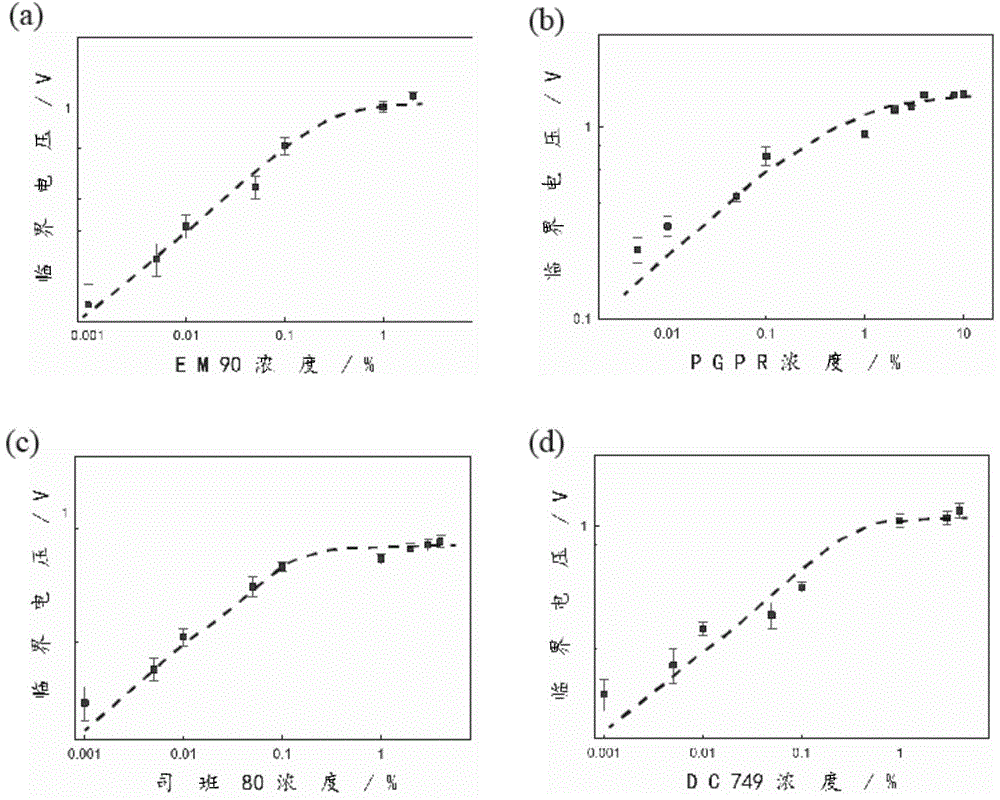

Examples
Embodiment 1
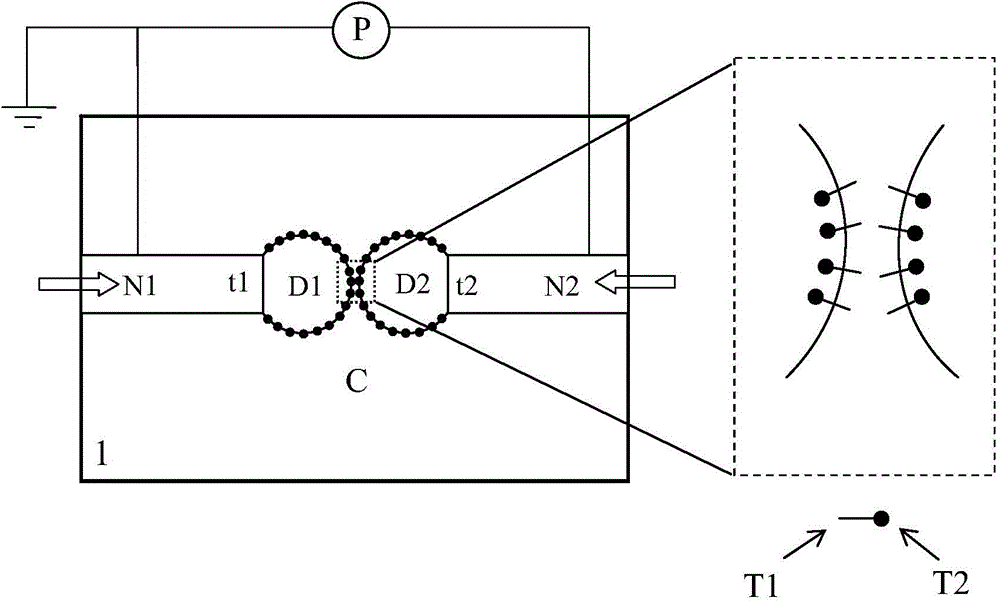
[0068] This example provides a method for testing the stability of emulsions, the method adopts such as figure 1 device shown.
[0069] Such as figure 1 As shown, the device used in the method provided in this embodiment includes: a container 1, which can be made of polymethyl methacrylate (PMMA); a first metal needle N1 and a second metal needle N2, through the Via ( figure 1 not shown in ) into the container 1, and the respective needle points t1 and t2 are close to and aligned with each other, and the ends of the first and second metal needles N1 and N2 located on the outside of the container 1 are respectively connected to the respective syringes ( figure 1 not shown in); the positive and negative poles of the power supply P are respectively connected to the first and second metal needles N1 and N2. In this device, the first and second metal needles N1 and N2 are connected to a power source on the one hand to serve as electrodes, and on the other hand to a syringe for i...
Embodiment 2
[0085] In addition to the critical voltage value, we found that when the droplets in the emulsion are coalesced by AC power, the obtained critical frequency saturation value also has a great relationship with the stability of the emulsion.
[0086] This example provides a method for testing emulsion stability, which is similar to the device used in Example 1, and uses the same water phase material, oil phase material and surfactant material, and the only difference is that the The power supply P used is an AC power supply.
[0087] When starting the test, first set a constant AC amplitude, which is greater than the critical voltage value described in Embodiment 1 above. Then start from a frequency with a large initial value, and slowly decrease the frequency until the two droplets D1 and D2 merge together. The maximum frequency at which the droplets D1 and D2 coalesce is the critical frequency.
[0088] We tested the impact of the amplitude of the AC voltage on the critical ...
Embodiment 3
[0094] This embodiment provides a method for testing the stability of liquid marbles, the method adopts such as Figure 7 device shown. Similar to the DC threshold voltage value for detecting the stability of the emulsion, the method provided in this embodiment uses the critical voltage value when the liquid marbles are coalesced to characterize the stability of the liquid marbles.
[0095] First, spread hydrophobic powder or particles on a bottom plate 2, then drop two water-phase (deionized water) droplets M1 and M2 on the powder layer, shake the bottom plate, and let the powder d evenly cover the droplets on, forming a stable liquid marble. The size of the liquid marbles can be conveniently controlled by controlling the size of the aqueous phase droplets dropped on the hydrophobic powder. when their diameter is smaller than the capillary length of the droplet Liquid marbles will remain roughly spherical.
[0096] Then, the two liquid marbles are brought into contact wi...
PUM
| Property | Measurement | Unit |
|---|---|---|
| diameter | aaaaa | aaaaa |
Abstract
Description
Claims
Application Information
 Login to View More