
Blink detection-based smart handset photographing system and method
A technology for smart phones and mobile phones, which is applied to the parts of TV systems, computer parts, character and pattern recognition, etc. It can solve problems such as difficult implementation, complicated implementation methods, and difficulty in applying mobile phone shooting systems, etc., to achieve easy implementation and accurate The effect of high precision and simple realization method
- Summary
- Abstract
- Description
- Claims
- Application Information
AI Technical Summary
Problems solved by technology
Method used
Image

Examples
Embodiment 1
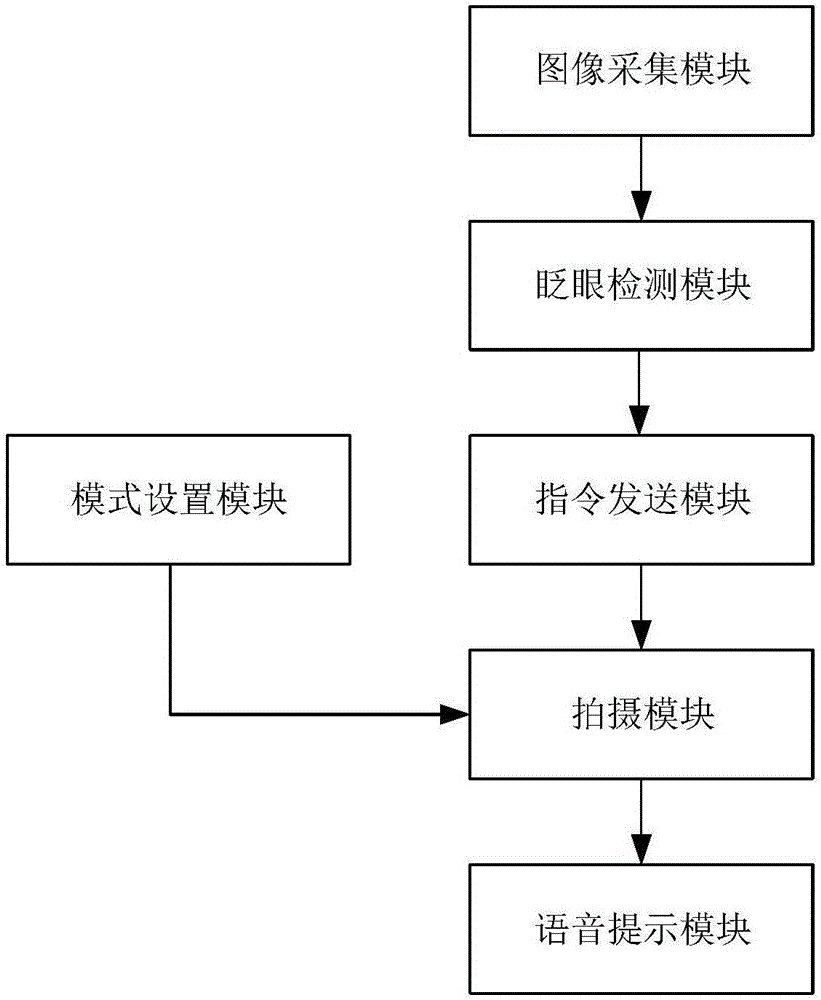
[0035] The present invention is a kind of smart mobile phone photographing system based on blink detection, see figure 1, including a mode setting module, an image acquisition module, an eye blink detection module, an instruction sending module, a shooting module and a voice prompt module. Wherein, the mode setting module is connected with the shooting module data, and sets the shooting mode of the shooting module. The shooting modes include Selfie mode and normal shooting mode, and the module is directly implemented through the mobile phone camera APP. In the present invention, the image acquisition module collects the face image of the photographer, and collects the facial image of the photographer through the front camera of the mobile phone. After collecting the facial image of the photographer, the facial image of the photographer is input into the blink The detection module performs blink detection. The blink detection module performs blink detection on the input photogr...
Embodiment 2
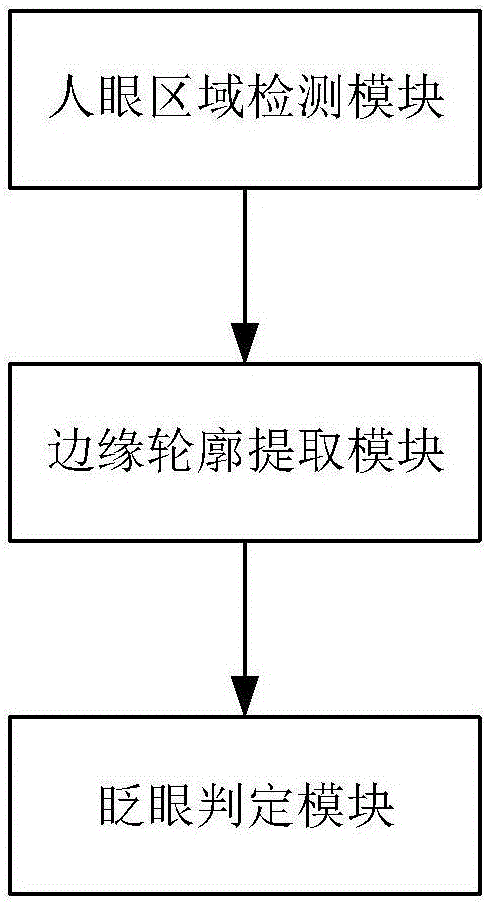
[0043] The overall composition of the smart phone camera system based on blink detection is the same as that in Embodiment 1, wherein the blink detection module is sequentially connected to the human eye area detection submodule, the edge contour extraction submodule and the blink judgment submodule in the direction of data flow, see figure 2 , each sub-module is described as follows:
[0044] The human eye area detection sub-module performs human eye detection on the m face images transmitted by the image acquisition module, and detects the human eye area. In this embodiment, the ASM human eye detection algorithm is used. The human eye sample images in the internal storage device, for example, 50 sample images, construct the shape model of the human eye area by selecting a certain number of human eye contour feature points in the human eye sample images. In this example, the sample human eye The selection number of contour feature points is 21. At the same time, according t...
Embodiment 3
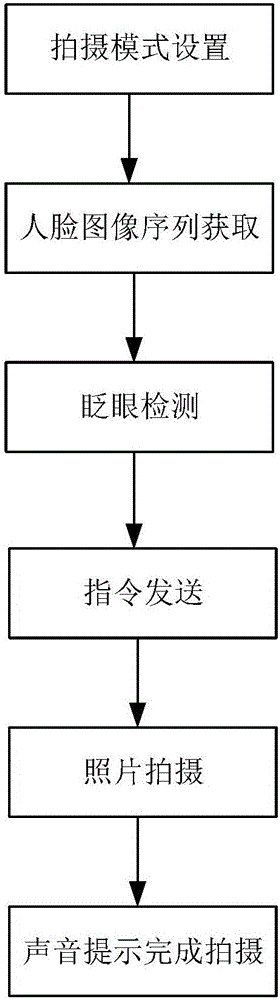
[0048] The present invention is also a smart phone camera method based on blink detection, which is realized on a smart phone camera system based on blink detection, see image 3 , including the following steps:
[0049] (1) Shooting mode setting is completed by the mode setting module, and the mobile phone shooting mode is directly set by the mobile phone camera APP. The mobile phone shooting mode includes two modes of Selfie and common shooting. The normal shooting mode is to shoot by the rear camera of the mobile phone. In the present invention , the two shooting modes are represented by two different signals. In this example, the signal 0 is used to represent the Selfie mode, and the signal 1 is used to represent the normal shooting mode. After the shooting mode is set, the signal representing the shooting mode is sent to the shooting module. The shooting mode setting is set before shooting.
[0050] (2) Acquisition of face image sequence. The front camera of the mobile ph...
PUM
 Login to View More
 Abstract
Description
Claims
Application Information
 Login to View More