
Method and medium formula for improving gene gun transient transformation efficiency of young wheat embryo
A culture medium formula and culture medium technology, applied in biochemical equipment and methods, horticultural methods, genetic engineering, etc., can solve problems such as complex genetic background, low transformation efficiency, and difficulty in achieving scale
- Summary
- Abstract
- Description
- Claims
- Application Information
AI Technical Summary
Problems solved by technology
Method used
Image

Examples
Embodiment 1
[0033] Embodiment 1, immature embryo is drawn material
[0034] Cut the young ears of wheat that have grown vigorously and have less pests and diseases and have bloomed for 10-14 days in the field or in the growth room, strip the seeds of the young ears, and disinfect them with 75% ethanol solution by volume for 1 minute; rinse them with sterile water for 3 times; Then sterilize with 1% silver nitrate solution for 15-20min; rinse with sterile water 3 times. The translucent immature embryos (ie young wheat embryos) with a size of 0.8-2.0 mm were peeled off after the embryos were excised with a scalpel in the ultra-clean workbench.
Embodiment 2
[0035] Embodiment 2, the transient transformation of immature embryo
[0036] Take the immature embryos stripped in Example 1, pre-culture for 6-8 days, inoculate the scutellum up on the hyperosmotic medium prepared by the following method, and place them in a 60×15 mm petri dish with a central diameter of 2.0 —In a circular area of 3.0 cm, seal with Parafilm, and culture in hypertonicity at 22°C for 4-6 hours in the dark. Biolistic transformation is a method of introducing exogenous DNA into plant cells by physical means. Hyperosmotic treatment of receptor material before bombardment by gene gun can reduce the damage to recipient cells during the bombardment process.
[0037] The formula and preparation method of hypertonic medium used in this embodiment are: CaCl 2 2.99mM, KNO 3 18.79mM, NH 4 NO 3 20.61mM, KH 2 PO 4 1.25mM, MgSO 4 1.50mM, MnSO 4 1mM, ZnSO 4 30 μM, H 3 BO 3 100 μM, KI 5 μM, NaMoO 4 1 μM, CuSO 4 0.1 μM, CoCl 6 0.1 μM, FeSO 4 100 μM...
Embodiment 3
[0061] Embodiment 3, the detection of instantaneous conversion efficiency
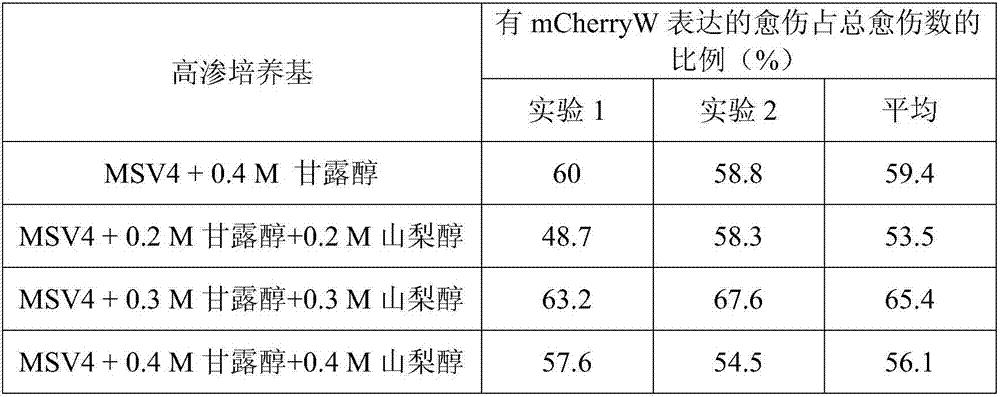
[0062] Because the concentration of hypertonic medium and hypertonic treatment time applicable to different receptor materials are different, the inventors compared the transient transformation efficiency of the plasmid in the ratio of different concentrations of mannitol and sorbitol in the above-mentioned medium. , the hyperosmotic treatment time is 4-6 hours, and the formula of MSV4 medium is: CaCl 2 2.99mM, KNO 3 18.79mM, NH 4 NO 3 20.61mM, KH 2 PO 4 1.25mM, MgSO 4 1.50mM, MnSO 4 1mM, ZnSO 4 30 μM, H 3 BO 3 100 μM, KI 5 μM, NaMoO 4 1 μM, CuSO 4 0.1 μM, CoCl 6 0.1 μM, FeSO 4 100 μM, Na 2 -EDTA 100μM, niacin 8μM, inositol 0.56mM, thiamine hydrochloride 30μM, pyridoxine hydrochloride 4.9μM, glycine 0.027mM, glutamine 0.2mM, hydrolyzed casein 200mg / L, sucrose 30g / L. The results are shown in Table 1 below. The acceptor material treated with 0.3M mannitol+0.3M sorbitol has the ...
PUM
 Login to View More
 Abstract
Description
Claims
Application Information
 Login to View More