Unlock instant, AI-driven research and patent intelligence for your innovation.

FPGA experimental platform based on multi-electrode array feedback synchronous control of neural nuclei

A multi-electrode array and FPGA technology, applied in the field of biomedical engineering, can solve the problems of no multi-electrode array feedback synchronous control experiment platform, non-real-time, low application value, etc., and achieve the effect of a good visual interface

Inactive Publication Date: 2020-08-04
TIANJIN UNIV
View PDF6 Cites 0 Cited by
  • Summary
  • Abstract
  • Description
  • Claims
  • Application Information

AI Technical Summary

Problems solved by technology

[0005] However, the existing technology is still in the basic stage, and there is no experimental platform for feedback synchronous control based on multi-electrode arrays.
So far, the research on the synchronization of neural nuclei is mainly based on software or hardware simulation of nuclei activity. The nuclei activity simulated by software is not real-time, and the structure of the neuron network model implemented by hardware is relatively simple, and its practical application value is low.

Method used

the structure of the environmentally friendly knitted fabric provided by the present invention; figure 2 Flow chart of the yarn wrapping machine for environmentally friendly knitted fabrics and storage devices; image 3 Is the parameter map of the yarn covering machine
View more

Image

Smart Image Click on the blue labels to locate them in the text.
Viewing Examples
Smart Image
  • FPGA experimental platform based on multi-electrode array feedback synchronous control of neural nuclei
  • FPGA experimental platform based on multi-electrode array feedback synchronous control of neural nuclei
  • FPGA experimental platform based on multi-electrode array feedback synchronous control of neural nuclei

Examples

Experimental program
Comparison scheme
Effect test

Embodiment Construction

[0018] The structure of the FPGA experiment platform based on multi-electrode array feedback synchronous control FPGA of the present invention will be described below in conjunction with the accompanying drawings.

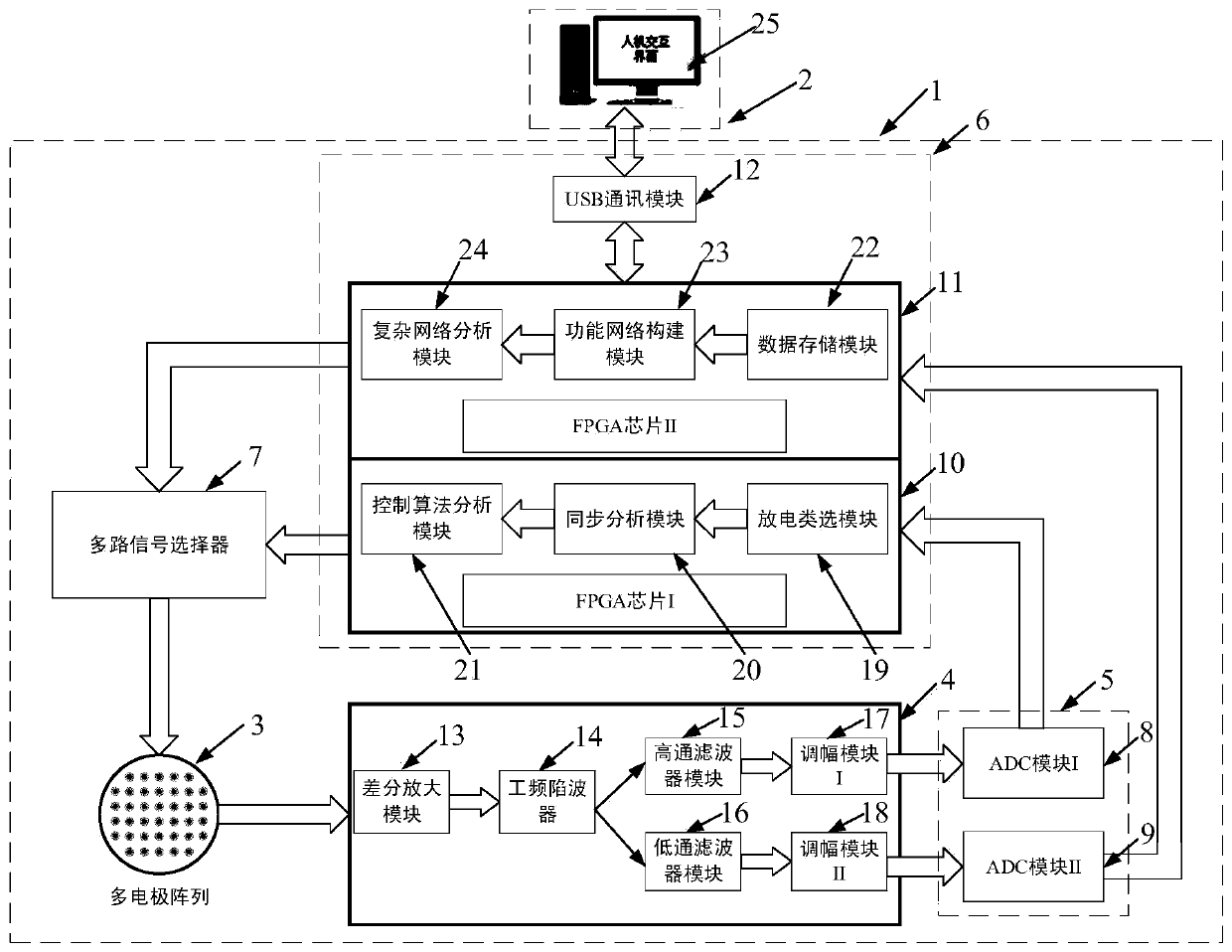
[0019] The design concept of the multi-electrode array-based neural nucleus feedback synchronous control FPGA experimental platform of the present invention is to first put the neural nucleus slices into the 120-channel multi-electrode array 3 to obtain neural electrical signals, and then design the signal acquisition preprocessing circuit 4 Perform preprocessing such as amplification and filtering on the physiological signals to obtain low-frequency local field potential signals and high-frequency discharge signals; use the ADC module 5 to transmit the discharge signals and local field potential signals to FPGA chips I10 and II11 respectively; FPGA chip I10 Read high-frequency discharge signals, and perform synchronous analysis and control strategy analysis; FPGA c...

the structure of the environmentally friendly knitted fabric provided by the present invention; figure 2 Flow chart of the yarn wrapping machine for environmentally friendly knitted fabrics and storage devices; image 3 Is the parameter map of the yarn covering machine
Login to View More

PUM

No PUM Login to View More

Abstract

The invention provides a nervous nuclei feedback synchronous control FPGA experimental platform based on a multi-electrode array. According to the experimental platform, a nervous nuclei which is measured and taken by the multi-electrode array is taken as an experimental object, an FPGA is taken as a lower computer, and a man-machine operation interface edited by an LABVIEW is adopted for displaying data of the multi-electrode array and setting control parameters; the FPGA is used for analyzing and processing experimental data of the multi-electrode array, an upper computer sets parameters through the man-machine operation interface, and thus synchronous control of the nervous nuclei is achieved. The nervous nuclei feedback synchronous control FPGA experimental platform based on the multi-electrode array has the advantages that based on multi-electrode array experiments, synchronous analysis and feedback synchronous control of the nervous nuclei are achieved by using the FPGA experimental analysis platform which operates in a high speed, the control parameters such as control points and feedback intensity are set through the man-machine operation interface of the upper computer, synchronous characteristics of the nervous nuclei are analyzed under different control effects, and thus the synchronizing or desynchronizing control effect of the nervous nuclei is achieved.

Description

technical field [0001] The invention belongs to the field of biomedical engineering, and relates to the acquisition and processing technology of bioelectrical signals, in particular to a multi-electrode array-based neural nuclei feedback synchronous control FPGA experiment platform. Background technique [0002] With the development of economy and society, the problem of population aging is becoming more and more serious, and the incidence of mental diseases such as Parkinson's disease, Alzheimer's disease, and epilepsy is increasing. Further detection and observation of the response behavior of the nervous system will help people to further understand Understanding the function of the nervous system and further understanding the pathogenesis of various neurological diseases are of great significance to the diagnosis and treatment of neurological diseases. Multi-electrode arrays are widely used in basic biology and medical diagnosis because of their ability to detect and rec...

Claims

the structure of the environmentally friendly knitted fabric provided by the present invention; figure 2 Flow chart of the yarn wrapping machine for environmentally friendly knitted fabrics and storage devices; image 3 Is the parameter map of the yarn covering machine
Login to View More

Application Information

Patent Timeline
no application Login to View More
Patent Type & Authority Patents(China)
IPC IPC(8): G05B19/042G06N3/063
CPCG05B19/0421G05B19/0423G05B2219/21137G05B2219/2214G05B2219/23067G05B2219/23258G06N3/063
Inventor 于海涛郭欣萌王江邓斌魏熙乐刘晨
Owner TIANJIN UNIV
Features
  • R&D
  • Intellectual Property
  • Life Sciences
  • Materials
  • Tech Scout
Why Patsnap Eureka
  • Unparalleled Data Quality
  • Higher Quality Content
  • 60% Fewer Hallucinations
Social media
Patsnap Eureka Blog
Learn More