Image restoration method based on convolutional neural network with symmetric cross layer connection
What is AI technical title?
AI technical title is built by Patsnap AI team. It summarizes the technical point description of the patent document.
A technology of convolutional neural network and neural network, applied in the field of image restoration
Inactive Publication Date: 2018-09-14
NANJING UNIV
View PDF4 Cites 7 Cited by
Summary
Abstract
Description
Claims
Application Information
AI Technical Summary
This helps you quickly interpret patents by identifying the three key elements:
Problems solved by technology
Method used
Benefits of technology
Problems solved by technology
In recent years, methods based on deep neural networks, especially deep convolutional neural networks, have been widely used in many computer vision and pattern recognition tasks, and have achieved remarkable results in many high-level image understanding tasks, such as image classification, image segmentation, etc. effect, but in the field of underlying image analysis and restoration, there are still many research points that have not been covered, so there is still huge room for breakthroughs in this field
Method used
the structure of the environmentally friendly knitted fabric provided by the present invention; figure 2 Flow chart of the yarn wrapping machine for environmentally friendly knitted fabrics and storage devices; image 3 Is the parameter map of the yarn covering machine
View more
Image
Smart Image Click on the blue labels to locate them in the text.
Viewing Examples
Smart Image
Click on the blue label to locate the original text in one second.
Reading with bidirectional positioning of images and text.
Smart Image
Examples
Experimental program
Comparison scheme
Effect test
Embodiment 1
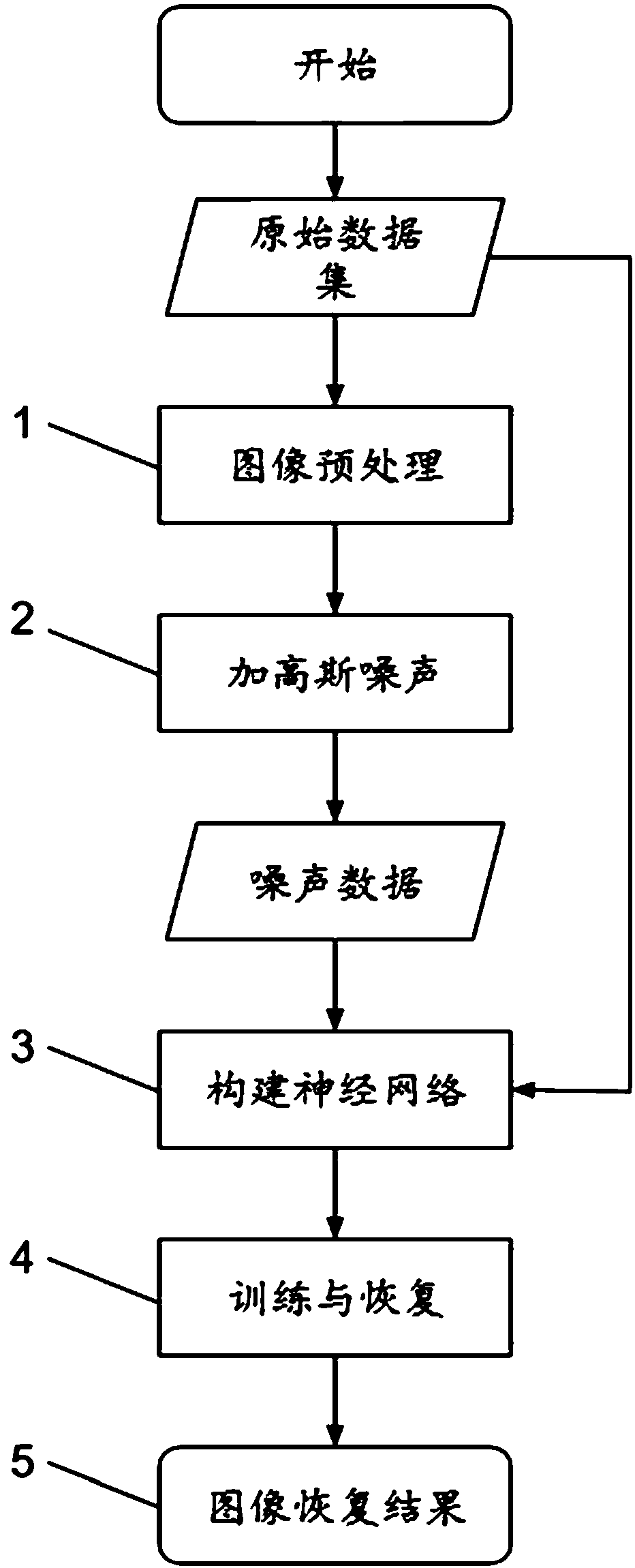
[0095] This embodiment describes image denoising, including the following parts:
[0096] 1. First, on the BSD natural image data set, a total of 500,000 image blocks of 50*50 are randomly intercepted, and Gaussiannoise with a mean value of 0 and a standard deviation of σ is added to the image (σ takes 10, 30, 50, and 70 respectively Four experiments were performed). Normalize the image after adding noise and the image without adding noise. Thus, a data set with a size of 500,000 is obtained, in which 450,000 image blocks are used as the training set and 50,000 as the verification set.
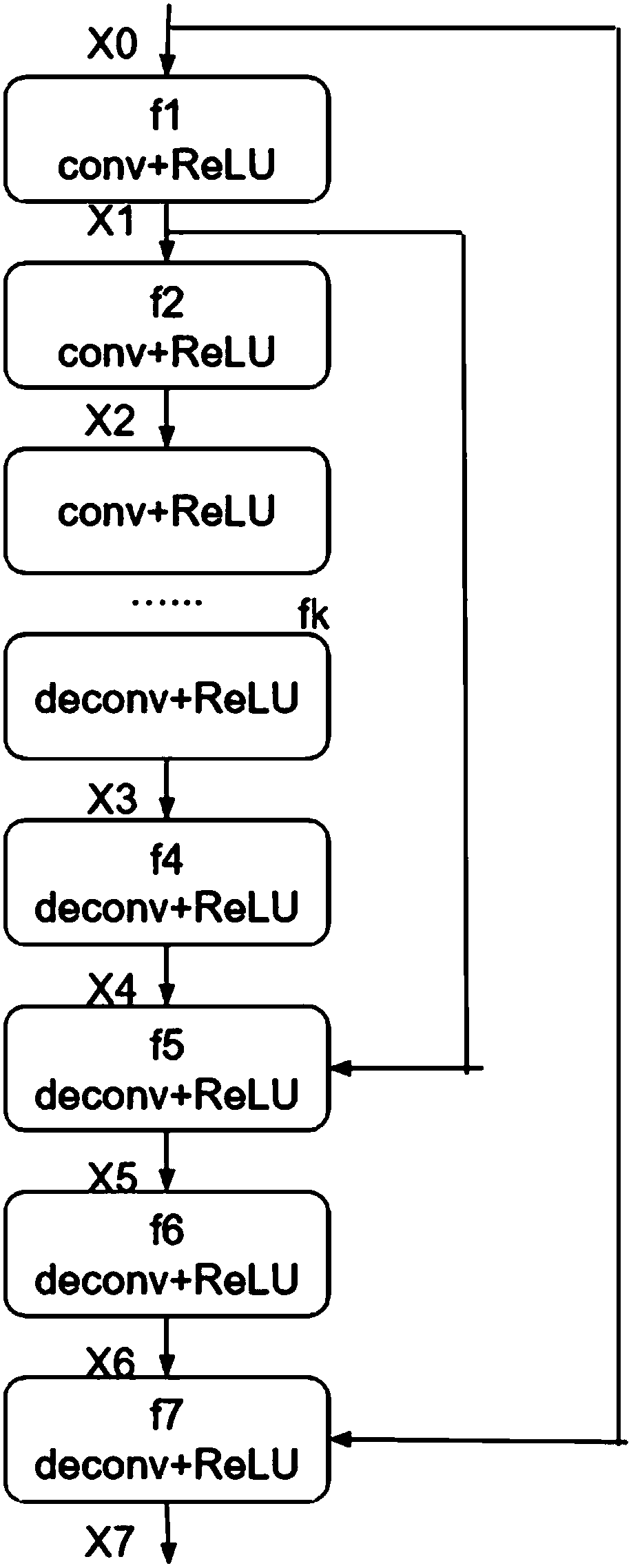
[0097] 2. Construct a 30-layer convolutional neural network with cross-layer connections, use the ADAM algorithm to train on the constructed data set, and set the learning rate to 1e-4 uniformly, and use the verification set to verify the parameter pre-training effect in each training round. Finally, a converged network is obtained.
[0098] 3. Test on the original image of the BSD200 test...
Embodiment 2
[0103] This embodiment describes image super-resolution, including the following parts:
[0104] 1. First, on the BSD natural image data set, a total of 500,000 image blocks of 50*50 are randomly intercepted. For each image block, the linear interpolation algorithm is used to shrink by s times (s is 2, 3 and 4 for three experiments), On the basis of the reduced image, a low-resolution image with the same size as the original image but with low definition is obtained by s-fold enlargement. Combine the low-resolution image with the original image to obtain a data set with a size of 500,000, of which 450,000 image blocks are used as the training set and 50,000 as the verification set.
[0105] 2. Construct a 20-layer convolutional neural network with cross-layer connections, use the ADAM algorithm to train on the constructed data set, and set the learning rate to 1e-4 uniformly, and use the verification set to verify the parameter pre-training effect in each training round. Fina...
the structure of the environmentally friendly knitted fabric provided by the present invention; figure 2 Flow chart of the yarn wrapping machine for environmentally friendly knitted fabrics and storage devices; image 3 Is the parameter map of the yarn covering machine
Login to View More
PUM
Login to View More
Abstract
The invention discloses an image restoration method based on a convolutional neural network with symmetric cross layer connection. The method comprises the following steps: training data are preprocessed; a fuzzy training image is generated automatically; a neural network is built; the neural network is trained; and restoration effects are verified and parameter adjustment is carried out. On the basis of a damaged image, a clearer original image can be restored, and the effectiveness of methods such as traditional image denoising, image super resolution and image completion is enhanced. Besides, through adding symmetric cross layer connection to the convolutional neural network, a deeper neural network can be optimized more easily, the model generalization ability is improved, the detailsof an underlying image are kept at the same time, and a better restored image can be obtained. High-efficiency and distinct image restoration is realized, and the practical value is high.
Description
technical field [0001] The invention relates to the field of image restoration, in particular to an image restoration method based on a convolutional neural network (Convolutional Neural Network, CNN) with symmetric cross-layer connections. Background technique [0002] With the continuous rapid development of information technology, various fields are generating various types of image data at an astonishing speed every day. In the process of acquiring and disseminating a large amount of image data, images are often compressed, reduced in resolution, or disturbed by non-artificial noise. How to restore the original image from the damaged image as realistically as possible has become a very important task. Important issues. With the increasing popularity of more and more mobile devices with camera functions, such as cameras, mobile phones, tablets, etc., and the rise of social networks, people have more and more ways to obtain images, which further promotes the rapid growth ...
Claims
the structure of the environmentally friendly knitted fabric provided by the present invention; figure 2 Flow chart of the yarn wrapping machine for environmentally friendly knitted fabrics and storage devices; image 3 Is the parameter map of the yarn covering machine
Login to View More
Application Information
Patent Timeline
Application Date:The date an application was filed.
Publication Date:The date a patent or application was officially published.
First Publication Date:The earliest publication date of a patent with the same application number.
Issue Date:Publication date of the patent grant document.
PCT Entry Date:The Entry date of PCT National Phase.
Estimated Expiry Date:The statutory expiry date of a patent right according to the Patent Law, and it is the longest term of protection that the patent right can achieve without the termination of the patent right due to other reasons(Term extension factor has been taken into account ).
Invalid Date:Actual expiry date is based on effective date or publication date of legal transaction data of invalid patent.


 Login to View More
  Login to View More