
A method for preparing manganese-bismuth alloy film with room temperature exchange bias effect
A technology of alloy thin film and bias effect, which is applied in metal material coating process, vacuum evaporation plating, coating, etc., can solve the problems of small room temperature exchange bias field and no exchange bias field
- Summary
- Abstract
- Description
- Claims
- Application Information
AI Technical Summary
Problems solved by technology
Method used
Image

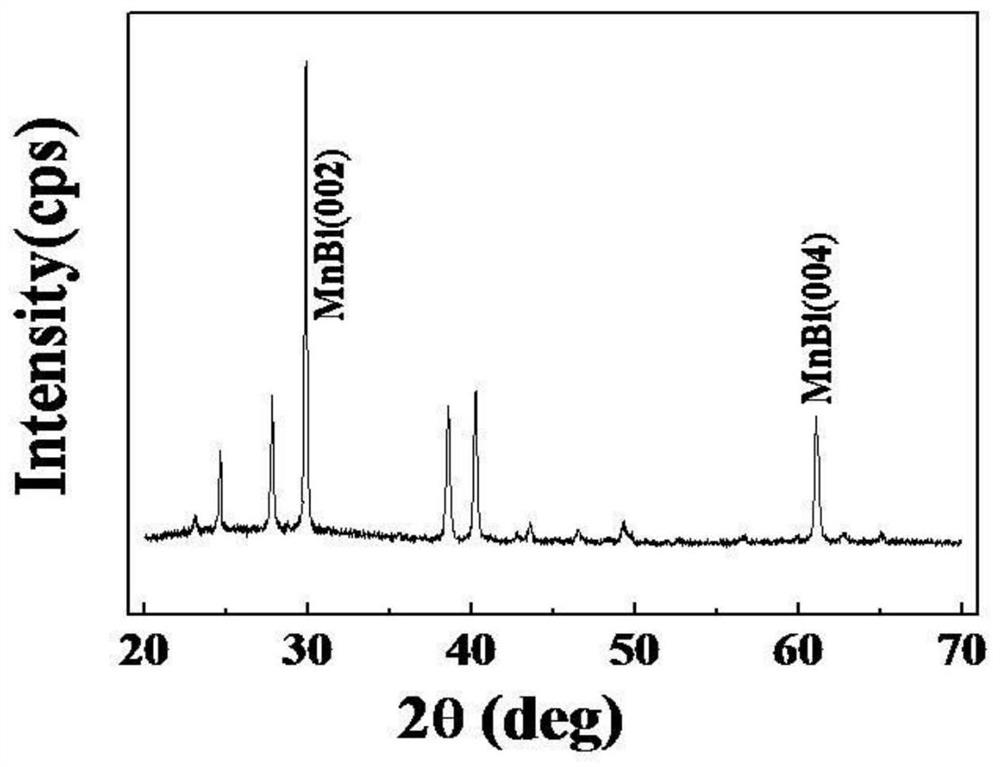
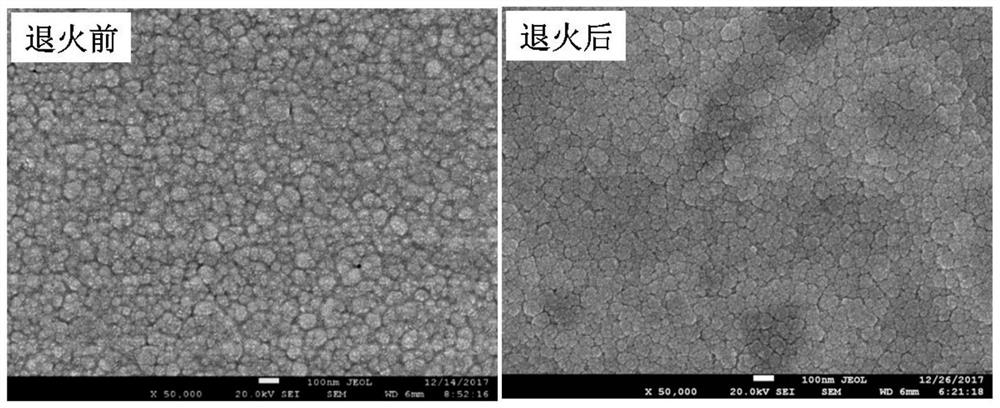
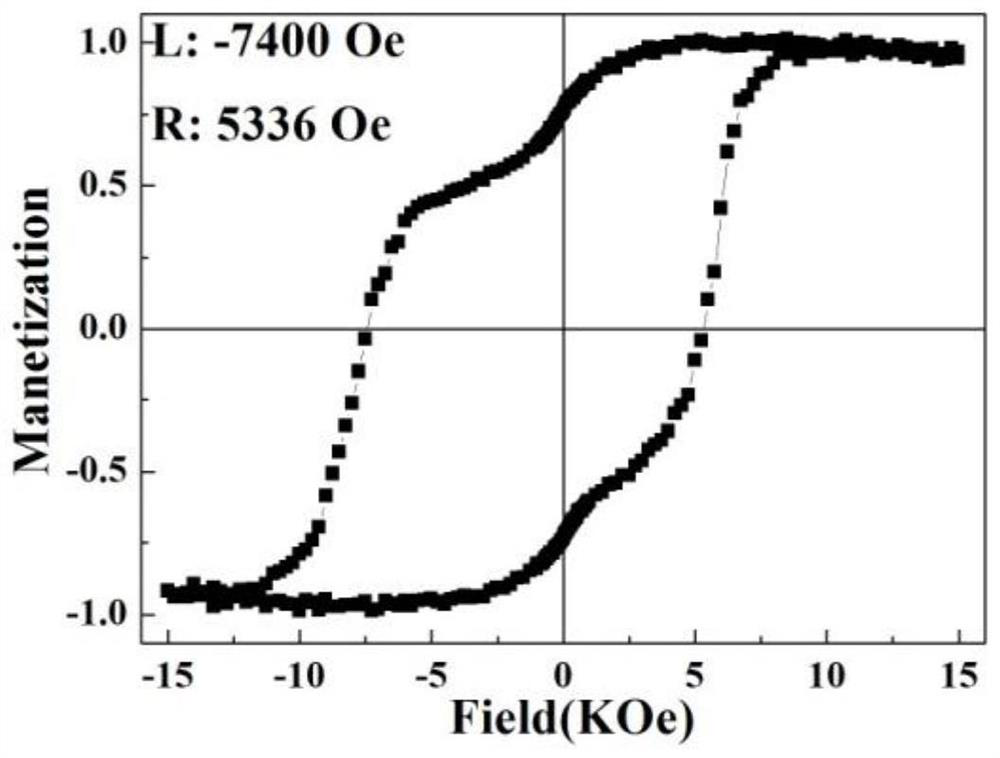
Examples
Embodiment 1
[0030] The present embodiment provides a method for preparing a manganese-bismuth alloy thin film with room temperature exchange bias effect, comprising the following steps:
[0031] Main preparation conditions: Mn sputtering power is 35W, Bi sputtering power is 8W, sputtering pressure is 2.3Pa, sputtering time is 2400s, annealing background vacuum is 1.0×10 -4 Pa, the annealing temperature is 380℃, and the annealing time is 2h;
[0032] Put Mn and Bi targets with a diameter of 60 mm and a purity of 99.99% and a glass substrate cleaned in advance into the magnetron sputtering chamber. Wait until the background vacuum of the vacuum chamber reaches 8.0×10 -5 When Pa, argon with a purity of 99.99% was introduced, and the flow rate of argon was adjusted to 80sccm. At the same time, the baffle valve was adjusted so that the sputtering pressure was 2.3Pa, the sputtering power of Mn was 35W, and the sputtering power of Bi was 8W. and sputtering at the same time, the sputtering time...
Embodiment 2
[0039] The present embodiment provides a method for preparing a manganese-bismuth alloy thin film with room temperature exchange bias effect, comprising the following steps:
[0040] Main preparation conditions: Mn sputtering power is 30W, Bi sputtering power is 8W, sputtering pressure is 2.3Pa, sputtering time is 2400s, annealing background vacuum is 1.0×10 -4 Pa, the annealing temperature is 380℃, and the annealing time is 2h;
[0041] Put Mn and Bi targets with a diameter of 60 mm and a purity of 99.99% and a glass substrate cleaned in advance into the magnetron sputtering chamber. Wait until the background vacuum of the vacuum chamber reaches 8.0×10 -5 When Pa, argon gas with a purity of 99.99% was introduced, the flow rate of argon gas was adjusted to 80sccm, and the baffle valve was adjusted to make the sputtering pressure 2.3Pa, the Mn sputtering power to be 30W, and the Bi sputtering power to be 8W. Sputtering, the sputtering time is 2400s; then the substrate after s...
Embodiment 3
[0044] The present embodiment provides a method for preparing a manganese-bismuth alloy thin film with room temperature exchange bias effect, comprising the following steps:
[0045] The main preparation conditions: Mn sputtering power is 28W, Bi sputtering power is 8W, sputtering pressure is 2.3Pa, sputtering time is 2400s, annealing background vacuum is 1.0×10⁻⁴ Pa, the annealing temperature is 380℃, and the annealing time is 2h;
[0046] Put Mn and Bi targets with a diameter of 60 mm and a purity of 99.99% and a glass substrate cleaned in advance into the magnetron sputtering chamber. The background vacuum of the vacuum chamber reaches 8.0×10 -5 When Pa, argon gas with a purity of 99.99% was introduced, and the flow rate of argon gas was adjusted to 80sccm. At the same time, the baffle valve was adjusted so that the sputtering pressure was 2.3Pa, the Mn sputtering power was 28W, and the Bi sputtering power was 8W. Sputtering, the sputtering time is 2400s; then the substrat...
PUM
 Login to View More
 Abstract
Description
Claims
Application Information
 Login to View More