
Method for trapping and killing tea lesser leafhoppers with plant repellent and attractant in push-pull manner
A tea green leafhopper and repellant technology, which is applied in botany equipment and methods, animal repellents, and pest-attracting agents, can solve the problem of rising control costs, excessive pesticide residues in tea, and inability to effectively control leafhoppers, etc. problems, to achieve the effect of reducing chemical control
- Summary
- Abstract
- Description
- Claims
- Application Information
AI Technical Summary
Problems solved by technology
Method used
Image

Examples
Embodiment 1
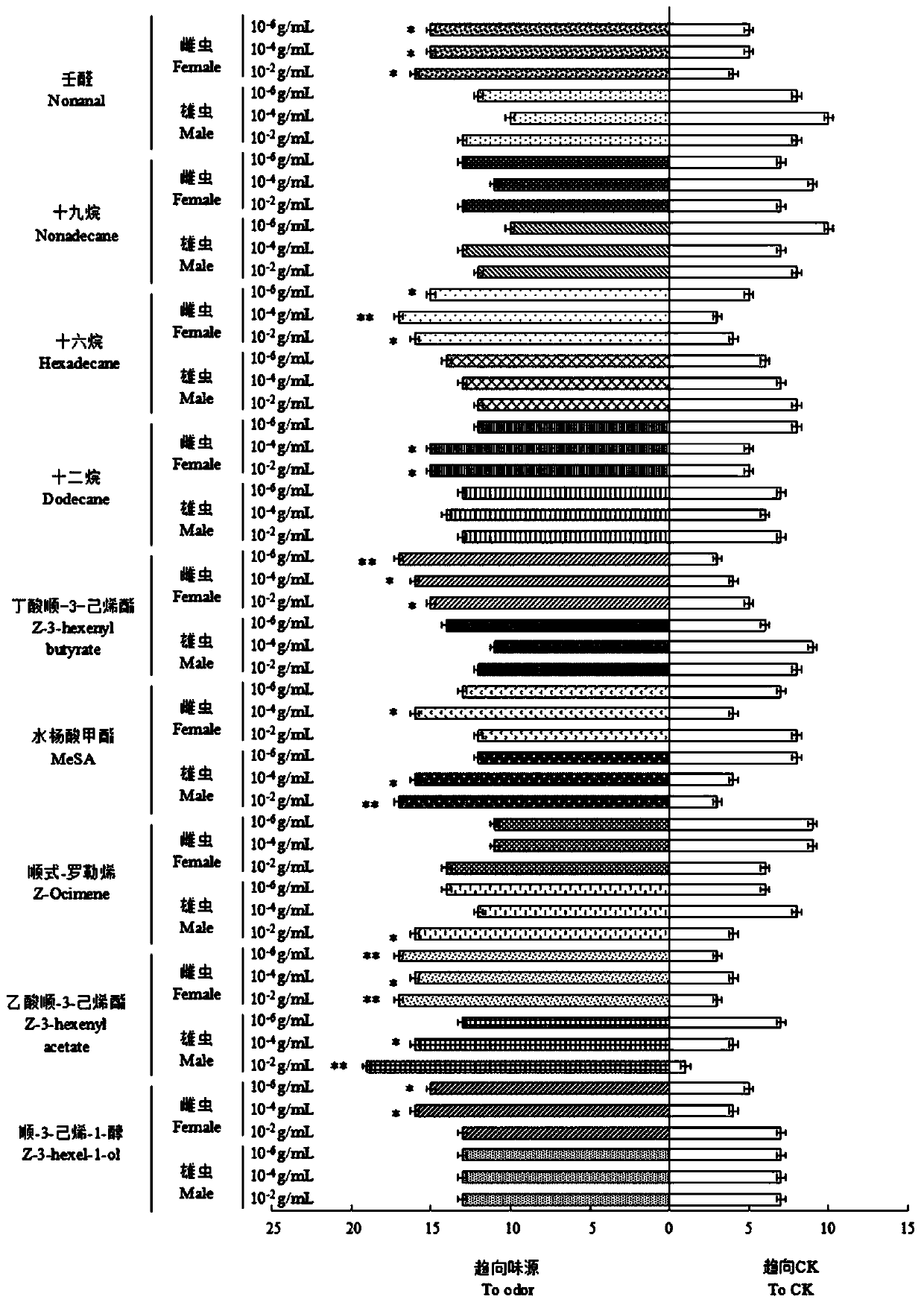
[0022] Example 1 Development of high-efficiency attractants by using components that significantly attract leafhoppers in the smell of the big-leaved jackfruit
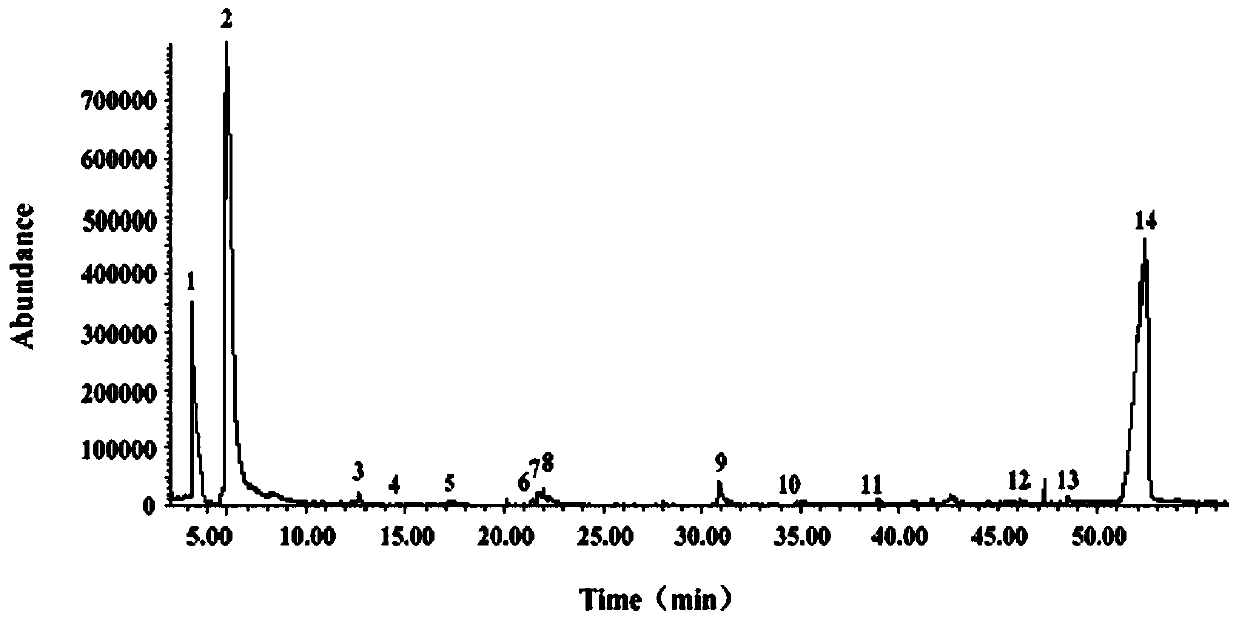
[0023] Qualitative and quantitative analysis of volatile components in 1.
[0024] 1.1 Extraction of volatile matter from the plant
[0025] Cut the strong plants of the big-leaved jackfruit from the root neck and put them into a glass cylinder. The cylinder consists of two parts, which can be worn in tightly or unscrewed, with a length of 30 cm and an inner diameter of 6 cm. The two ends of the cylinder are respectively connected to the air inlet and the air outlet. The air inlet is connected to the air filter (containing activated carbon) and the flow meter in turn, and the air outlet is connected to the Super Q adsorption column (100mg), the water absorption device, and the air pump in turn. The parts are connected with Teflon tubes. After pumping for 2 hours, remove the Super Q adsorption column, rinse the adso...
Embodiment 2
[0054] The trapping and killing effects and differences of 3 kinds of attractants in the tea garden of embodiment 2
[0055] 1 attractant preparation
[0056] In this study, 13 compounds were identified from the volatiles of the plant, and 9 components with relatively high content were selected. According to the measurement results, using n-hexane as solvent, three kinds of attractants (Table 2) were formulated according to the content ratio between the identified components: eight-component attractant, four-component attractant 1, four-component attractant Agent 2. Add 400 μL of attractant dropwise into each groove of the rubber head to make attractant cores.
[0057] 2 Experiments on trapping and killing tea leafhoppers in tea gardens
[0058] The color printing factory of Zhejiang University printed bud green plates, each color plate is 40cm long and 20cm wide. The color space adopts the absolute measurement method, and the measured brightness L, chromaticity coordinate...
Embodiment 3
[0065] Example 3 The effect and difference of 3 kinds of repellents in the tea garden to drive away leafhoppers and trap them on the color plate
[0066] 1 Repellant preparation
[0067] The research group identified and screened two repellent substances from lavender volatiles, namely thymol and 2-isopropyl-4-methylanisole, and made repellents according to the dosage in Table 2, and put them on each rubber head Add 400 μL of repellent dropwise into the groove, and put it on the rubber tip to make a repellent lure.
[0068] 2 Experimental design of repelling tea leafhoppers in tea gardens
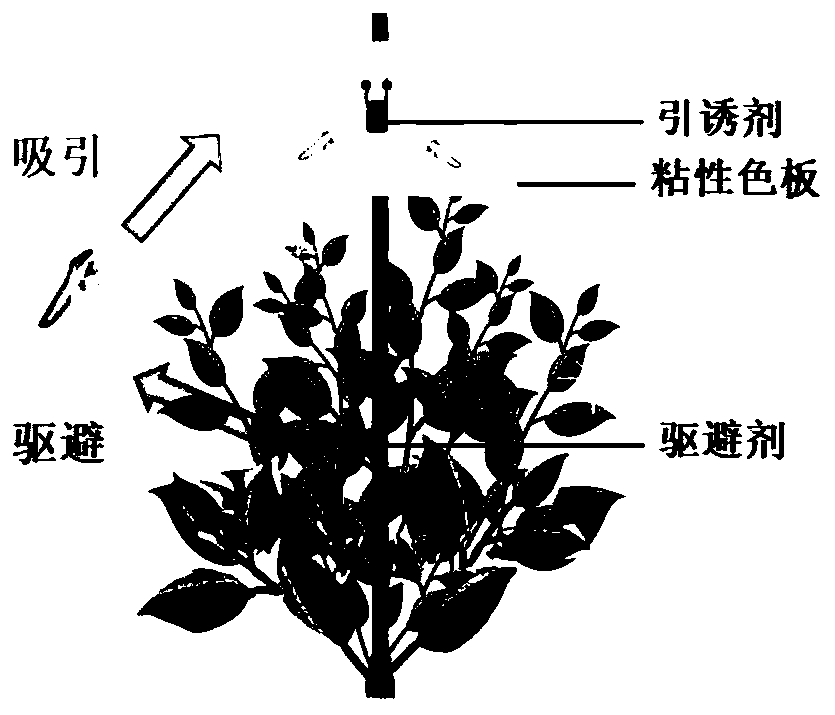
[0069] In August, when a large number of tea leafhoppers occurred, 80 bud green sticky boards were inserted in the tea garden in the same way, with a distance of 7-8m between them, and 20 boards were randomly selected, and placed in the tea bushes directly below each board, at a distance from the lower edge of the color board. About 30cm, fix a two-component repellent lure on the tea bran...
PUM
 Login to View More
 Abstract
Description
Claims
Application Information
 Login to View More