
Preparation method of hyperbranched polyphenylene sulfide
A technology of polyphenylene sulfide and dichlorothiophenol, which is applied in the field of preparation of hyperbranched polyphenylene sulfide, can solve the problems of severe end group decomposition, single end-capping end group, and increased viscosity, and achieve short reaction time , good thermal stability, high molecular weight effect
- Summary
- Abstract
- Description
- Claims
- Application Information
AI Technical Summary
Problems solved by technology
Method used
Image

Examples
Embodiment 1
[0032] A preparation method of hyperbranched polyphenylene sulfide includes the following steps:
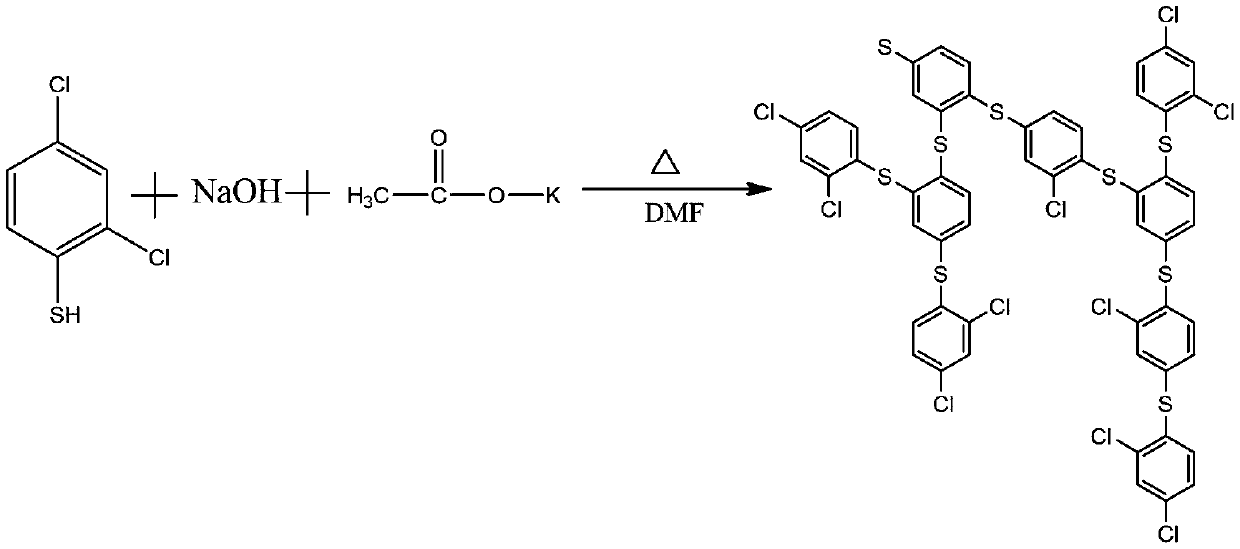
[0033] 1. Put 2,4-dichlorothiophenol (1 part), sodium hydroxide (1.5 parts), potassium acetate (0.9 parts) into the solvent of N,N-dimethylformamide (8 parts), Put it into a three-necked flask and heat it in an oil bath under the protection of high-purity nitrogen (99.999%);
[0034] 2. Raise the temperature of the system in step 1 to 275°C for 180 minutes;
[0035] 3. Cool the system of step 2 to 80°C, add 8 parts of distilled water, and continue to stir for 60 minutes;
[0036] 4. Put the system of step 3 into 40 parts by mass of 8% hydrochloric acid solution, and continue to stir for 240 minutes;
[0037] 5. After filtering the system of step 4, take the filtrate, put it into 16 parts of acetone solution for elution, and repeat the elution 8 times;
[0038] 6. After filtering the system of step 5, take the filtrate and put it into 20 parts of distilled water for elution, and repeat the ...
Embodiment 2
[0041] A preparation method of hyperbranched polyphenylene sulfide includes the following steps:
[0042] 1. Put 2,4-dichlorothiophenol (1.1 parts), sodium hydroxide (1.6 parts), potassium acetate (1 part) into the solvent of N,N-dimethylformamide (8 parts), Put it into a three-necked flask and heat it in an oil bath under the protection of high-purity nitrogen (99.999%);
[0043] 2. Raise the temperature of the system in step 1 to 270°C for 180 minutes;
[0044] 3. Cool the system of step 2 to 85°C, add 8 parts of distilled water, and continue to stir for 60 minutes;
[0045] 4. Put the system of step 3 into 40 parts by mass of 8% hydrochloric acid solution, and continue to stir for 240 minutes;
[0046] 5. After filtering the system of step 4, take the filtrate, put it into 17 parts of acetone solution for elution, and repeat the elution 8 times;
[0047] 6. After filtering the system of step 5, take the filtrate and put it into 19 parts of distilled water for elution, and the elution...
Embodiment 3
[0050] A preparation method of hyperbranched polyphenylene sulfide includes the following steps:
[0051] 1. Put 2,4-dichlorothiophenol (1.2 parts), sodium hydroxide (1.7 parts), potassium acetate (1.1 parts) into the solvent of N,N-dimethylformamide (8 parts), Put it into a three-necked flask and heat it in an oil bath under the protection of high-purity nitrogen (99.999%);
[0052] 2. Raise the temperature of the system in step 1 to 268°C for 180 minutes;
[0053] 3. Cool the system of step 2 to 80°C, add 8 parts of distilled water, and continue to stir for 60 minutes;
[0054] 4. Put the system of step 3 into 40 parts by mass of 8% hydrochloric acid solution, and continue to stir for 240 minutes;
[0055] 5. After filtering the system of step 4, take the filtrate, put it into 18 parts of acetone solution for elution, and repeat the elution 8 times;
[0056] 6. After filtering the system of step 5, take the filtrate and put it into 18 parts of distilled water for elution, and repeat t...
PUM
| Property | Measurement | Unit |
|---|---|---|
| density | aaaaa | aaaaa |
| melting point | aaaaa | aaaaa |
| glass transition temperature | aaaaa | aaaaa |
Abstract
Description
Claims
Application Information
 Login to View More