A gene for in situ detection of microrna-34 in living cells and its preparation method and application
A technology for in situ detection and living cells, applied in the field of genetic engineering, to achieve enhanced clinical significance, high sensitivity, and high specificity
- Summary
- Abstract
- Description
- Claims
- Application Information
AI Technical Summary
Problems solved by technology
Method used
Image



Examples
preparation example Construction
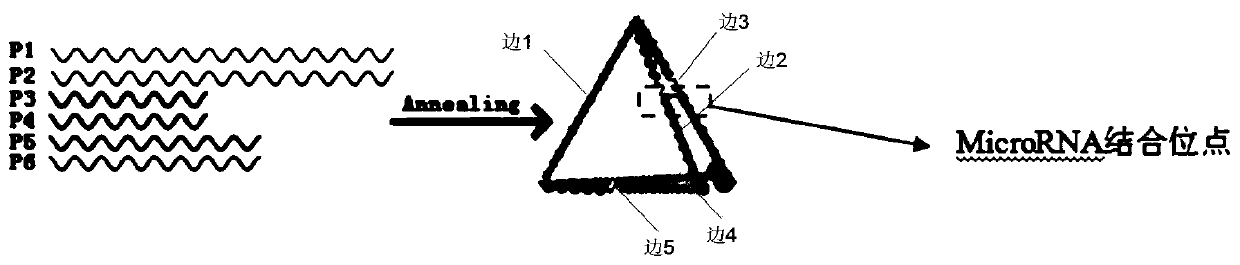
[0027] The present invention also provides a preparation method of the gene, comprising the following steps: after mixing equal volumes of P1, P2, P3, P4, P5 and P6, denaturing at 95° C. for 5 minutes, and cooling to obtain the gene.
[0028] In the present invention, the concentrations of P1, P2, P3, P4, P5 and P6 are all preferably 10 μM. The present invention has no special limitation on the instrument for said denaturation, preferably a PCR instrument. The temperature reduction in the present invention is preferably natural cooling to room temperature (18-25° C.).
[0029] The present invention also provides a living cell detection kit for microRNA-34 in situ, which includes the gene or the gene prepared by the preparation method.
[0030] The present invention also provides the application of the kit in the in situ detection of microRNA-34 in living cells.
[0031]The in situ detection of live cells in the present invention is preferably for non-diagnostic purposes. In...
Embodiment 1
[0034] The assembled strands of the three-dimensional DNA tweezers were mixed in equal proportions at a concentration of 10 μM, denatured at 95°C for 5 minutes, and then slowly cooled to room temperature to form a three-dimensional DNA tweezers structure. The sequence of the three-dimensional DNA tweezers assembly chain is shown in Table 1.
[0035] Table 1 The sequence of assembled strands of three-dimensional DNA tweezers
[0036]
PUM
 Login to View More
 Abstract
Description
Claims
Application Information
 Login to View More