
Preparation of umbilical cord mesenchymal stem cell factors with hair growth effect
A technology of mesenchymal stem cells and umbilical cord, which is applied in the field of preparation of umbilical cord mesenchymal stem cell factors, can solve the problems of unguaranteed use safety, short storage time, and reduced activity, so as to avoid social and ethical disputes, simple acquisition, The effect of stable storage
- Summary
- Abstract
- Description
- Claims
- Application Information
AI Technical Summary
Problems solved by technology
Method used
Image


Examples
Embodiment 1
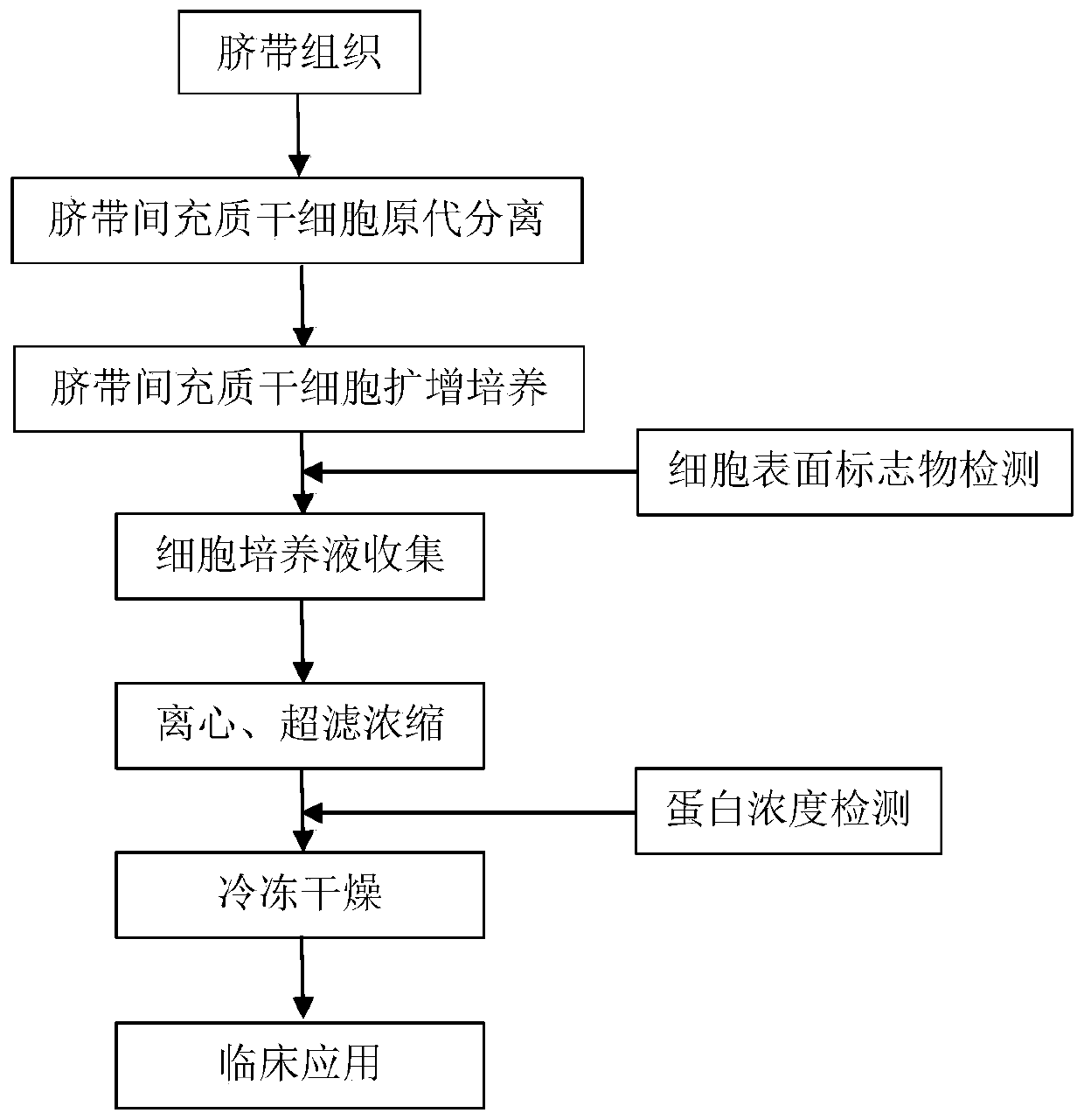
[0054] Step 1: Primary isolation and culture of umbilical cord mesenchymal stem cells
[0055] (1) Put the qualified umbilical cord tissue in a sterile bottle containing 200ml of tissue preservation solution (α-MEM medium containing 2% double antibody), seal it well, and refrigerate and transport it to the laboratory within 4 hours;
[0056] (2) In the clean room of the laboratory, check whether the aseptic bottle holding the umbilical cord tissue is complete, whether the transportation temperature is qualified, record the container label, delivery time, and temperature-related information in detail, observe the color of the umbilical cord, measure the length of the umbilical cord and take photos for storage;
[0057] (3) In the biological safety cabinet, put the umbilical cord into a new aseptic bottle and wash it with normal saline for 5 times, keep the 1ml mark of the last washing solution and send it to the quality inspection room for bacteria inspection;
[0058] (4) Use ...
Embodiment 2
[0062] Embodiment 2: collection, centrifugation, ultrafiltration concentration of cell culture fluid
[0063] (1) Take the cells of the P4 generation, wait for the cells to grow to 85%, collect the cell culture medium and centrifuge in a centrifuge bottle, 800rpm, 5min;
[0064] (2) Collect the centrifuged cell supernatant, first perform ultrafiltration dialysis through a 50KD ultrafiltration membrane, and take the dialysate; then pass the dialysate through a 5KD ultrafiltration membrane to collect the intercepted liquid, and the obtained liquid contains a large amount of cytokines of concentrate.
Embodiment 3
[0065] Example 3: Preparation of umbilical cord mesenchymal stem cell factor freeze-dried powder
[0066] (1) Weigh 100g of mannitol, heat it to 60-70°C, and dissolve until clear.
[0067] (2) Take another beaker, weigh 4g of dextran 40, dissolve the dextran 40 with 10% volume of purified water, heat and boil until completely clear, mix dextran and mannitol, and then add 6g of trehalose , stir well until clear.
[0068] (3) After the liquid is cooled to room temperature, add umbilical cord mesenchymal stem cell factor concentrate, and finally dilute to 1L with purified water, and stir until it becomes clear.
[0069] (4) Liquid filtration: The uniformly dissolved liquid is filtered with a 0.22 μm filter, and the filtrate is collected in a sterilized container.
[0070] (5) Liquid packaging: the filtered liquid is divided into 2mL per vial (7mL) and half-filled with rubber stoppers (the containers used for the packaging must pass through 121°C, 20min, 0.1MPa Sterilized under...
PUM
 Login to View More
 Abstract
Description
Claims
Application Information
 Login to View More