
Power battery temperature prediction model based on liquid cooling heat dissipation mode and modeling method
A liquid-cooled heat dissipation, predictive model technology, applied in computer-aided design, design optimization/simulation, calculation, etc., can solve problems such as the limitation of use range
- Summary
- Abstract
- Description
- Claims
- Application Information
AI Technical Summary
Problems solved by technology
Method used
Image

Examples
Embodiment Construction
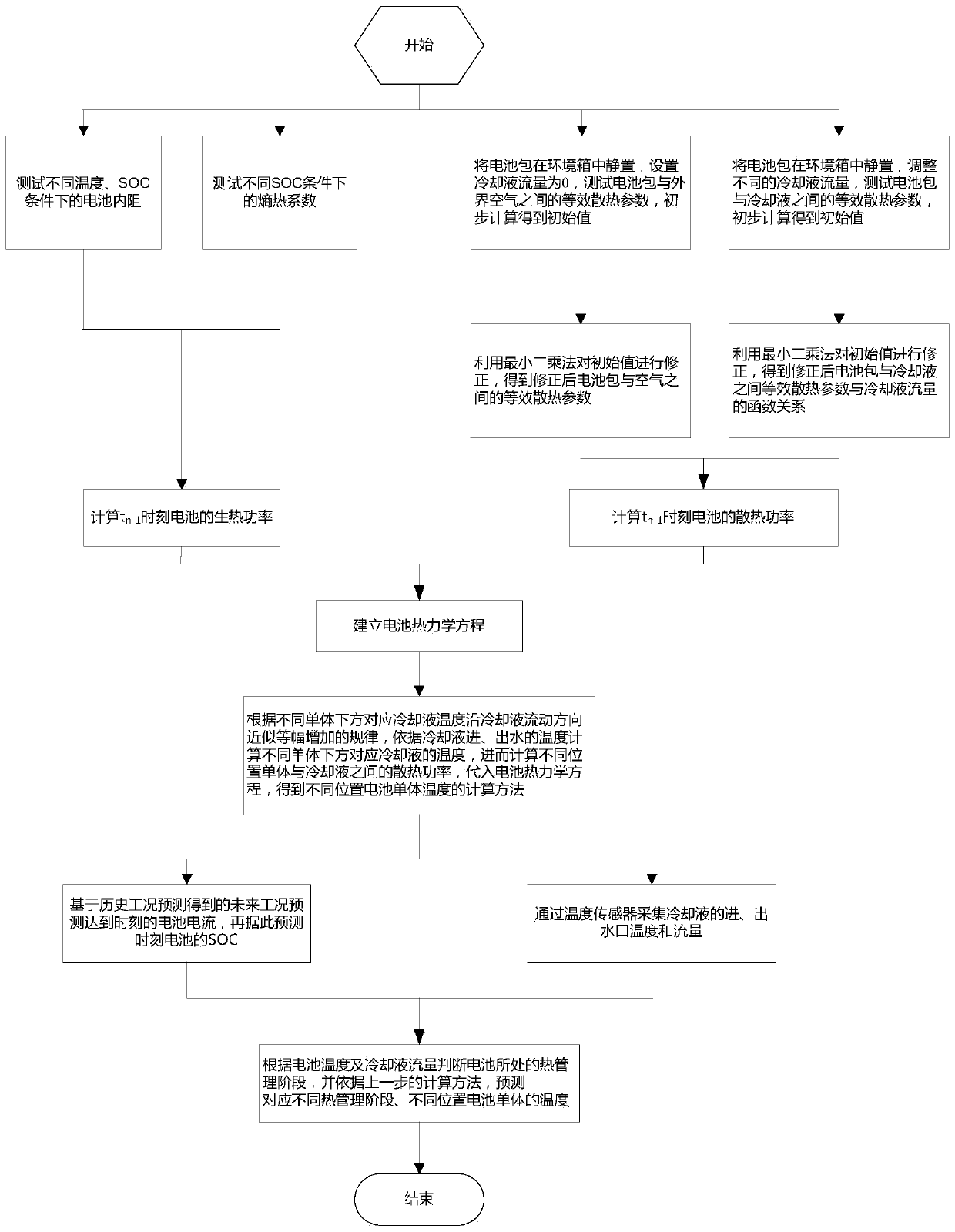
[0151] The present invention provides a power battery temperature prediction model and modeling method based on liquid cooling and heat dissipation. The modeling process is as follows:
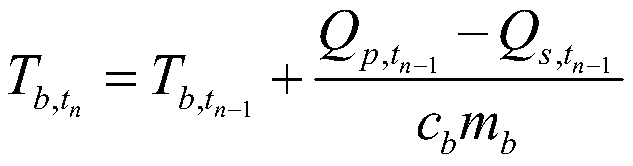
[0152] (1) Establish the thermodynamic equation of the battery:
[0153]
[0154] Among them, c b is the specific heat capacity of the battery, m b is the weight of the battery, and respectively t n and t n-1 the temperature of the coolant at all times, and respectively t n-1 The heat generation power and the total heat dissipation power at any time.
[0155] (2) According to the Bernadi heat generation rate model, the heat generation rate Q of the battery p Can be expressed as follows:
[0156] Q p =I 2 R+IT b k rev
[0157] Among them: R is the internal resistance of the battery; k rev is the entropy heat coefficient of the battery, calculated with the following formula.
[0158]
[0159] Among them, U OCV is the open circuit voltage of the battery.
[0160] Subs...
PUM
 Login to View More
 Abstract
Description
Claims
Application Information
 Login to View More