Electronic motion trail prediction method and storage medium
A trajectory prediction and electronic movement technology, which is applied in the direction of prediction, complex mathematical operations, special data processing applications, etc., can solve the problems of high requirements for experimental conditions, difficulty in determining electronic electronic trajectory, equipment and experimental damage, etc., to improve prediction The effect of precision
- Summary
- Abstract
- Description
- Claims
- Application Information
AI Technical Summary
Problems solved by technology
Method used
Image


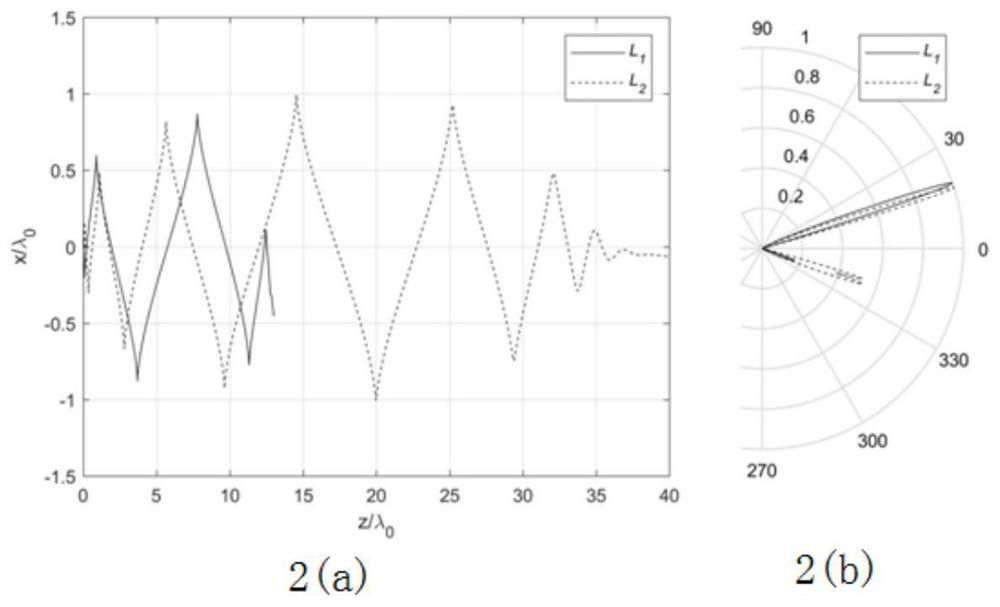

Examples
Embodiment 1
[0046] Embodiment 1, electronic motion trajectory prediction method, the flow chart is as follows Figure 8 As shown, the following steps are specifically included:
[0047](1) Determine the vector potential model of the femtosecond tightly focused Gaussian laser pulse according to the amplitude parameters, phase parameters, focus diameter, pulse width and laser pulse width of the pre-determined relativistic electrons; wherein the vector potential model of FTFGLP is expressed as:
[0048]
[0049] Here, a 0 is the amplitude parameter, which characterizes the characteristic of relativistic electrons, that is, the intensity of the laser pulse, and the expression is: Relativistic factor γ=(1-u 2 ) -1 / 2 , u is the electron velocity normalized by the light velocity c in vacuum, where a 0 use e / mc 2 Normalized, |A| is the amplitude of the vector potential, λ(μm) and I(W / cm 2 ) are the wavelength and intensity of the laser respectively, and the values of m and e are respe...
Embodiment 4
[0067] Embodiment 4. On the basis of Embodiment 3, high-energy electrons emit radiation in one direction, which can be expressed as: Such as figure 1 shown. In this example, the unit solid angle Normalized radiant power:
[0068]
[0069] In the formula, is the position vector of the electron, and t′ is the time or delay time of the electron. Embodiment five, on the basis of embodiment four, in order to determine the relationship between the movement time and delay time of electrons, obtain a more accurate trajectory prediction result, the relationship between t' and t in this embodiment is defined as follows:
[0070]
[0071] In the formula, R 0 is the distance from the origin to the observer.
Embodiment 6
[0072] Embodiment 6. This embodiment provides a method for predicting the trajectory of electrons, including the following steps: The characteristics of relativistic electrons are Relativistic factor γ=(1-u 2 ) -1 / 2 , u is the electron speed normalized by the speed of light c in vacuum. The vector potential of FTFGLP can be expressed as:
[0073]
[0074] Here, a 0 Is the amplitude parameter, which characterizes the intensity of the laser pulse, with e / mc 2 Normalized. |A| is the amplitude of the vector potential, λ(μm) and I(W / cm 2 ) are the wavelength and intensity of the laser respectively, and the values of m and e are 9.1×10 -31 kg, 1.6×10 -19 c. The formulas of parameters C and CL related to pulse width b and laser pulse width L are as follows:
[0075]
[0076]
[0077] In the formula, b 0 is the focal diameter; is the corresponding Rayleigh length. is the phase parameter of FTFGLP, and its expression is as follows:
[0078]
[0079] Among ...
PUM
 Login to View More
 Abstract
Description
Claims
Application Information
 Login to View More