Temperature prediction method for permanent magnet synchronous motor
A technology of permanent magnet synchronous motors and prediction methods, which is applied in neural learning methods, biological neural network models, design optimization/simulation, etc. It can solve problems such as complex training process, consumption of training time, and insufficient accuracy, so as to improve training effect, Prediction results are accurate and the effect of accelerated training
- Summary
- Abstract
- Description
- Claims
- Application Information
AI Technical Summary
Problems solved by technology
Method used
Image

Examples
Embodiment 1
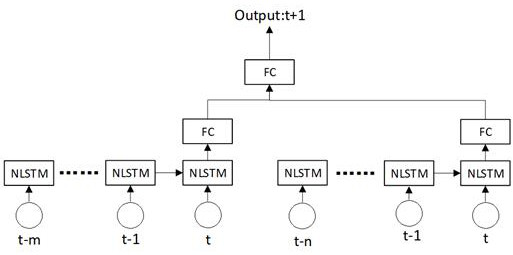
[0073]Example 1: A temperature prediction method of a permanent magnet synchronous motor, which combines a depth learning model NLSTMS (Nested LSTMS, NLSTMS), and the pseudo-twin neural networkfigure 1 The PSNLSTMS model shown (SIAMESE NETWORK is a network structure, intended to connect the neural network, SIAMESE NETWORK to achieve "continuous" by weight sharing. When the neural network of neural networks on the left and right, the neural network weight is not shared or both side models are not At the same time, it is called a PSEudo-Siamese Networks, which is a PSNLSTMS model that combines NLSTMS to pSeudo-SiameneTWorks and then uses a data set to train the PSNLSTMS model. The baseline data set used in this embodiment is from kaggle data science online. The competition platform is measured and collected by power electronics and electrical transmission lines at University of Padbern, Germany. The data set has been standardized, including the temperature of the main components of th...
Embodiment 2
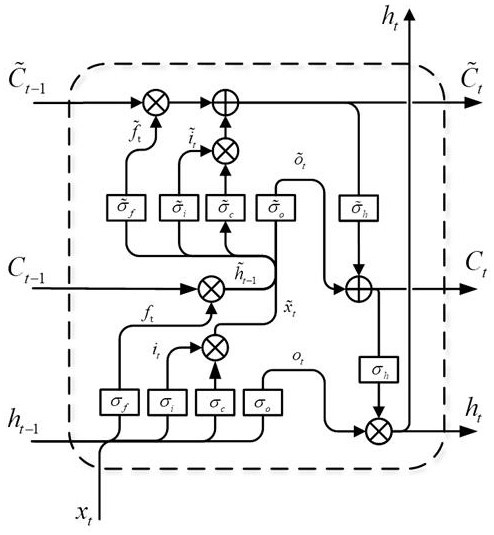
[0077]Example 2: On the basis of Example 1, the structure of the depth learning model NLSTMS is asfigure 2 As shown, it is shown:
[0078];
[0079];
[0080];
[0081] ;
[0082] ;
[0083];
[0084];
[0085] ;
[0086];
[0087] ;
[0088] ;
[0089];
[0090]among themIn order to point the pendant, [,] indicates the combination of two vectors in brackets;The input, forgetting door, output door, input door, cell state, internal memory cell state and output, respectively, in turn. In turn, the cell state, output, internal memory cell status and internal memory output, respectively;In turn, the internal memory input, internal memory forgetting door, internal memory output door, internal memory input door, and internal memory output, respectively, in turn.Corresponding to the weight matrix in each door,Corresponding to the bias item in each door; the input and output of NLSTMS is not changed relative to LSTMS, but the temporary cell state is increased, which is the transfer of cell states in the internal memory between d...
Embodiment 3
[0122]Example 3: In Example 2, the applicant was trained in the PSNLSTMS model, in the case of the same number of training wheels, using the same data set, set the same hyperfeit, and compare the NLSTMS model. The results are shown in Figures 5 and 6 (shown in Figure 5 (a) for the loss graph of the NLSTMS model training set using the learning rate optimization strategy, Figure 5 (b) has not used a learning rate optimization strategy NLSTMS model training Loss graph, Figure 6 (a) Loss graph of NLSTMS model verification set with learning rate optimization strategy, Figure 6 (b) is a loss graph of NLSTMS model verification set without learning rate optimization strategy; 5 It can be seen that the NLSTMS model using the learning rate optimization strategy is significantly slower in the first 5 rounds of NLSTMS models that have not been used in the learning rate optimization strategy, because the initial learning rate is relatively small, but as the learning rate is steadily improved The...
PUM
 Login to View More
 Abstract
Description
Claims
Application Information
 Login to View More
 - R&D
- Intellectual Property
- Life Sciences
- Materials
- Tech Scout
- Unparalleled Data Quality
- Higher Quality Content
- 60% Fewer Hallucinations
Browse by: Latest US Patents, China's latest patents, Technical Efficacy Thesaurus, Application Domain, Technology Topic, Popular Technical Reports.
© 2025 PatSnap. All rights reserved.Legal|Privacy policy|Modern Slavery Act Transparency Statement|Sitemap|About US| Contact US: help@patsnap.com