Machining equipment with tension testing function for special-shaped lifting lug

A technology of tensile testing and processing equipment, which is applied in the direction of applying stable tension/pressure to test the strength of materials, measuring devices, instruments, etc., which can solve the problem of inability to ensure that the stress point of the material to be tested is located at its axisymmetric center, and the material to be tested is clamped. The holding and fixing operation is complicated and affects the accuracy of the experimental results, so as to achieve the effect of easy and rapid reset, stable clamping and stable clamping.

CN112798416AInactive Publication Date: 2021-05-14东莞市史雷帝三维数控科技有限公司
0 Cites 1 Cited by

Patent Information

Authority / Receiving Office
CN · China
Current Assignee / Owner
Publication Date
2021-05-14
Estimated Expiration
Not applicable · inactive patent

Smart Images

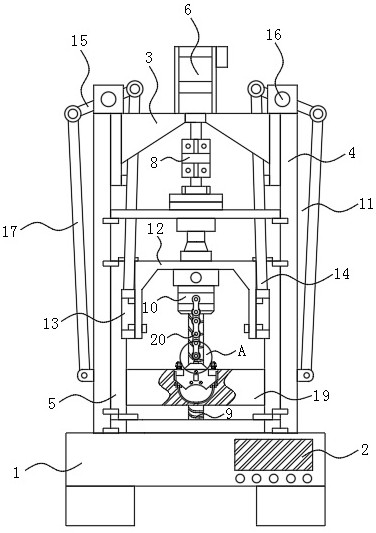
  • Figure 1
    Figure 1
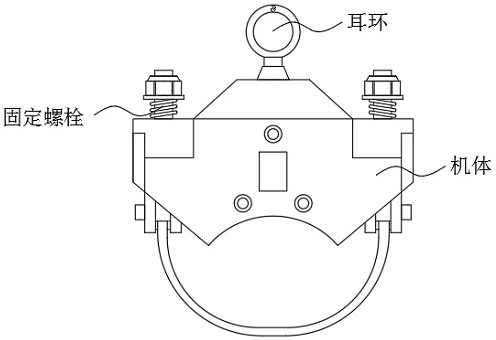
  • Figure 2
    Figure 2
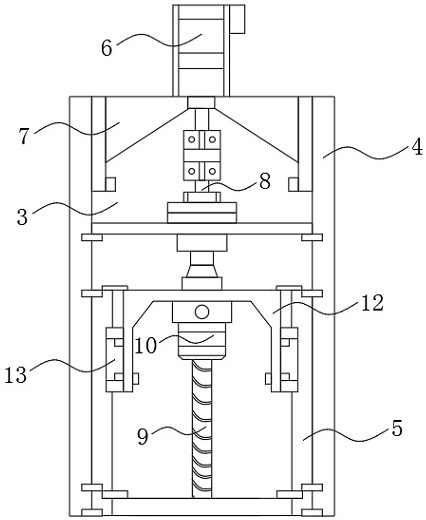
  • Figure 3
    Figure 3
Patent Text Reader

Abstract

The invention discloses machining equipment with a tension testing function for a special-shaped lifting lug, which relates to the technical field of machining and detection of special-shaped components, in particular to a workbench, a lead screw tension mechanism, a connecting rod transmission mechanism, a pull rod clamping mechanism and an output end. One side of theworkbench is provided with a control end. According to the machining equipment with the tension testing function for the special-shaped lifting lug, by arranging the pull rod clamping mechanism, the problems that in the background technology, an existing tension testing mechanism is complex in operation of connecting clamping points of a to-be-detected material and depends on manual positioning are perfectly solved; a user drives the bayonet lock to rotate around the lug shaft by rotating the adjusting handle, so that the locking arm on one side of the bottom end of the bayonet lock locks the end face of the base plate, meanwhile, the eccentric block rotates under the transmission of the screw rod, and the lug part of the to-be-detected material is positioned and clamped through the output end on one side of the top end of the eccentric block, so that the clamping is stable while the operation is simple and convenient; and meanwhile, a centering effect on to-be-detected materials which are symmetric about a vertical symmetric axis is achieved.
Need to check novelty before this filing date? Find Prior Art

Description

technical field

[0001] The invention relates to the technical field of processing and testing of special-shaped components, in particular to a processing device with special-shaped lifting lugs with the function of tensile testing. Background technique

[0002] Lifting lug is the force-bearing component installed on the equipment for lifting; the lifting lug is an important connecting part in equipment hoisting, which is directly related to the safety of large-scale equipment hoisting. Among many conveyor accessories, lifting lug is the It is an indispensable part in the operation. It is the main lifting point structure, so it requires good load-bearing capacity and stability. The strength requirements of its own strength and equipment connection.

[0003] The common problems of the existing lifting lug processing and testing equipment are: in order to ensure the safety of hoisting, the design and production of the lifting lug adheres to the principle of no deformation of t...

Examples

Embodiment Construction

[0028] The following will clearly and completely describe the technical solutions in the embodiments of the present invention with reference to the accompanying drawings in the embodiments of the present invention. Obviously, the described embodiments are only some, not all, embodiments of the present invention.

[0029] In the description of the present invention, unless otherwise stated, the meaning of "plurality" is two or more; the terms "upper", "lower", "left", "right", "inner", "outer" , "front end", "rear end", "head", "tail", etc. indicate the orientation or positional relationship based on the orientation or positional relationship shown in the drawings, and are only for the convenience of describing the present invention and simplifying the description, rather than Indicates or implies that the device or element referred to must have a particular orientation, be constructed and operate in a particular orientation, and therefore should not be construed as limiting the...