Paenibacillus strains and methods for their use
A technology of the genus Bacillus and Paenibacillus is applied in the field of bacterial strains and their ability to prevent and control plant diseases and increase plant vigor and crop yield, and can solve the problems of difficult development of active ingredients and high development costs
- Summary
- Abstract
- Description
- Claims
- Application Information
AI Technical Summary
Problems solved by technology
Method used
Image

Examples
Embodiment 1
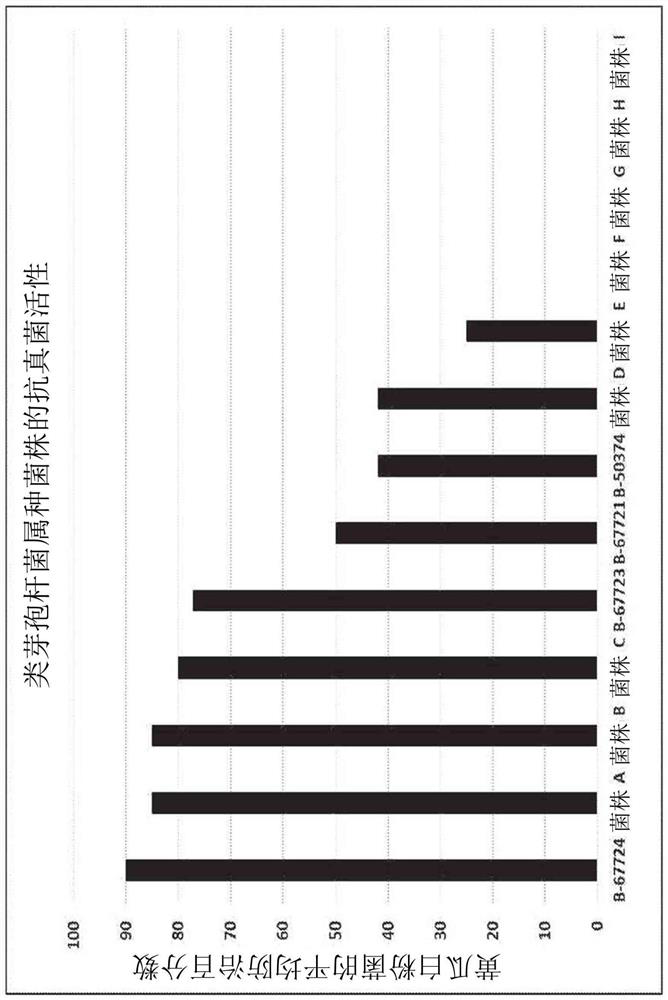
[0197] Example 1. Antifungal activity of Paenibacillus sp. strains NRRL B-50374, NRRL B-67721, NRRL B-67723 and NRRL B-67724 against powdery mildew of cucumber
[0198] Paenibacillus sp. strain NRRL B-50374, Paenibacillus sp. strain NRRL B-67721, Paenibacillus sp. strain NRRL B-67723 and Paenibacillus sp. The genus strains were grown in soy-based media to produce whole broths. The whole broth is diluted to a concentration of 20% in a mixture of water and organic solvent. The diluted whole broth was applied to young plants, which were subsequently exposed to an inoculum of Cucumber powdery mildew (PODOXA), also known as Cucumber powdery mildew.
[0199] Several days after exposure to the phytopathogen inoculum, each plant was scored for percent pathogen control relative to untreated control plants. Each treatment was evaluated in triplicate and the average percent control was reported.
[0200] All strains had previously been evaluated for antifungal activity in several roun...
Embodiment 2
[0201] Example 2. Antifungal activity of Paenibacillus sp. strains NRRL B-50374, NRRL B-67721, NRRL B-67723 and NRRL B-67724 against Botrytis cinerea
[0202] Paenibacillus sp. strain NRRL B-50374, Paenibacillus sp. strain NRRL B-67721, Paenibacillus sp. strain NRRL B-67723, and Paenibacillus sp. strain NRRL B-67724 in soybean-based media Cultivated to produce a whole broth, which is diluted to concentrations of 20% and 5% in a mixture of water and organic solvent. The diluted whole broth was applied to young plants, which were subsequently exposed to an inoculum of Botrytis cinerea (BOTRCI), also known as Botrytis cinerea.
[0203] Several days after exposure to the inoculum of the phytopathogen, each plant was scored for percent pathogen control relative to untreated control plants. Each treatment was evaluated in triplicate and the average percent control was reported. This analysis was repeated several times and see Table 1 for representative results. Paenibacillus sp. ...
Embodiment 3
[0206] Example 3. Antifungal activity of Paenibacillus sp. strains NRRL B-50374, NRRL B-67721, NRRL B-67723 and NRRL B-67724 against wheat leaf rust
[0207] Paenibacillus sp. strain NRRL B-50374, Paenibacillus sp. strain NRRL B-67721, Paenibacillus sp. strain NRRL B-67723, and Paenibacillus sp. strain NRRL B-67724 in soybean-based media to produce a whole broth, which is diluted to a concentration of 20% and 5% in a mixture of water and an organic solvent. The diluted whole broth was applied to the young plants, which were subsequently exposed to an inoculum of P. tritici (PUCCRT) (also known as wheat rust).
[0208] Several days after exposure to the phytopathogen inoculum, each plant was scored for percent pathogen control relative to untreated control plants. Each treatment was evaluated in triplicate and the average percent control was reported. This analysis was repeated several times and see Table 2 for representative results. Paenibacillus sp. strain NRRL B-50374, P...
PUM
 Login to View More
 Abstract
Description
Claims
Application Information
 Login to View More
 - R&D
- Intellectual Property
- Life Sciences
- Materials
- Tech Scout
- Unparalleled Data Quality
- Higher Quality Content
- 60% Fewer Hallucinations
Browse by: Latest US Patents, China's latest patents, Technical Efficacy Thesaurus, Application Domain, Technology Topic, Popular Technical Reports.
© 2025 PatSnap. All rights reserved.Legal|Privacy policy|Modern Slavery Act Transparency Statement|Sitemap|About US| Contact US: help@patsnap.com