
DTY (Draw Textured Yarn) oiling agent and DTY
An oil and lubricant technology, applied in the field of chemical fiber spinning, can solve the problems of oil splash, broken ends, filaments, etc., and achieve the effect of improving the oiling rate, ensuring uniformity, and reducing filaments
- Summary
- Abstract
- Description
- Claims
- Application Information
AI Technical Summary
Problems solved by technology
Method used
Image

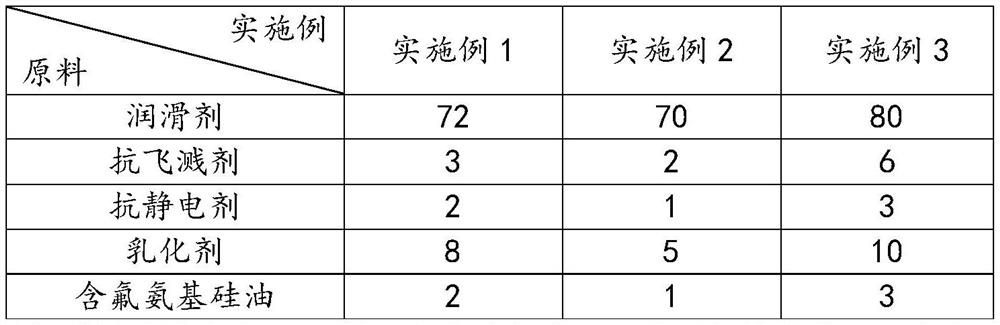
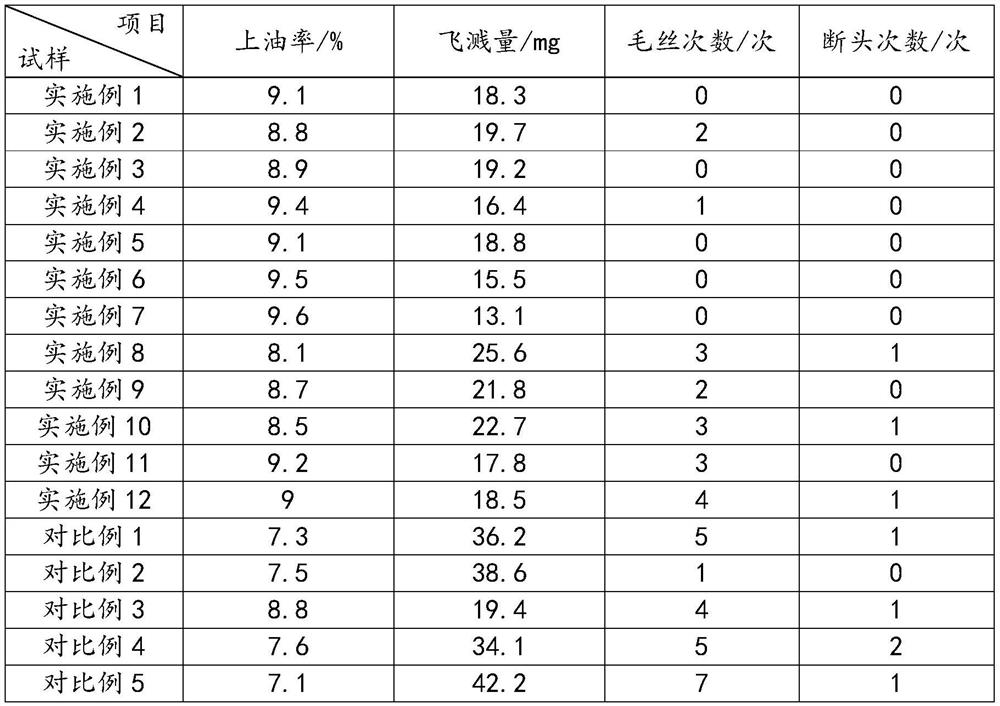
Examples
preparation example 1
[0037] Preparation example 1, a polydimethylsiloxane emulsion, was prepared according to the following method:
[0038] S101: Dissolve 30g of sodium dodecylsulfonate and 9g of OP-10 in 3L of water under stirring, continue to stir and heat up to 70°C, add 400g of octamethylcyclotetrasiloxane and 100g of tetramethyl tetrasiloxane The mixed solution composed of vinyltetrasiloxane was stirred for 2 hours at a speed of 200 rpm to obtain a pre-emulsion;
[0039] S102: Add 5g of p-toluenesulfonic acid (initiator) to the pre-emulsion, stir and heat up to 80°C, stir at a constant temperature and react for 7h to obtain a reaction solution, then drop to room temperature, add sodium bicarbonate solution (buffer) to adjust The pH value was 7, and a polydimethylsiloxane emulsion with a viscosity (at 25° C.) of 350 mm2 / s was obtained.
preparation example 2
[0040] Preparation example 2, a polydimethylsiloxane emulsion, was prepared according to the following method:
[0041] S101: Dissolve 60g of sodium dodecylsulfonate and 15g of OP-10 in 5L of water under stirring, continue to stir and heat up to 80°C, add octamethylcyclotetrasiloxane with a mass ratio of 450g and 90g A mixed solution composed of tetramethyltetravinyltetrasiloxane was stirred for 3h at a rotating speed of 500rpm to obtain a pre-emulsion;
[0042] S102: Add 8g of p-toluenesulfonic acid (initiator) to the pre-emulsion, keep a constant temperature at 85°C and stir for 10h to obtain the reaction solution, then drop to room temperature, add sodium bicarbonate solution (buffer) to adjust the pH value 7. Obtain a polydimethylsiloxane emulsion with a viscosity (at 25° C.) of 900 mm2 / s.
preparation example 3
[0043] Preparation example 3, a polydimethylsiloxane emulsion, was prepared according to the following method:
[0044] S101: Dissolve 20g of sodium dodecylsulfonate and 7g of OP-10 in 3L of water under stirring, continue to stir and heat up to 70°C, add 420 g of octamethylcyclotetrasiloxane and 80 g of tetramethyl tetrasiloxane The mixed solution composed of vinyltetrasiloxane was stirred for 2 hours at a speed of 200 rpm to obtain a pre-emulsion;
[0045] S102: Add 5g of p-toluenesulfonic acid (initiator) to the pre-emulsion, stir and heat up to 80°C, stir at a constant temperature and react for 6h to obtain a reaction solution, then drop to room temperature, add sodium bicarbonate solution (buffer) to adjust The pH value was 7, and a polydimethylsiloxane emulsion with a viscosity (at 25° C.) of 200 mm2 / s was obtained.
PUM
 Login to View More
 Abstract
Description
Claims
Application Information
 Login to View More